Eat Big, Play Big – Merry Khaos Notes

If you were in my “EAT BIG/PLAY BIG” class at Beat Me Halfway, you know we jumped around a little bit. This is not going to be a thorough explanation of the notes nearly as much as a bullet point list of what we covered. For more information, explanation, or to work with me on your nutrition plan, message me at DerbyAmerica@gmail.com

I will remind you that I’m not going into all the biochemistry of this. You don’t care about it anyway, you just want to know the what and the basic why. So this is like 1st grade chemistry when we are told “This is how it is!” and then in high school they say “Yea, ok BASICALLY that’s how it is, but it’s actually more like THIS.” So keep that in mind.

The 5 ‘Pillars’ of Athlete nutrition
– Calorie Count
– Metabolism
– Protein
– Water
– Vitamins

You must eat for YOUR goals. Roller derby is a contact sport, and a high energy one.  You should not be designing your food plan in order to meet society’s view of beauty. If your personal situation demands weight loss, then eat for weight loss. If you already are low body fat percentage, then don’t obsess over six pack abs, worry about your strength and progress instead.

I am going to focus on strength and athletic performance, not ‘weight loss’. Note – if you eat for sports performance and pair it with a proper training program, chances are you will lean out anyway. So it’s a win win.

METABOLISM

Basic idea: your metabolism is your energy mechanism and how your body gets vitamins distributed around the body. So if the metabolism slows, then your body can’t burn as effectively or get the vitamins you eat around to the places it needs to get to.

We keep the metabolism running by eating. Your body is like a bonfire. If you stop feeding the fire, it dies. If you stop feeding your body, the metabolism slows to a crawl. Think of simple carbs (like bread, sugar, rice) as newspaper, leafy greens as large branches, and proteins as giant logs of oak.

If you are doing heavy lifting (which we all should be doing) you can and should eat more simple carbs than someone who is primarily doing cardio.

CALORIE COUNT

You’re not eating enough. I’m making this judgment call based on the fact that you were interested enough in this topic to read. But chances are: you’re not eating enough.

How much should you be eating? Step one is to find out your “RMR” (Resting Metabolic Rate). There is a big long equation that you can google or go to my favorite cheat sheet right here!

To make it easier for you, I went and did some EXTRA research to see if I could find something a little more uniform. What I found they most for athletes that participate in an intense training routine:

MEN: 23 – 30 calories per pound of body weight
WOMEN: 19 – 25 calories per pound of body weight

If you are weight lifting at least twice a week with heavy weights, you should be at the higher end of the spectrum. On your rest days, go on the lower end of the spectrum.

If you’re eating 3000 calories a day, you should be breaking down your calories into many meals and snacks, not trying to eat three 1000 calories meals each day. If you plan out six meals, that means 500 calories per meal! These can be protein shakes, full ‘classic’ meals, bars, snacks, etc.

How do you know what to eat to hit that intake? Here’s a quick cheat:

1g of Protein = 4 calories
1g of Carbs = 4 calories
1g of Fat = 9 calories

I like to give myself a range, so I’m 150# right now. That means I should be eating between 3000 and 3400 calories. (Which means even I haven’t been eating enough!) Giving yourself just a ceiling can cause you to not hit a minimum. I’d rather you say “I’m going to eat at LEAST __________” as opposed to “I can’t eat more than ________”.

THE DIRTY BULK

Here’s where it comes in. We talked about “The Dirty Bulk” – the time where you just eat whatever you want (primarily brownies and fast food) and then you get ‘huge and strong’. Guess what? It kind of works in the temporary, but not for long term results, and not for what we are focused on. If you are a strict powerlifter, a dirty bulk is appealing. You don’t have to be strict on what you’re eating, you can stuff your face, you get big, you pull big numbers.

Powerlifters don’t have to try and catch The Smacktivist on wheels occasionally. Powerlifters don’t have to be as quick as Gnat King Kill. Powerlifters don’t have to out skate Mercy.

For roller derby skaters (and any athlete that treasures their cardio health), the dirty bulk packs on fat, cholesterol, and poundage that weighs you down instead of pushing you forward. There are times you could dirty bulk (a true offseason), but you would have to counter it with a very specific, strict period of eating afterwards.

Should-I-Dirty-Bulk

PROTEIN

We are made of protein. If you do not give your body protein, you cannot build muscle. You cannot repair or create new cells with optimal performance. If you don’t give your body protein to burn during competition and training, your body will burn the protein it can find – your muscles.

Is your hair thin, skin flakey, nails weak? Part of your problem could be a lack of protein.

Here’s your easy equation: Athletes need to eat 1g of protein per 1 pound of body weight.

Eating more will certainly not hurt you!

Because protein is the biggest piece of your caloric puzzle, you want to calculate that first! I’m 150# … I want to eat between 150 and 175g of protein per day. So that means 600-700 calories of my day come from protein. BAM. Now I know that about 2300-2700 calories have to come from carbohydrates and good fats.

Side Note: Good Fats = mono- and poly- non-saturated fats. Nuts, avocados, beans, etc.

BULKING MYTH

Ok, so something I hear all the time is “But Khaos, I don’t want to get big”. Guess what? You have to be super super dedicated for many many years to get big and bulky (especially women). You know what actually happens when you increase your calories and you start weight lifting and doing a hefty training routine? You lean the hell out. Your body takes the fat on your body and makes it into muscle.

Srsly. Your body needs fat to make muscle. It’s part of the process. So don’t worry about the “I’m going to get big”. You may gain some weight at first, but keep with it! A year from now you will look like a different person.

Not eating protein, not lifting weights because “I’m going to become a bodybuilder” is like not driving a car because “I’m going to become a Nascar driver” … it just doesn’t happen that way.

muscle_thumb

SOY MYTHS

Yes, there are some studies out there that say that soy is bad. However, there are just as many studies that say that you would have to eat SO MUCH SOY to get those effects that … well… I hope you have stock investments in Silk. I can show you photos of men and women who have been consuming soy protein as part of their meal replacements and snacks (edamame!) on a daily basis for a long time and they do not have extra fat. They do not have breast cancers. Coincidence SHOULD NOT imply correlation. If you’re allergic to soy, don’t eat soy. If your doctor tells you not to eat soy because ‘it’s bad’ then … well…

DOCTORS AREN’T NUTRITIONISTS SO HE PROBABLY GOT HIS INFO FROM THE TV.

WATER

We are 70% water. If we do not give ourselves enough water, our body will not have anything to use for…

Cell creation processes, our joints, our brains, our endocrine system, our blood, to flush out extra stuff in our digestive tracks, etc etc

Have you ever gone to practice and you tell your feet to do things and there is some kind of disconnect? You can usually do the things, but you just feel like there’s a lag? Could be dehydration.

Here’s your equation for athletes:

75% x body weight = Ounces of water to drink daily

A gallon of water is 128oz of water.

If you are more than 170# this means you must drink more than a gallon of water per day. If you have never drank that much before, and are super nervous about doing so, go to the grocery store. Buy 7 gallon jugs. Label with a day of the week. That’s your water for that day.

You will hate me for the first few days. Your body won’t know what to do with the extra water you’re taking in. KEEP AT IT! The water you drink today hydrates you a few days from now. You have to keep going.

urine_color_chart

WATER DROWNING MYTH

Ok, here’s the time of the day where people send me nasty messages about ‘not needing that much water’. When it comes down to it, I don’t know the exact, precise number of ounces my body needs from day to day. It could be 87.7oz. Do I get water from the veg I eat? Sure. But guess what? It’s easier to just drink my gallon a day and be done with it than to overanalyze and hope that I got enough in that day.

To think that every person can drink eight 8oz glasses of water and be good is silly. My body needs less water than Spectral Abyrration. He’s a dude. He’s bigger than me. For us to use ANY of the same measures for nutrition is odd.

ALCOHOL

Sorry guys. Alcohol is bad for you. No matter how you try and frame it. Is there carbs in a beer that are great for recovery post bout? Yes. But there’s also ALCOHOL. And that saps your body of water and vitamins. The negative outweigh the positive. Subscribe to my blog, I’m going to be rebooting my article about this pretty soon.

VITAMINS

Vitamins are what your body uses to create new cells. They are molecules that your body needs to initiate certain processes. Most vitamins and nutrients cannot be made by your body, your body cannot hold onto vitamins, and your body needs them throughout the day.

So moral of the story? You need vitamins all the time.

Why take a multivitamin? Mostly because we have such high vitamin needs as athletes (think of all those chemical processes going on in your body ANYWAY – then add all that training in? Your body is a madhouse of cell creation), that eating your vitamins through food sources only is damn near impossible. Considering that our food supply is much less nutrient dense than it used to be due to over-farming, picking before ripeness, and shipping long distance.

You can argue with me if you want, but seriously, it’s true. You can tell me that you “eat frozen, and buy local, and do all the things that make me wrong”, but guess what? Still not as nutrient dense. Sorry. And again, if you can take a multi and cover the gaps in your vitamins that you may not know you had: Why wouldn’t you?

I don’t know about you, but I don’t analyze myself for vitamin and nutrient intake through bloodwork daily. I’d rather just take my multi 3x a day, eat veggies, drink properly balanced meal replacement shakes, and not have to worry about it.

Yes. 3x a day. If your multi is one a day, you need to change multis.

WHAT YOU’RE EATING

So supplements are exactly that – supplements. You should build your whole foods, healthy diet and then fill in the gaps of what you’re missing with your supps. Some basics that I make sure I have?

Multivitamin, Meal Replacement shake (it’s an easy snack), my Cell Activator keeps my digestive track healthy and happy, pre-workout, post-workout, 24 Hydrate is my electrolyte supplement, and my fish oil/heart health for injury recovery (mine is flavored with vanilla so I don’t get fish burps).

Otherwise, my food involves a lot of rice, eggs, pasteurized egg whites (for protein shakes), PB2 (also for shakes), black bean pasta, all the veggies, chicken, ground turkey, wheat pasta….

I eat the same things all the time. MAKE A PLAN. Make a plan and know what you’re eating every day.

If you don’t make a plan, then you won’t know what you’re eating at 3p, which means when that time rolls around and you’re hungry – you’ll grab whatever you can. If you know on Sunday that at 3p Wednesday you are eating a protein bar, you better believe you’ll have that protein bar in your desk at work.

Also, this allows you to meal prep! Take a couple hours at the beginning of the week to pre-make and pre-portion all of your meals… or at least everything that you need to take with you.

3c482de5550c12bda796a8c02de6cdbe

You know what else this does? It gives you a very specific grocery list. Now you will be saving money because you’re not grabbing everything that sounds kind of appealing. You will buy what it is on your list.

Get with me to talk about pre- and post-workout shakes, but in the meantime… what I like to do is eat a meal about 2 hours before training, and then something small right before I train. After, I get 24g of protein RIGHT AWAY (you have a 45 minute “window of opportunity”) and then eat a meal within 2 hours.

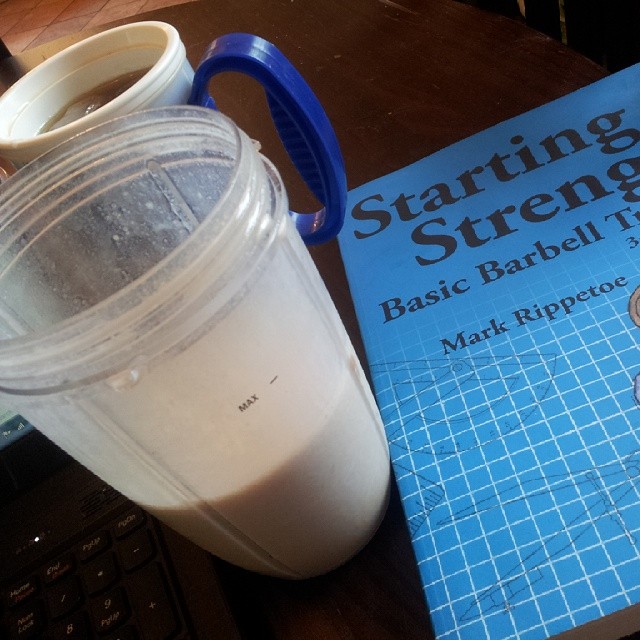
One of my favorite shakes right now!
One of my favorite shakes right now! Great after a workout.

GMO TALK

Here’s the point where I start making friends. We talked about GMOs during the clinic. First of all, only about 3 people knew what the O in GMO stands for: “Genetically Modified Organism”.

Here’s what’s up people: We are not pulling a Jurassic Park on our food sources. We have been selectively choosing strains of fruits and veg to replant since the start of farming. Are there some foods that have been tweaked in a lab? Yes. But guess what… natural selection and our own farming practices have made EVERY FOOD SOURCE genetically modified.

I have two apples. One apple is SUPER JUICY but is kind of small and not perfectly red. The other apple has that perfect apple shape, and is much larger, but doesn’t taste as good. Guess what? The larger, perfect apple sells better! WOOT! MONEY! We’re going to replant the apple that people BUY.

The small apple does not get another growing season. The large apple does. BOOM. GMO.

ORGANIC SOAPBOX

This is the other place I make friends.

Organic is just a label that farms buy. There are a lot of things about “organic” that you may not think about … like the fact that arsenic is on the approved list (it’s natural!), or that runoff from the farm next door is common. So just because your big farm doesn’t spray that specific pesticide on your green pepper, doesn’t mean that the neighbors don’t use that pesticide on their apples… which wash off in rain. And get on your peppers through water transfer.

Also, just because it says organic, it doesn’t make it healthy. A lot of big farms have hopped on the “organic” bandwagon because they charge a lot more for [essentially] the same veg.

Want to know what you’re buying? BUY LOCAL! Go to farmers markets, become a part of a CSA. Research other labels, like “Food Alliance Certified”. Talk to the people growing your food. Or [gasp] start growing some of your own. Not all of us have the space for it, but there’s something rad about never-ending kale and tomatoes from your backyard.

FINAL THOUGHTS

Ok! So that’s the gist of things. I can help you create a specific plan based on ALL the things. I personally use Derbalife products, but that’s me. If you wanted to hop on Skype and talk about YOUR training plan, and YOUR nutrition, than let’s do it!! Drop me a line at DerbyAmerica@gmail.com or send me a message on Skype at KMGrey.

There is a little bit of trial and error involved in nutrition. Even the days when you’re “bad” you’re probably not doing THAT bad. I also incorporate nutrition in my in person coaching, so if your derby/football/soccer/softball/any other sport team is looking for classes, training, nutrition – let’s get it set up!! Let’s do it!!

You can also visit my website to check out Herbalife at http://www.GoHerbalife.com/K.grey and do some research at http://www.Herbalife24.com for our sport line (we have so many Elite Athletes on our list that it’s insane).

Eating well makes you strong! Just ask my buddy, Pixie Panzer of Harrisburg Area Roller Derby! <3
Eating well makes you strong! Just ask my buddy, Pixie Panzer of Harrisburg Area Roller Derby! ❤

Building You as a Better Skater (Blog Reboot)

REBOOT: I’m slowly moving some of my more popular articles from my Examiner.com site over here to WordPress! Some of the photos are from a couple years ago, some of the info may be referencing events from a few years ago, but the info is still awesome and useful! (at least I think so). Every now and again I make a more modern note, but I’ll let you know where I’ve added in. 😉

BUILDING YOU AS A BETTER SKATER

At the Northeast Derby Convention this past weekend, common questions among attendees included: “How did she get so good?” “Has she been skating forever or is she just naturally talented?” “Will I ever be that good at derby?” “How can I improve quickly to an elite level of gameplay?”

As you progress through the lists, thoughts and derbys please remember that the background for all of this should be enjoyment. Drop the ego and HAVE FUN! It’s just f***ing roller derby, and I think we all forget that sometime.

Everyone has a tip to offer, and some of these probably sound familiar. Being in my fourth season, I have been through a lot of ups, downs and across many plateaus. So here is my humble insight.

Be a goofball on your skates
Photo: ParaNorma of the Susquehanna Valley Derby Vixens has fun during an open skate event hosted by As the Bearing Turns. Photo by Toxic Shock.

Be a goofball on your skates

Step one to getting better is spending time on your skates. Any vet will tell you that. What they may forget to tell you is that it’s not just a matter of skating circles. Getting better on your skates means that you are challenging your balance and your confidence; it means you are pushing yourself to improve.

The easiest way to challenge yourself is simply to goof around when you roller skate! Throw yourself forward and backwards. Hop. Go to open skate or an outdoor rink with your friends and skate backwards, turn, play games. The more comfortable you can get on your skates in odd positions or pulling a balancing act, the better you will be able to control yourself during drills and gameplay.

Play and watch ALL the derby
Photo: The flat track mash-up, Team Rogue, took on MADE skaters in the Derby Ink Tournament in April 2013. We all learned a few things about physics. Photo by JPaden Photography

Play and watch ALL the derby

When I say “ALL the derby” I mean beyond your own scope of derby. Yes, if you’re a WFTDA skater, you should absolutely be eating up WFTDA game play to understand how the mechanics and flow of game and strategy work (also to see how skills are being newly applied to the game). That being said, I cannot express how much I have learned in the last three months because of:

Playing MADE rules on a bank track, watching junior derby, watching men’s flat track, scrimmaging men with MADE rules on the bank track, going to open flat track scrimmages, watching the All Star bout at NEDC.

Being a woman, playing derby with boys really helped me to challenge my own perception of strength and balance. It can be intimidating to go up against a man who is a head higher than you and significantly bigger (and has a bit of a temper, but I still love you Yosemite Slam) AND you’re on a bank track against him… But then you play anyway. Then when you’re on the flat track against another team – they don’t look nearly as scary or intimidating. (Note from today – I feel like I can take on anyone now that I’ve gotten past Sutton Impact and Tink as a jammer at RollerCon.)

You never learn when you’re in your comfort zone. Just like with going to open scrimmages with new people and throwing off your balance at open skate, playing and watching unfamiliar types of derby will teach you techniques and strategy more than you think is possible. Seriously. I love that damn tri-block.

RollerCon has some awesome classes for skaters of all levels.

No. Really. Go to the events and trainings.

The world of roller derby is so much more expansive than it was when I joined in 2009. Back then, we felt lucky to get a guest coach for the night and we all dreamed of having the money to make it out to the only collection of trainings available – Rollercon. The times, they are a-changin’!

Not only are there a ton of boot camps and trainers available (DNA CoachingDerbalife,Getsome Athletics, Left Turn Coaching among others), but there are more conventions and events than ever! This past weekend the Northeast Derby Convention had a successful second year. Beat Me Halfway promises to be an awesome time, as does the addition of classes at Virginia is for Shovers. And this is just a small piece of the training pie.

Leagues are now able to bring in guest coaches or boot camps whenever they want. Elite leagues also hold camps throughout the year to train and coach skaters. And just because you’re a vet doesn’t mean you can’t benefit. I did a Team USA boot camp last summer next to Holly Go Hardly (most would say she ‘doesn’t need’ training , but there is no perfection in roller derby and some of us always strive for more). At NEDC this weekend, when coaches weren’t coaching – they were in other classes!

Do you know how many friends were geeking out about being in a class with Demanda? Or Punchy? Always strive to be better and take the training when it is available – if it’s not available, seek it out or bring it in!

Read and absorb
Photo: DNN may be gone, but DerbyLife and other publications (like mine!) still are around. Photo by Ryan Starr.

Read and absorb

Bout recaps, new skill explanations, boot break-downs. Read it all. Absorb it. Seek it out. Funny memes. Blogs. Discussion groups. The more knowledge you have about derby off the track, the more you can apply to your footage viewing, your live consumption of derby and your own on-the-track game.

Derby News Network, DerbyLife, FiveonFive Magazine, Rollout Magazine, Blood & Thunder, Inside Line, Elektra Q Tion, RollerDerp Tumblr, Khaos Theory and more… they are are all great places to hear about thoughts on derby, derby related life and how derby works itself into other aspects of the world. Go and read some stuff.

Do that thing you hate
Photo: The Dutchland Rollers take on a new physical challenge with theCrossfit Collective

Do that thing you hate

When I joined roller derby I decided that suddenly, I didn’t have to do cardio outside of practice. I thought I could use the occasional weight machine at Planet Fitness – and that would be enough. I avoided anything outside of derby, made faces at it, and was absolutely convinced that I could just skate more and that would be enough.

In 2012 I decided, finally, to become a runner and cross-trainer. And in 2012 I became the derby player I should have been previously.

Cross-training gives your body a chance to develop the muscles and stabilizers that derby doesn’t work on. It doesn’t work on them, but can utilize them. Incorporating strength, interval training, plyo metrics and other sports (I’m a fan of rock climbing and kick boxing myself) will give your body extra balance, strength and endurance that you can use on the track. Show me one elite skater that hasn’t cross-trained.

That’s what I thought. Want to learn more about real crosstraining for derby means? Check out my Shifting Perspective article.

Southern Discomfort gets together to watch footage. I've heard that they watch other teams as well as themselves (may have something to do with their quick rise in rankings)
Southern Discomfort gets together to watch footage. I’ve heard that they watch other teams as well as themselves (may have something to do with their quick rise in rankings) Photo by Matthew Sutton

Watch yourself play through footage

Watching yourself can be brutal.

Don’t get me wrong, I know it. Nothing like having a game that you feel awesome about only to watch the footage and think to yourself “Why didn’t I go there? What was that? How come I didn’t do ______” and so on. It’s also very easy to get caught in the trap of “Why didn’t the ref call that?” or “Did you see that terrible call?”

Watching video should not be an exercise in negativity. It should be an exercise in study and analysis. You need to be able to watch what you and your team mates did and deduce what worked and what didn’t. To be able to think about how you could move or position differently in the future. To think about where you are and what you need to work on next.

Visualization after you watch video can really help you incorporate your findings. Take 10 minutes after you watch bout footage (and you can do this with any team’s footage, not just your own!) and play out the scenarios in your head. Imagine your reaction, the quickening of your breath, the sliding of your wheels against the floor. Create the images of what you see and how you feel and what you do next in different situations that you saw in the footage. Imagine yourself conquering the situation and bursting past the blocker, spinning through a wall or blocking a jammer out of bounds. Visualization is an amazing tool to give to your unconscious.

Remember that watching bout footage with your team mates of OTHER bouts is super important too! Not only will it help you talk through the strategy of other teams, but it’s a bonding experience for you to all know derby a little bit better. You can talk about what teams did that work, didn’t work, or what you think you could incorporate into your own blocking or jamming styles. Team derby-time is awesome.

SCRIMMAGE NIGHT!!
Jerzey Derby Brigade have great scrimmages available once a month. Photo by JPaden Photography

SCRIMMAGE NIGHT!!

We all love scrimmage night. All of us. It’s why we put on our skates and deal with freshmeat training and months of knee fall and hip checking drills. We may say that there are other reasons that we do the roller derby thing – but let’s call a duck a duck. We do it for the PLAY TIME. Taking advantage of your scrimmage team with your team I very important: here you learn how to interact with each other. You build bonds of trust and you learn how to react and rely on each other.

Another important piece of this puzzle is taking advantage of OPEN scrimmage nights that other teams have. Why? At open scrimmages you can learn how to react quickly in new situations. You can learn how to adjust to new floors, new opponents and new obstacles. Also, it’s a great way to make friends in derby and learn how opposing skaters play (could be useful in future games, don’t you think).

Plus, remember why we are part of derby? PLAY TIME!

Embrace your inner zebra
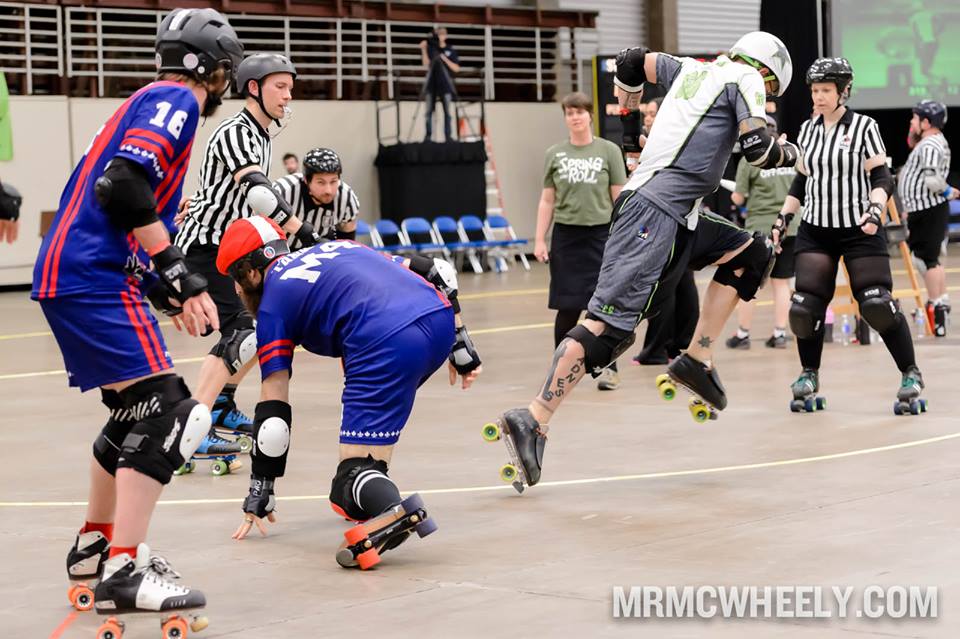
A zebra pow wow at Spring Roll IV. Photo by Mr. McWheely

Embrace your inner zebra

Wait, what?

Yes. I said it. Go visit another league to get practice at it. Volunteer to help your league if you’re team doesn’t have a bout coming up. Reverse the roles now and again so that you can see the game from a new perspective. Remember, you aren’t learning anything inside your comfort zone.

Not only will you get a new perspective on gameplay, but you’ll have a new found respect for refs. Part of being a ‘better derby skater’ is keeping your cool on the bench during a bout. Not getting riled over penalties will help you keep an even demeanor and a clear head in each jam.

Best way to understand the refs is to put yourself in that spot. I bet you’ll be surprised at how hard it actually is. Aside from that all, you get to give back to the sport that has given you so much. When you’re not skating, help others to skate! Don’t have the attention span for a zebra huddle? The NSOs could use a hand, too.

Goals are your friend

Goals are your friend

I have found that setting goals is best to do with a buddy. Captains and coaches are preferable, but if you have someone in your league that you trust that you want to go on this journey with, that’s awesome too. Remember that goals should be SMART (specific, measurable, attainable, realistic, time-specific).

To set a goal such as “Block better in the next bout” is a goal that you cannot hope to measure and it’s certainly not specific. Say instead: “Practice blocking techniques 3 times a week for a half hour for the next 4 weeks.” Through the practice of it, you will become sharper and thus, “Block better in your next bout”. It’s a matter of phrasing and giving yourself something to focus on.

For example, the photo is from May of 2012. I had decided that I wanted to be the top scorer for Harrisburg Area Roller Derby against Providence Roller Derby. (In 2010, I had the star taken from me because I couldn’t break their walls. This was redemption year.) Instead of making the above statement my goal, I worked on the strength in my legs, running and plyometrics. The photo is me and Craisy Dukes getting our MVP awards for that bout. And yes, I was top scorer.

Vision boards are awesome too. I’m a big fan of writing down your goals and putting them in places you can see them so that you’re reminded of them daily. Mixing that with positive images and mantras, your goals will crumble under your powerful skates!

Nutrition nutrition nutrition

Nutrition nutrition nutrition

Just like with cross-training, I thought I had my pulse on “good eating”.

Truth be told, 90% of us in derby have no idea what we’re putting in our bodies or why it’s not good for us. Yes you have some folks that are uber informed (I am now) and then others who like making a joke out of their lack of nutrition (go ahead and have that burger and Red Bull, I want to see how many times I can lap you).

I thought my diet of farm food and whole grain was awesome. I couldn’t figure out why, after 2 years of skating, NOTHING happened with my skill level or my body.

Turns out I didn’t know everything.

There are lots of diets, regiments and philosophies that have been coming into the world of roller derby. It was only a matter of time. The health and wellness industry in America alone is a multi-billion dollar one. Some programs are based in science and research, some really are not. I, personally, confine myself to dietary restrictions for performance reasons that I have imposed on MYSELF. We all have different goals, and your program should reflect those goals and desires.

Here’s what I will say about nutrition (and yes this is coming from a Derbalife coach – this is our philosophy):

  1. Protein. 35-40% of your calories should come from protein. If you’re really looking for a quick adjustment to your diet and want to go at things hard? Think of consuming 1g of protein for every pound that you weigh.
  2. Hydration. Half your body weight in ounces. Minimum. Daily. When in doubt, drink a gallon. We’re made of water. How can we function as humans if our cells don’t have water? How can our body flush toxins (like the by-products of lactic acid) if we’re not hydrated? This is just good sense, people. No, you will not be at risk for water overdose. Unless you drink that gallon in a very short period of time.
  3. Vitamins. Guess what? You’d have to eat about 3500 calories of fruit and vegetable to get your recommended daily amount of the 65 vitamins and minerals the body needs for function. Now couple that with the fact that your body needs it throughout the day (it flushes vitamins it can’t absorb at the time), so that one-a-day you’ve been taking is mostly ending up in the sewer line. Oh yea, if you’ve been eating poorly for the last X number of years, it means your body isn’t even able to capture all the vitamins you put into it because, chances are, the good bacteria in your body isn’t healthy. Vitamins need to happen 3x a day MINIMUM in a dose of about 30% of your RDA.
  4. Metabolism. Keep the furnace going throughout the day. You should be eating small meals 4 to 8 times a day (depending on your size and activity level). When you go 5 hours without eating it means the metabolism shuts off. Vitamins aren’t being distributed. Protein isn’t being used. Calories aren’t being burned. No good at all.
  5. Quick burning carb are bad if you’re trying to lose fat. Complex carbs are good – like in vegetables, sweet potatoes and quinoa. Quick burning carbs like bread (yes, even stone ground, whole grain), pasta and corn spike your blood sugar and turn to fat in your body more often than are burned off. That being said, in sports like roller derby, it doesn’t hurt to have a little extra padding. If you’re weight lifting or doing lots of activity, don’t be afraid of adding in carbs.

Look, if you want to talk nutrition more (Derbalife or not) send me an e-mail at DerbyAmerica@yahoo.com. It’s kind of what I do when I’m not writing things like this.

Have an amazing mindset!
Cutandjacked.com

Have an amazing mindset!

The biggest piece of the derby puzzle is confidence.

If you do not believe in yourself, then you are never going to be successful. I’m sorry if that is harsh, but I have seen too many people self-sabotage because of their own self-doubt or because of toxic influences coming from their personal life.

You are good enough to play this sport. Every single woman, man and child can be as successful and strong as they want to be. It just is a matter of time, effort and having the mindset to go along with it. You are not going to be Suzy Hotrod overnight. It takes a combination of all the things listed here (and more) to get you to that level. It takes years of dedication and focus. If you want it to come quicker, you have to work harder.

If you quit the moment you get tired, or your feet hurt or you sweat … guess what? Your league has plenty of Non-Skating Official positions that are ready for you to help with. Everyone has a different gauge on accomplishment and everyone has a different bar they want to conquer. What commitment is really necessary for you to hit yours? Take a hard, honest look at what you are doing now.

Take a good, honest look with how you handle situations. Do you invite negativity into your life? Do you spend more time complaining about the stuff that happened or looking forward to the way you’re going to overcome it? Do you have the attitude of “This will make a great story one day!” or “Why do bad things always happen to me?”

In life and in derby, the cancer of negativity will kill your hope, drive and spirit. You must be diligent to be a happier person with a positive outlook. Maybe you can’t do a 180 toe stop. Do you say “I try really hard but I can’t do it.” Or do you say, “I’m going to work on it UNTIL I can do it.” That’s the difference. That’s the key.

Need a help with this part of the puzzle? Personal development readings, audios and videos are amazing for your mind. May I suggest some Les Brown, Jim Rohn or Eric Thompson? May I suggest TED Talks? Reading books likeThe Slight Edge and The Big Leap.

Believe in yourself the same amount your coaches do and you will do amazing things.

2014 MRDA Champs Preview: #1 Your Mom Men’s Roller Derby

Your Mom is coming.

Your Mom

Two time MRDA champion, Your Mom Men’s Roller Derby is a collection of some of the most talented skaters in the world who also just happen to be phenomenal at roller derby. Disclaimer: I talk about roller derby pretty real at a couple points in this blog. This is not meant to make anyone #butthurt (as Elektra Q Tion would say), but if a blog about derby can’t say it, who can?

Your Mom is known for fast skating, and intense walls. When you watch them, they are not hard hitters – they don’t have to be. Their non-verbal communication and self-awareness is so sharp that if they rarely have to hit opponents to contain them. Their work is smooth and effortless. Hits are not short strikes, but rather elongated motion that carries the intended target out of bounds, or drives the target behind the blocker’s hips. Edges, edges, edges. Study it. Their bursts. Their control. Their awareness.

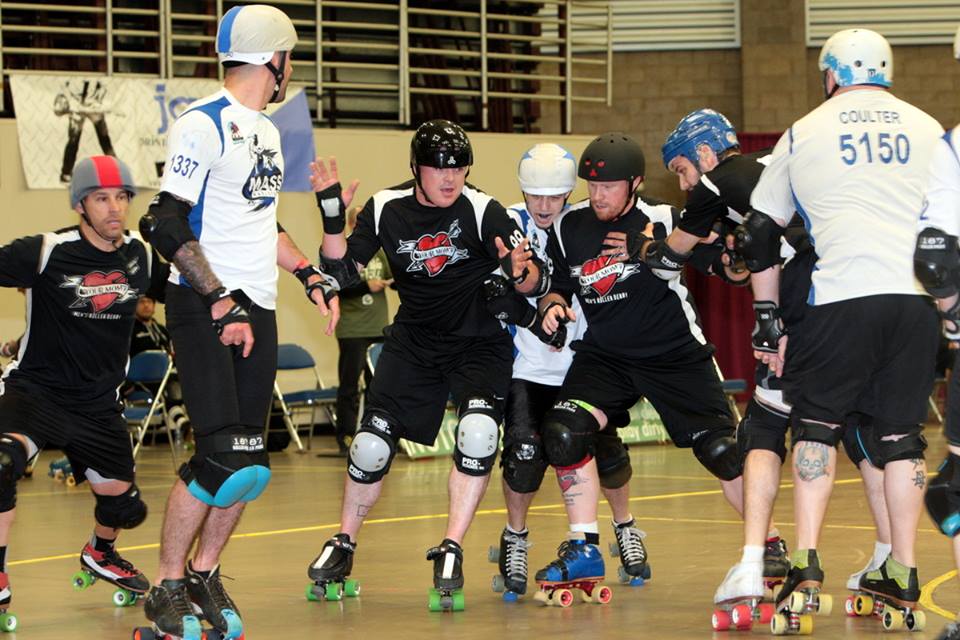
Against Mass Maelstrom at Spring Roll. Photo by DeFord Designs

Your Mom knows what you’re going to do before you know what you’re going to do. They aim for where you’re going, not where you are, and they rarely have to catch the jammer, because the jammer is so commonly ensnared in their net.

How do you know that their blockers are interchangeable and their rosters fluid beyond measure? Think about this: Who are their big hitters and which jammer has the best differential? Sure, Seahorses Forever and Sugar Boots stand out because of their height. Yes, everyone knows Frank NotsoHotra. Otherwise it is hard to picture any skaters that are exceedingly more important than the others. On every other team you can look at a line up and pick out ‘key pieces’. Sure, every team SAYS they don’t have any players that are more important than the rest, but we all know that’s not true.

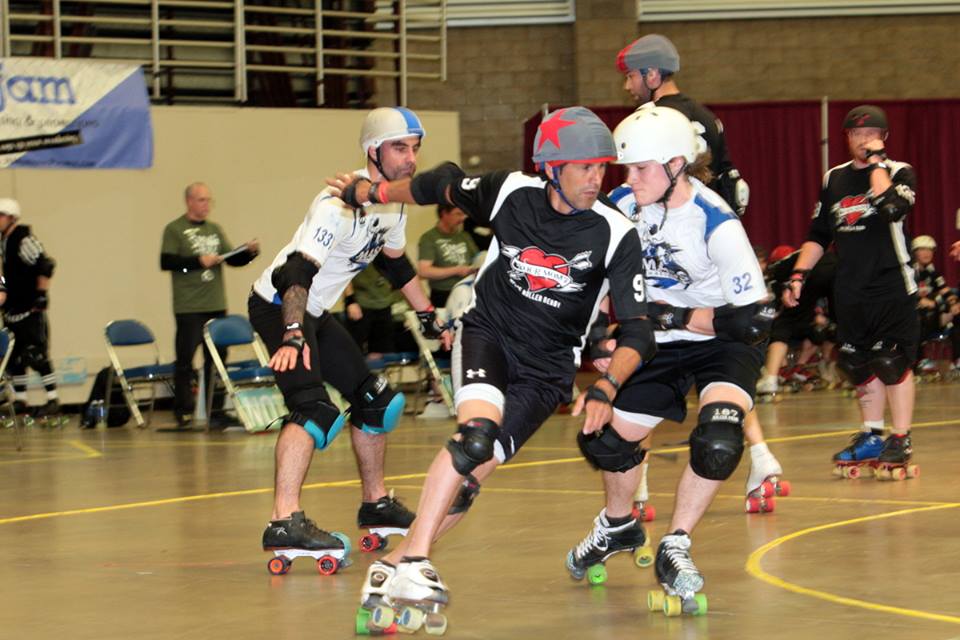
Close the gap. Photo by DeFord Designs

Double Excel. Magnum PIMP. Jonathan R. Szabo. Dilly Dally. Speed Dealer. Cozmo Damage. Shreddy Mercury. Richard Gaudet. Wes Turn. Sutton Impact. Reaper.  Keith Rucker. TJ Binkley. Are these the only players that matter on their teams? Absolutely not! Do you want to beat that their teams would be a tad concerned about overall performance if one or both of these skaters were missing from the line up? Yes, I honestly think so.

On Your Mom they don’t have to worry about it as much. No Cleveland Stever? You’ve Dirty Larry. No Tony Muse? You got Dante Muse. No B Stang? You got Rollomite. No Sugar Boots? You’ve got Seahorses Forever. No Lily Pad? You’ve got Suicide Snow Cone. You getting the idea? There is no one on the roster that Your Mom can’t respond to with a “But we’ve got these 5 people that CAN do it”. And they have up and coming skaters that they’re training so that the tradition of winning continues.

Frank Notsohotra - commonly referred to as "The fastest man in roller derby." Photo by DeFord Designs
Frank Notsohotra – commonly referred to as “The fastest man in roller derby.” Photo by DeFord Designs

“But Khaos!” You say, “You can’t really appreciate Your Mom.” (giggle) “They fly in all their skaters!”

Untrue.

There are 3 remote skaters that I know of. And by “remote” I mean living more than 3 hours away. And even if there were more, so what? Charm City, Philly, and Tampa Bay Men’s (for example) all have skaters that travel upwards of 3 hours to play with their teams. Those skaters could play for Charlottesville, or Suburbia, or Brevard Area Men’s, but they have chosen a different league and has made a commitment to the league of their choice. It is a hobby, we don’t get paid, so why should anyone feel that they are not allowed to play with the league of their choice? Why do we not hear about the skaters that travel across state lines to be a part of PRG or CCRG or TBMRD?

Because they’re not world champions.

As soon as a team starts winning division titles (Oly) or champs (YMMRD), suddenly it’s an issue. Jack Hammer’d lives in South Carolina (everyone in the MRDA knows that he moved, so I’m not exactly revealing a scandal). He is here with Maelstrom this weekend. Why? Because he fulfilled the attendance requirements set forth by his league, and thus qualified to play at Champs with Mass Maelstrom. Here is your tiny bit of beeswax so that you can mind your own.

And guess what? We saw from the WFTDA championships in previous years that sheer talent doesn’t win titles, teamwork, and practice time does. Your Mom Men’s Roller Derby has teamwork, communication, and ‘synergy’ (that’s for you, Austintatious). That doesn’t come from a bunch of people randomly showing up on bout day and not ever practicing with one another.

Positional control. Photo by DeFord Designs

This weekend is going to be tough for teams to oust Your Mom as champions. Many of the men on the roster are very accustomed to a sticky hardwood floor like that of the Tacoma Armory. Several of the skaters were GLOWING at the opportunity to play Champs on such a surface.

Every team that faces Your Mom is going to have to bring the strongest walls, the ability to multitask, awareness like woah, and the endurance of a Champion.

Check out YOUR MOM (giggle) on Facebook to get continually information about them. They play Denton County Outlaws in the opening bout of the tournament at 9a PST on Saturday. Yes. That means in about 9 hours. Get some rest, and if you’re not in Tacoma check it out on WFTDA.tv! Thank you DeFord Designs for all the photos in this article. Hey Photogs! YMMRD needs more pictures taken of them next year. #JustSayin #BloggerinNeed

2014 MRDA Champs Preview: #2 St. Louis GateKeepers

The GateKeeper defense are the thing nightmares are made of. Like the 2000 Baltimore Ravens of eggball, the GK have line-ups of monsters that have one objective: Ruin your jammer’s day [and do it as a team].

gatekeepers

Another old dog of the MRDA, GK has been growing since Magnum PIMP and Bat Wing decided to form the league in 2009. With over 50 active members, the GateKeepers (and their highly competitive B team the B-Keepers) strive to bring a balance of speed, communication, airtime, and pure pain to the roller derby track.

This season, GK appeared at Spring Roll and RollerCon. From an outside perspective, ti seemed that they approached these two events with one goal: Establish unquestionable dominance over every team they meet. And, for the most part, they did.

Gnat King Kill getting it done at Spring Roll against Southern Discomfort.

If you’ve ever seen GK play than you know that they rely on super strong blockers who are huge AND have amazing lateral motion across the track. Coming up against a wall of Monster Jam, Double Excel, and Neil Death Experience is a terrifying prospect [and I am not even skating this weekend]. Not only does each take up the entire track by themselves, but they know how to seal holes to prevent jammer breakthroughs and their timing is all excellent.

Mixing in blockers like Bane-Ana, Debaucherous Prime, and Gnat King Kill into lines help to keep the GK diamonds fluid and fast. These are the blockers that can dart out of a pack and pick off a stray jammer or destroy an opponent’s brace to give Shane Bower some space to run.

GK 1
“The Totes Adorb” Bane-Ana and Wrecking Bill team up to hold Jonathan R at RollerCon. Photo by Brangwyn Jones.

In every article I have talked about teamwork. The GateKeepers exemplify what it means to have teamwork. What it means to understand how your allies on the floor skate, and how to pick apart an opponent as a two or three wall, instead of as an individual. BUT if the time comes where an individual needs to make a quick save, they know who is bridging, who is chasing, who is baiting the pack to speed up, and how to recycle back to that massive concrete wall.

The only time the GateKeepers get in trouble is when they start landing in the box. Yes, obvious statement, but true nonetheless. I don’t have the stats packs to prove my point, but I remember GK getting into some penalty trouble against Shock Exchange, and that’s when NYSE starting getting a little more ahead. When they finally took hold of the NYSE game is when they calmed down, worked as a wolf pack, and ate the NYSE jammers and blockers alive [while NYSE let them at least].

Flight. By Screecharound. Photo by Mr. McWheeley

The jammers of GK are not to be forgotten because they are majestic to watch. Remember how I said that they mix in ‘airtime’ to their strategy? These guys eat apexes for breakfast. In fact, if we can have a contest this weekend to have Screecharound from GK and Reaper from Southern Discomfort have a head-to-head ‘jump off’ battle, I’d really appreciate it. (Ironic note: It wasn’t until after I was coming back through and editing that I realized that Screecharound is #66 and Reaper is #666. Obviously there’s a connection.)

While Screecharound and Shane Bower both have the long, beautiful legs that allow them to take flight each bout [without effort]. Both skaters are able to switch up between long, loping strides and the small, controlled edgework to fake out opponents.

Shane Bower has a little more experience under his belt, and you can see it when he comes up against stronger walls. He’s deft at playing offense for himself by simply shifting his weight as he approaches a pack and trying out different spots in a wall until someone over commits and he can easily glide through. He seems to find holes in defenses unperceivable to the human eye on the physical plane.

Magnum P.I.M.P. hops another apex at Spring Roll. Photo by Mr. McWheeley
Magnum P.I.M.P. hops another apex at Spring Roll. Photo by Mr. McWheely

Then there is GateKeeper founder, Magnum P.I.M.P. Magnum is to be feared with the star. He is strong, he is light on his feet, and he has a head for the game. He understands his blockers, and how they move on the track. His offense understands him and can create the smallest distraction for him to take full advantage of. He is definitely a utility jammer.

In the first round the GateKeepers will be coming up against a relatively green Southern Discomfort. While the men from England are ready to make a statement, they are going to have to pull out all the stops and have a stellar game to make a dent in the GateKeeper strategy. GK’s jamming bench is deep and wide, and their blocker rotation is so versatile that the SD jammers are going to have to continually readjust to the styles thrown at them. Do I think So Disco could come out with a surprise for the GateKeepers? Absolutely.

You Shall Not Pass. Photo by Mr. McWheely
Neil tells Ballistic Whistle: “You Shall Not Pass”. Photo by Mr. McWheely

“But Khaos! The Gatekeepers already beat So Disco by 200 points this year!”

True. However, look at the circumstances: SD played GK the last game of Spring Roll in Fort Wayne, Indiana. The GateKeepers had a 6 hour drive to the venue, and had only played two other games that weekend. Southern Discomfort was 6 hours out of their normal time zone, and had already played six games in the previous 8 days (including games against Mass Maelstrom and Your Mom). So Disco did not come into that bout as they will come into this one: Fresh, studied, and hungry.

However, there is still the fact that they’ll be facing off against the St. Louis GateKeepers who are on a mission for Your Mom.

Doing work at Spring Roll. Photo by Mr McWheely

You can see the GateKeepers work to hold back the British Invasion at 11a PST on WFTDA.tv, if you’re not at the MRDA Championships live. Check out the GK facebook page for updates. Thank you Mr. McWheely for the photos in this article. Visit his page to buy prints! Thank you also to Brangwyn Jones. You should totally go like him on Facebook.

The House that Derby Built: 4 Corners of Training with Mixed Levels

Support Merry Khaos and getting back on skates at GoFundMe.com/KhaosACL

How the hell do you run practices when your league has practicing membership from Level CobraSnake to Level NewbornFoal? THIS is the biggest question asked across the world by coaching committees in roller derby right now. How can we keep our vet skaters challenged and satisfied with the training process [so they don’t transfer out] while bringing new skaters up [quickly] to a level to be able to play with those vets?

I had such a huge response to the blog I posted two days ago, about League Rebuilding that I wanted to make sure that my blog about training the leagues that are rebuilding went up quick!

There are fundamental corners to The House that Derby Built: Skills, Teamwork, Strategy, and Health. Without one of the corners, the house will not fall, but it will lean a little funny. Without two of the corners, you don’t have much of a house.

TESTING THE FOUNDATION

First you need to understand where your league is at with each of these fundamental pillars. The first step is to take an honest look at where each skater is individually and as a league. For Skills and Health you can actually do measurable tests to help you with your mapping process.

Set up a practice to set benchmarks and test skills, and I would recommend asking coaches from nearby leagues to come in and help with the ranking process, since the will be more impartial in the process. Create a list of skills (crossovers, one foot glides, lateral motion, hip checks while moving, jumping, counter blocking, 180 toe stops, blocking to the line, etc) and have them ratable 1-10. Move your way through drills, as you would when doing a certification, but make sure you have more advanced skills on the list than a strict certification process.

For Health, you simply create a list of ‘events’ like a football combine. You can test squat strength, bench strength, 100 yard dash, 400 yard dash easily. You can create short ‘obstacle courses’ and time each player through it while rating their cuts, bursts of speed, jumping, and footwork. You can do one foot balance, long jumps, pull-ups, or anything else you think would be applicable to strength and endurance needed for derby.

Once you have your 1-10 data points you can put them into a spreadsheet and simply create a point chart! Boom. You now know where people are. This is not to make anyone feel bad. This is simply a way to benchmark individuals so that the training staff can develop upcoming practices and make recommendations about cross-training. This information is also a great starting point for goal setting! Part of setting goals is that they have to be MEASURABLE. With benchmarks in hand, captains can meet with skaters to create a real list of SMART goals for the skater to focus on in upcoming months.

To benchmark Teamwork and Strategy is harder. Teamwork, though very easy to see the presence (or lack of) teamwork, it is not easy to quantify. You may want to ask those coaches to come and observe your team in a scrimmage against another league to rate overall Teamwork and Strategy. When you map, you will not be mapping for your team, but you will be mapping for groups of skaters, or the team as a whole.

Things to rate from 1-10 in Teamwork could be: Proximity of skaters, holding lanes, communication, mobility of walls, awareness, recycling, and protecting edges.

Things to rate in strategy could be: Offense, O to D/D to O switch speed, Bridging, Jam line start, power jam defense, preventing recycling. Watch some bouts and make notes of how to describe strategy and teamwork and create your list to test (use the words and ideas that I listed as your example).

CREATING THE PLAN

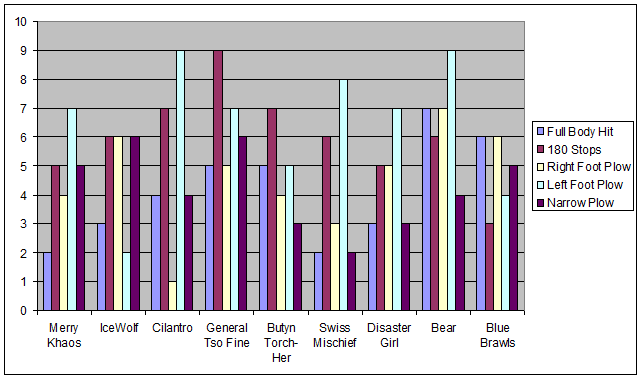
After you map the data, you can analyze it with your training staff. You’ll be able to see weaknesses very easily. Data doesn’t lie. Create the charts however your brain can deal with the data. After playing around a bit, I decided that I like the bar graph, since I can see distinct lines across. I just made up a mock chart for an example (I picked derby names at random, I didn’t actually rate people on things).

chart

From looking at the chart, you can see that some people have strengths, and some have extreme weaknesses. You do not want to use those as your focus. You want to teach to the median weaknesses. Note: This does not mean ignore the strengths, it just means you now know where to focus more of your training energy. Looking at this chart, I immediately notice that NO ONE has even a 7 on narrow plows. Next thing I see is that while we have a few people strong at left foot plows, the rest are not, and no one is strong at right foot plows.

If you have a team that is primarily new skaters, and you are noticing that in the corners of your house, the median score is 1-5 in most areas, than grade on the curve. So you can’t look at the data and go, “Oh man, there are only a couple 7s. WE MUST FOCUS ON EVERYTHING.” Right, ok, so, bring the top grade to 7 and look at the skills from there. If 7 is the top and you’re noticing some skills have more 4/5s and others have more 2/3s, focus on the 2/3s.

You do this with all four of your pillars. Identify your team’s overall weaknesses.

THE EXCUSES

“But we have too many new skaters to do this!” No. No such thing. If your skaters can’t complete skills they get a 1 on the scale. That’s it. Everyone can run, lift, jump on sneakers.

“But we don’t have any place to do the off skates benchmarks!” Really? You know that? I just suggested it and you’re already coming up with an excuse to not do it? Have you called the gyms in your area and asked about it? Tell them what you want to do. Offer them advertisement in exchange for use of their gym to do benchmarks. They can be the “Official Combine Location of the Blankety Blank Roller Vixens”. Local, privately owned gyms or franchises are the best place to start. You may want to approach CrossFit gyms about it, because they’ll usually have sprinting space too, and some of those coaches have experience in combines.

“But we already spend so much time at derby, we don’t have the time for this! We know how our skaters are, can’t we just use what we know?” Cancel practice for a week and do this. If you want to improve and you’re serious about focusing your training program, you need to know what you’re working with and you need to have an OBJECTIVE view of where you are starting. Without data, provided with the help of people who don’t know you from Adam, all you are doing is continuing old habits. Your current training is based on what you think you know about your skaters. Chances are your advanced skaters are not advanced. Chances are your fresh meat have skills you didn’t realize.

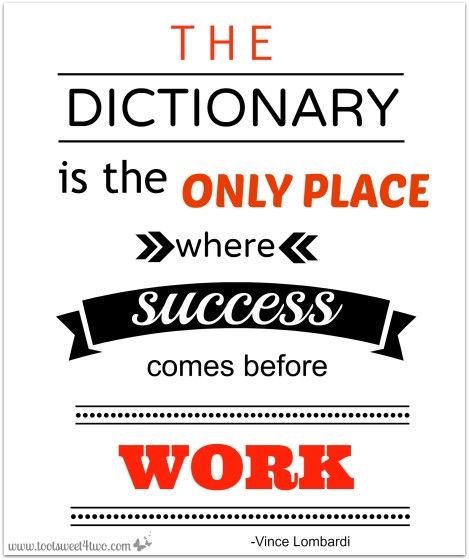
“But we’re not Gotham or Bay Area. We don’t need to train like a D1 WFTDA team.” Well I will respond with a Vince Lombardi quote:

“If it doesn’t matter who wins or loses, then why do they keep score?” You don’t have to be a D1 team to want to be successful or to train to be successful.

What it comes down to is that this is new, and new is scary. What it also comes down to is exposure. Exposure is scary. Skaters (especially self-proclaimed ‘vets’ and those who like to pop into practice when convenient) do not like being told that they need to improve at something, or that the ‘lowly fresh meat’ is actually better than them at a skill. This is not about belittlement. This is about recognition and understanding. Without it, you cannot move forward.

DON’T FEAR TO START AT THE START

If you have to grade on the curve, and you have noticed that you have that moment of “We have to work on everything”, then step one is take it back to the beginning. Begin training the TRUE fundamentals for individuals and teamwork:
The mechanics of roller skating & speed skating
New derby position (tailbone tucked, feet shoulder width)
Toe stop & duck runs
Holding a lane
Skating without using your arms or looking at the floor
Skating in a pack
Pace lines & Speed control
Lateral motion/Laterals using edges & leading with your knees Carves (short and long)
Narrow & One foot Plows
Stopping with edges
Making a wall
Moving as a wall
Anatomy of hitting
Sticky blocking
Transitions both directions
Communication & awareness while in motion

This is the start. These are the building blocks. You cannot do a box drill if skaters don’t know how to control their speed and skate close to other people. You cannot do a weaving pace line if your team doesn’t know how to do a basic pace line. This is your first check list. And honestly? I probably missed things. (I have walked away from this list and come back to it several times.)

Old derby position (l) - Butt out, weight middle of the feet/heels New derby position (r) -  back straight, tailbone tucked, feet hip to shoulder width apart You won't be as low in new derby position, but you have more mobility from this position, and a stronger stance for blocking and walls
Old derby position (l) – Butt out, weight middle of the feet/heels; New derby position (r) – back straight, tailbone tucked, feet hip to shoulder width apart
You won’t be as low in new derby position, but you have more mobility from this position, and a stronger stance for blocking and walls

“But my vets will be bored!” No, they won’t be. In any drill that involves team play, the vets should be focused on helping their team mates cover lanes, maintain position, and work on speed change. The vets need to be the coaches through the drills with the new skaters. For any individual skill, the vets need to be focused on cleaning up their own abilities. Encourage the vets to work on precision, quickness, reaction, depth of skill, and visualizing they’re in a game situation.

Your vets can plow? They should work on plowing narrower, sharper, stopping quicker, keeping their hips more square, their back stronger, and their head up and looking around while doing it. Your vets ‘know how to roller skate’? Encourage them to make their stride deeper, lengthen their pushes, and focus on breathe work and mental tricks as they go around the track that they can access during game play to calm themselves.

***THERE IS NO PERFECTION IN ROLLER DERBY***

Every skater needs to review and practice these fundamentals. These building blocks are not things to check off a list and never visit again. I recommend revisiting these fundamentals often, even after every skater on your crew can rank at an 8+ with them.

NOTE: Every skater is responsible for their own progress and should be empowered by their team and coaching to take responsibility for practicing fundamentals on their own time as well as whatever happens in practice. Just like with the health section at the end of the blog, it is not the coach’s responsibility to mother each skater to make sure they are keeping sharp on their skills on their own time.

DO NOT COACH DOWN

Just because you are working on fundamentals, it does not mean that you need to treat your skaters like 5 year olds, or offer them drills that do not challenge them. Create drills that push your new skaters. Do not assume that because they are fresh, that means they are incapable. Keep your pace lines challenging. Do not skip a drill that works on something that needs to be addressed because someone thinks the fresh meat won’t be able to do it.

When Mystery Violence Theatre came to HARD she couldn't stand on her skates. Through coaching confidence & her own hard work, she now skates for Gotham's Wall Street Traitors & Bronx Gridlock. Photo by David Dyte
When Mystery Violence Theatre came to HARD she couldn’t stand on her skates. Through coaching confidence & her own hard work, she now skates for Gotham’s Wall Street Traitors & Bronx Gridlock.
Photo by David Dyte

You do not get better unless there is a challenge. Making drills JUST above the median level or intensity will push your largest faction of skaters. Dotting in more advanced drills or more basic drills, will keep everyone confident and working hard.

For example:

Let’s say you are working on edgework! You can start with carving long and slow and then short and sharp. Time these for about three minutes, with all skaters moving around the track.

Next, put dummy blockers around the track, facing proper derby direction, near the inside and outside lines. Have them stand NEAR the line, but with some space. Have your skaters carve between the blockers and the line, showing their back to the blocker as they go through (they’ll have to twist their body). After everyone has done it for a few laps, have the dummies take an extra step away from the line, and have skaters get by them by bursting past with a 3 step duck run (which utilizes edges).

For newer skaters, put bodies about as far away as the green cone. For the more advanced skaters, go with the red.

Then put obstacles in the track – one in the middle of each straightaway, one at either end (trashcans or chairs work great). Have skaters rolling and approaching the object, then bursting around the object with the 3 step duck run. They can challenge themselves to get as close to the object (without touching it) as they can before they burst around it.

After this, bring the practice back down by practicing lateral motion, leading with the knees, from line to line across the track. You have started with something very basic, upped the intensity a few times, and then brought it back down to a lower intensity, more precision-based drill.

So the moral of the story is – don’t think that your new skaters can’t do it just because it’s harder. You can always offer ways to adjust a drill harder and softer to accommodate for all skaters.

MIXING LEVELS IN PACKS

“Do we have levels mix together in drills?” Yes and no. I will define who skaters should get with as we progress through a coaching plan. This is something that the coaches need to decide. I will say “vets with tots” or “Get with someone of your skill level” or “find someone on your home team” to define who I want them to work with.

You may want to rotate skater partners too, so that way the newer skaters get the advantage of in-drill coaching. Don’t be afraid to spend a longer amount of time on drills and skills. You do not have to rush through practicing; it’s through repetition, repetition that our bodies learn. It takes 5000 SUCCESSFUL repetitions to establish muscle memory. Let them practice in mixed levels, then switch them to equal levels to allow themselves to push and challenge each other.

LESS IS MORE

Less talking, less complication, less spending of energy: in roller derby, less is more.

Do not spend 30 minutes talking about a drill. Do not spend 30 minutes arguing about a better way to do the drill. Do not allow other skaters to try to bully the coach into doing the drill a different way. Explain the drill, demonstrate, try it, observe it, correct misconceptions, do it again, observe it, tell everyone what you’re noticing, do it again, bring everyone to the center, talk about what you observed, take quick questions, move on.

Do not think that you have to bring drills to practice that have 15 steps. Simplification is critical. One piece at a time, and build your blocks. Practice your one foot plows/chomps. Then practice stopping in a two wall. Then practice stopping in a three wall. The practice stopping a jammer in the three wall. Then practice stopping a jammer in the three wall, and having the wall step in front of the person blocking. Build.

Do not think you have to be good at every strategy. Vince Lombardi is one of the most decorated NFL coaches of all time not because his Green Bay Packers could do ALL the plays. It was because they did a handful of plays SO WELL that no one could defeat them. By keeping things more concise, you will give your skater tots less to learn (less overwhelming), meaning they’ll be able to advance quicker and get to the level of working with the vets and having everyone be successful.

Teamwork, communication, being on the same page, and focus. Less is more.

lombardi success

3 FAVORITE PRACTICE THINGS FOR ALL LEVELS

Boxes: Everyone is in a tight box, on the whistle the box completes an action. You can either pick actions before the drill starts, or coach can shout the action before the whistle. Actions can be: rotate right, rotate left, inside line, outside line, hop, front to back, back to front, make a wall, make a line, make a box, speed up, slow down, 180 stop, etc etc etc. Start basic. Work up from there.

Double Pace Lines: Especially if your league needs some long endurance work, double pace lines can be beneficial to teach speed control, footwork, skating proximity, and awareness. You can have individuals weave, teams weave and lead, teams race, individuals block, teams weave and hit between the pace line, and more.

Games: Soccer (use an empty water jug instead of a ball), dodgeball, tag, and more! Get your team distracted from what they are doing by making them do something that isn’t roller derby. It’s amazing how the footwork, stops, awareness, avoidance, cuts, spins, toe stops, and communication improve after just one session. Plus – it’s really really fun!

Check out my Put the FUN in Fundamentals class notes from RollerCon 2014!

OUTSIDE OF PRACTICE

So that “health” corner of the house? Here’s the tough thing: You cannot make people do anything outside of practice time. If a skater wants to live on McDonalds and potato chips and watch 5 hours of television on their non-practice nights, that is their prerogative. Doing the benchmark combine may be the shock some people need to start developing some outside healthy habits, but you cannot count on that (You would think being winded after a lap and dreading the 27 in 5 would be enough motivation, but not everyone motivates the same).

YOU CANNOT WANT IT FOR THEM.

You can give all the Braveheart speeches you want, but each person makes their own decision of what to do with their body. If you are a decided rec team, what you can do is make recommendations as a training committee of how people can train for roller derby outside of practice. If this blog hasn’t tired you out completely, check out my SHIFTING PERSPECTIVE blog about training for our sport.

5efb67fd063f8dc613ff8ee4f8e830a0

Some leagues I have come in contact with have an ‘extra practice’ that they must complete each week on their own – it’s a set of workouts that they can do at home or in a gym. More serious leagues (or leagues that want to become more serious) are requiring their all-stars to have gym memberships (these leagues usually also have some kind of agreement with their local gym for discounted rates). In the future, some may require a level of baseline fitness in order to qualify for all-star rosters.

Every league is different. Do not be afraid to adopt these health requirements for your league, simply because it is unprecedented in your area. Do not be afraid to not adopt such policies because you do not believe it would be right for your league. Either way, it’s a discussion that the league as a whole may want to have.

My first league was not a D1 level of play, but it was understood that we did NOT drink alcohol the week of a bout.

Nutrition is as critical a part of fitness as the weight lifting, yoga, land drills, sprints, etc. As a Derbalife coach, I spend a lot of time simply teaching skaters what is and is not good fuel for the body. Creating a voluntary fitness challenge with rewards within your league could be a great way to get your skaters to do something good for them (and their skating) without the league instating rules and policies. It can be something people ELECT to do.

I guarantee the people who lift weights and do extra conditioning work outside of practice will, in the long run, excel past those who do not.

PROTEIN! HYDRATION! VITAMINS! EATING BEFORE PRACTICE! EATING PROTEIN AFTER PRACTICE! CUTTING DOWN ON SUGAR! These are things that can play a huge role in a skater’s success on the track.

CONCLUSION

Wow you’re still here? Well done!! I hope I have addressed your questions, concerns, and issues at least a little bit. This is a difficult problem for a league to have.

If your league is looking for bodies all the time, then you will continually have to rotate in fresh skaters into your tots. It’s imperative that you develop a new skater check list for each player to practice and complete and be tested on before they make their way onto the track with the vets. This way you can be sure that each player that is introduced to your team have spent time building up each corner of their house before they mix it up with more advanced skaters.

Remember that you are not the only league going through this training process. Pick goals, plan out your trainings a few weeks at a time, keep communication open, and evaluate and adjust after each chunk of training plans.

Skate hard, skate fast, be excellent to each other and do it for THE LOVE OF DERBY!!

Like me, Merry Khaos, on Facebook! Like DNA Coaching on Facebook! Want me to come out to your league to help with this stuff? Need nutrition and fitness help for you or your league? Drop me a line at DerbyAmerica@gmail.com and let’s chat about Derbalife.

Stuck in the Middle with You – Merry Khaos Class Notes

I got to revisit this class at BEAT ME HALFWAY in 2014, so I’ve gone through the original notes and added in some stuff we did at BMH, but kept in the stuff we did at RC 2014. 😀 Anything BOLD is new content. There’s not too much. 

I used to be a big fish in a small pond. I thought I was advanced because of how many points I would rack up during games, because of my jammer differential, because of my lead jam percentage, because I could own opposing players with my team. Then I transferred to a Top 20 team and, though I knew I was in for a humbling, I didn’t realize how humbling it would be.

It was awesome.

I have improved so much in the last year through changing my training program up and skating with Charm City Roller Girls (and now Tampa Roller Derby and Tampa Bay Men’s Roller Derby!). I designed this class to pass along the things I’ve done in the last year to take me from true Intermediate to a low-to-mid Advanced roller derby player.

Here is the video that compliments this blog!

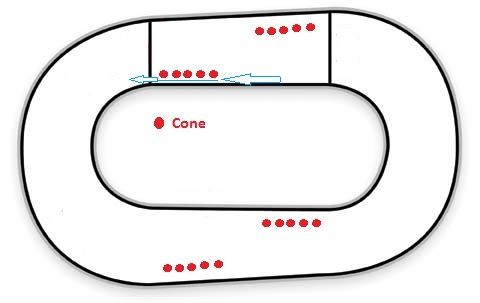
TOE STOP SIDE RUN

Each skater approaches the lane on their wheels and must quickly transition to the toe stops, side step (preferably with the grapevine step) through the cones, and then burst out of the cones back onto wheels. When sidestepping, skaters should be facing the interior of the track.

If you have many skaters, make lines before each set of cones and have skaters rotate between inside and outside line as they go through. Skaters should challenge themselves to be as close to the line as possible. Think about where you are looking (not at the ground!), how straight are your legs (knees need to be bent a bit), and how easily you can drop your toe stops (they may need to be lowered).

AMENDMENT: If running on your toe stops is super easy, try different ways of running the line – forward, side shuffle, side-step crossover, and also BACKWARDS through the cones! Try all the new things!

How to set up the toe stop run cones

BACKWARDS LATERALS

Using the cone pattern shown below, skaters have to move backwards to each cone. THEY SHOULD NOT SHUFFLE STEP, they should use backwards crossovers to get from cone to cone.

At each cone, skaters should use a one foot plow stop to stop COMPLETELY before moving on to the next cone.

Focuses: Stopping as CLOSE to the cone as possible, getting from cone to cone as QUICKLY as possible, and spotting the cone then looking forwards again. We want to work using periphery and not relying on having to stare at an object to get there.

If skaters have trouble with backwards crossovers, have them create small Cs with their feet to get them going. If skaters have trouble starting the lateral, wiggling the butt is a great way to get started. You can also do a pivot on the front wheels to start the motion.

Pattern of movement for backwards laterals

EDGING AT THE LINE

Every skater will need a straight line of clearance on the track. For 30 second intervals (at first, you can bump it up for more advanced skaters), skaters will push off from one side of the track. The goal is to get from one line to the other in one push, and use their edges to stop as close to the line as possible. A video will explain this better, but here’s the procedure:

  • Standing at the outside line
  • Inside foot points towards your destination. Outside foot pushes off of the outside edge of your skates to get momentum. All weight on the inside foot.
  • Put the back foot down on the floor, pointed at the spot you pushed off from, and transition your weight onto that back foot.
  • At the inside line, ‘stomp’ your foot (push into your edges) in order to stop your momentum

Remember to keep your center of gravity low, but you probably won’t be able to do this in SUPER low derby stance.

Do intervals of these. I like to do at least 3 30 seconds worth of practice. This will lead into the next drill.

STEPPING IN FRONT AS A WALL

We’re deviating from the flow of the class at this point, but I don’t care, it makes the most sense to explain this after the edge to edge work.

In groups of four, have everyone number off. This is their number for the whole drill. The groups will skate around the track in a four wall (hopefully winging out in the corners, and practicing all other good fundamentals of wall work as they do so).

The person controlling the drill will stand in the middle and call out numbers at random intervals. When the number is called, that person “has the jammer”. Their job is to tell their team mates. Their team mates job is to step in front of that person as quickly as possible while maintaining their wall. The person who was called IS NOT DROPPING BACKWARDS – EVERYONE IS COMNG FORWARD. The person who’s number was called should do some lateral motion for a three count, and then re-enter the wall quickly and efficiently. The person calling the numbers should do so every 7 or 8 seconds at the beginning and then you can get faster as the drill progresses.

A NOTE: I have not done this drill yet where there is at least one person/group that does not understand the “Count to three and then get back in the wall” concept. There is always a person who will hang out behind the wall and look at you confused (and sometimes angry) when another number is called and they’re not in the wall. If you figure out a way to eradicate this, please send me an e-mail.

HIPS IN FRONT

Back to solo stuff! This is something I go over in the video. You want to pair up and have partners (first at a standstill, then rolling) work on moving their hips in front of an opponent. The skaters should be hip to hip, and then one person at a time will work on stepping just in front of the other person and moving their hips to establish position. There’s a big of a hip swaggle that happens. You have to get a little sexy with your partner.

CREATING SPACE TO KNOCK A JAMMER OUT

Jammers are really good at leaning on our backs and making it impossible for a goon defensive skater to come out of the wall, and knock that jammer out of bounds. Often times, there’s just no room for us to get our shoulder or hip in front of the jammer to walk her out of bounds. So, we need to know how to create space between ourselves (the wall) and the jammer who is leaning on a seam to get through.

These are not supposed to make HUGE impacts. When you’re practicing these, if it feels like the opponent isn’t going very far, it is ok! You’re just trying to create a breadth of air. These may not be used all the time, but you want to be able to know how to use them.

CAN OPENER (Johnny Crash, any number of other names)

In pairs, have one skater leaning on the back (legally, no back blocks!) of the other skater. The skater in front will practice throwing her shoulder backwards to pop the opponent off of her shoulder.

BOOTY POP (Twerk, and any other silly name you want to give it)

Same set up to practice as the can opener, this time, instead of using the shoulder, you are going to pop your hips backwards into your opponent to create space.

A NOTE: For both of these, you must have proper derby form. That is to say, strong back, tailbone tucked. If your ass is exceptionally extended behind you, you will have no booty to pop. You will have no contact with the jammer before you throw the can opener.

TAKE IT UP A NOTCH: Next time you practice walking a jammer out of bounds with a wall in front, have your skaters practice these techniques to create space. When I am blocking, if I can’t get my shoulder in front of a jammer, I will yell to my wall, “Pop her!” and they know to throw a shoulder or hip to make room for me.

BREAKING WALLS

JACK HAMMER SHOULDERS

Just like you can use your shoulders to attack people while blocking backwards, you can attack a wall with ‘jack hammer shoulders’. In groups of 3, have one blocker press up against the seam created by the two wall.  (S)he should use her shoulders [independently] to hit the legal pieces of the opponents to create some space and hop thru the hole. Bonnie Thunders does this ALL THE TIME.

ASS IN THE GAP

This is something that not everyone will do well, or should do at all. This is another tool for the tool belt. You will have your two wall (like above), and the jammer will get a little bit of speed (the two wall should be rolling), and right before she gets to the wall, she should transition backwards and thrust her ass into the seam.

In order to do this successfully, you must fold yourself in half and propel yourself into the seam, you cannot turn around and attack the seam at a full stand up. It doesn’t work. Snot Rocket Science (Steel City), Holly Go Hardly (Charm City), and Skinny Guinea (Brandywine) are some skaters I’ve seen do this in bouts. I am trying to find gif footage!!

YOU’RE FACING THE WRONG WAY!

Ok, so we love backwards blocking these days. However, many many many skaters use it too much, and incorrectly. If you are backwards, and catch someone, you have two options: 1) Hold that skater until your friends come to your rescue or 2) pop them a bit as you turn around to face normal derby direction [which is where you have more power and control and are less likely to incur a pentalty].

To make the opponent hurt, and give you a second to turn around, you will pair up. The jammer will press into the blocker. The blocker will practice the quick succession of throwing a shoulder into the jammer (as practiced before), turning 90 degrees, and popping the jammer in the sternum area, completing the turn to establish contact with the booty of the blocker. There is no 3rd hit necessary. Shoulder facing the jammer, shoulder at a 90 degrees (at full speed it’ll look like a hockey stop with your feet), finish the turn and establish position. It is quick, it is sharp, and you have to bob with your legs on the second hit a little bit.

TO THE LINE! (PARTNER ASSIST)

In pairs, you will practice a cannonball to the line. I like having one person practice for a length of time and then switching. The pair will start in an ‘unsuspecting’ two wall. The person throwing will push their partner to the line, catch their arm, and keep them in bounds. They will then reset into a two wall. The person being thrown will be loose enough to be thrown, extend the ass over the line as FAR as possible (fold yourself over like when you put your ass through a seam as described above), and keep your skates in legal ground. Immediately reset into a two wall ON THE LINE. Then move back towards the center of the track to do it again.

See video for more explanation of this move!

NOTE: Do not anticipate being thrown on this!! Try and simulate how it would actually happen in a bout. You’re not going to be set up for a cannonball with the jammer approaching, so don’t practice it here.

Crazy Legs Drill

Two lines of cones should be placed about every ten feet in a line, and just wider than the track. Skaters are to ‘lead with their knees’ and move their feet in small, edging motions to get across the track. Toe stops are not to be used (in fact, I would recommend doing this drill during a practice where no toe stops are allowed). This is not a shuffle step, or a crossover. They are small, sometimes gliding, steps and stops where you control your speed and balance with your edges.

Your hips are always facing forward. Once a skater has reached the cone by going across the track, they should move up to the next cone at a diagonal, and use a one foot plow stop at that cone. Try and get as close to the cone as possible. Then, move across the track again. The first time through, the crazy legs should be moving to the right, and they’ll be gliding to the left. Reverse it for the second time through.

ADVANCED VERSION:

Do it again, but this time, keep your head over your shoulder. Pick ONE shoulder to look over the whole time. Move across trying to keep your eyes on that spot behind you for as much of the crazy legs as possible. You can also reach your hands behind you, pretending that there is someone on your back, and you are just making a one second contact in order to know where they are.

The very last gif on this page has an example of the “3 second check”. This is Tony Muse (Peter Pan) of Your Mom executing in perfectly. Look for the gif with the description: The “less-than-3-second-hand-check” rule can effectively widen your wall by up to a few feet on each side. Just be careful it doesn’t turn into a forearm block.

http://rdjunkies.tumblr.com/tagged/defense/page/25

FINAL THOUGHTS

Don’t be a drill dick. There’s a lot of skills in here that involve some practice. Don’t make your two walls ridiculous – make them realistic. No two wall is glued at the hips and body from the moment the jammer approaches, because if they were – the jammer would just go to the outside, and that two wall would be rendered ineffective. Keep some space. These drills are just as much practice for the blockers as it is for the jammers.

Blockers should practice keep their brakes on as jammers challenge them, and keep it challenging (but not asshole level).

Outside of derby: Start lifting weights. If you want to know why, read my blog about PERSPECTIVE SHIFT!

This was a class about getting to the next level, so I gave a similar speech in the class and I will type something similar here:

Roller derby is not always fun.

I know that we like to think it is. We like to tell ourselves that derby is a blast and amazing and fun all the time. Guess what? If you really want to improve, you are going to have to train. If you train, it’s not going to be fun all the time. Getting better is not fun. Knocking a bitch over in a game is fun. Winning is fun. Knowing that you just deadlifted twice your body weight is fun. Pause squats are not fun. Falling is not fun. Persistent sweat, pain, and failure is not fun. However, it is necessary for improvement. I did not get awesome at footwork magically. I simply did things over and over and over. I fell. I pushed. I lifted. I flipped tires. I cried. I bled. I sweat. I bruised.

It is not always fun, and that is ok. If you’re not ready for it not to be fun, than you may not be ready yet to advance to the next level. Everyone has to decide their level of commitment and level of training they are willing to accept. (And sometimes, team mates, you have to be accepting that your team mates may not be at the same level of commitment that you are.)

Go forth and be awesome!! Thank you again for anyone who came to my class at RollerCon 2014, make sure you tell them that you love me and you want me to teach more! If you want me to come to you, or if you want me and DNA Coaching to come to you – drop me a line at DerbyAmerica@yahoo.com … I also am a health coach with DERBALIFE and it has changed the effectiveness of my training. Get with me for more info!

VIDEO LINK ONCE MORE

Thank you to Keyesboard for the featured image on this blog!!

Put the FUN in Fundamentals – Merry Khaos Notes

I love this class. I love this class so much, and I will submit it again next year! I hope that it gets on the schedule more than once, because everyone has a blast. The point of this class is to do something OTHER than derby in order to work on fundamental skills.

Many of us get White Jacket Syndrome when we practice plows, hockey stops, edging, etc at training sessions. We have our coaches watching. We want to impress them. We want to get on that next roster. We’re worried about the skills of the people around us compared to our own. These games take that out of the equation. This is great to mix skill levels into, because you’re taking derby out of the equation – so EVERYONE is learning at the same pace. Though advanced skating skills can definitely be an advantage, there is more than pure experience on skates involved for most of these games.

Ultimate Roller Derby
Props needed: 2 balls larger than a baseball
Focus skills: Teamwork, communication, awareness, multitasking, periphery vision

This is the game closest to roller derby. Only with an Ultimate Frisbee twist.

Each jam is 2 minutes. Teams field the same players as usual, and we play on the derby track. Each team on the track has a ball. Players on that team must pass the ball THREE TIMES, successfully, between themselves in order to let their jammer try to leave the pack.

The ball must always be PASSED, not handed off and opposing players are allowed to block passes. If the ball hits the floor, or is caught by an opposing team member, the 3 count is reset. After 3 passes are successful, the jammer (and to make it more advanced, the jammer OR pivot) may attempt to break the pack. Your points are counted by how many times the jammer has left the pack.

So yes, when one team completes their passes, the other team should be trying to stop that jammer from leaving the pack!

Duck Duck GOOSE
No props needed
Focus skills: Speed, agility, endurance, speed control

While you can play this game in the classic “everyone sit on the floor” way, I like it better when it’s moving.

Get your team into a pace line. I recommend doing this at a moderate speed for YOUR team (obviously London Roller Girls’ All Stars would be able to do this faster than a start-up league). The person at the back of the line goes first to make it easiest. As the advance up the pace line, they call out “duck” for those who are not chosen. When they decide that someone is the “goose” they complete a legal hit on that individual. That begins the race around the track back to the goose’s position in the line.

Beginner version: It does not matter who makes it back to the goose’s place first. The GOOSE is now IT, regardless. They drop to the back of the line and begin playing.

Advanced version: Whoever reaches the goose’s place in line successfully first (as in, they’re in the line and matching the line’s pace), are safe. The other person is now IT and drops to the back of the line to start playing.

I will run this until everyone has been chosen at least once.

DODGEBALL
Props needed: As many balls as you desire. I like to do 4-6 of varying sizes.
Skills: Footwork, avoidance, awareness

Level 1 –
Split your players into two teams. Place the balls in a line directly between the two groups. Blow a whistle to release them and let the dodgeball commence!

Note: I had an interesting thing happen this year during this game. One team hung at the very back of the ‘engagement zone’ because they realized the balls wouldn’t fly that far. If you have players not participating in this way, don’t be afraid to shorten the boundaries they must stay within.

Level 2 –
No one is on a team. Every person is on their own team. Have all the skaters line up at one end (or you can split them into two ends). Those on the sideline each take a ball. The players are told that when the first ball hits the ground, they are released!

You can either play this to the end, or do it until there are 3-5 players left. These players step to the side and then you play another round. Eventually you do a “championship” round!

SOCCER
Props needed: A net, or other boundary marker for the two goals. An empty water gallon jug (you may want to have multiples for back-ups).
Skills: Footwork, edging, stops, avoidance, awareness, teamwork, short endurance

This is exactly what it sounds like: you play soccer on roller skates, but you use a gallon jug instead of a soccer ball (the jug does not roll the same way, so it makes the game actually playable).

Level 1 – NON CONTACT!
Level 2 – Legal contact

Feel free to have refs around to regulate things like low blocks, back blocks, illegal contact, and hand balls (it is soccer after all).

I play 5 v 5 and let the rounds go for 4 minutes OR until a team has scored 2 goals in that period. Then you switch out.

Blood & Thunder: Spin Edition
No props needed
Skills: Timing, strength, agility, transitions, backwards blocking, balance

Blood and Thunder. King of the Mountain. Queen of the Rink. Last Man Standing. There are a ton of names for it, but in derby most of us have played the game where we all get on the track and hit the snot out of each other until one person remains. This is a version of that.

Everyone starts skating, and when told to go, the carnage begins. When a skater is knocked down or goes out of bounds – they are out. In this version, do NOT have them stay on the track unless you have advanced skaters. You can also have refs calling penalties, and if anyone commits a penalty, they are also out.

With this version, when two skaters connect, if NEITHER skater goes out or down, than BOTH of them must flip to begin skating the opposite direction. Every skater will always skate DERBY direction, it’s just a matter of whether they are forward or backward. You should have people on the outside reminding skaters to spin around when contacted. There’s always one that just doesn’t understand/remember that they have to flip around whenever someone touches them.

This is another game that I like stopping each round when there are 3 people left, so that you can do several rounds, ending in a Championship.

MUSICAL CONES
Props Needed: As many cones (minus one) as you have people playing.
Skills: Stops, speed, awareness

Every person playing gets a cone, except for one person. Each person should place the cone on the inside or outside edge of the track. The person in charge decides what stop the round will focus on. You can do an entire game of ONE stop, if you want.

Everyone starts skating at pack speed. When the person in charge decides, they blow the whistle and everyone must get to a cone and use the stop APPROPRIATELY and without falling or advancing past the cone. If they are unsuccessful, a ref or wrangler should call them out and they must go to the NEXT cone and try it again.
Follow me on Facebook: Facebook.com/MerryKhaos1918
Twitter: @DerbyAmerica
Instagram: @Khaos24Fit

And if your league is looking for coaches and trainers, drop me a message at DerbyAmerica@gmail.com – DNA Coaching is currently booking boot camps and sessions and we’d love to talk to your league!

During Blood and Thunder
1972386_10152612655029770_3880944585047767912_n
Sliding out during Musical Cones
During Blood and Thunder

Upcoming blogs about athletic improvement

“I want to be better at roller derby.”

I hear this all the time as a health coach with Derbalife. It’s what we do. We help people ‘get better’ at roller derby. I spend a lot of time thinking and researching what that really means to each individual person who contacts me. A 200lb female is going to have different challenges than a 135lb male in the sport.

derbalife
Static Shock of the Carolina Wreckingballs has very different goals than Hittsburg of Charm City Roller Girls; each must train (and eat) appropriately. Photos by ShutHerUp and Tyler Shaw

I’m going to do a series of blogs about how to “get better at roller derby” off the track, and I’m going to do my best to include science (or at least link science articles for you to read up on and try and translate the jargon).

Training for any sport is not simple. If you decide to compete in a marathon, you may think, “Oh, I’ll just run!” but there are different philosophies, different styles of running, different techniques to prepare for the marathon.

Charm City White Star RoadRunner knows that training for distance running takes more than just mileage.

With contact sports, you must train your long endurance, short endurance, capacity for large muscle power, stability and strength in tiny ligaments and minor muscle groups, coordination, sensory reaction, mental power and cognitive understand, and the recovery time from constant impact. “Oh, is that all, Khaos?” No, it is not all. Within each individual piece are an infinite number or focuses you can take. So I like focusing on a few things at a time.

Themes of upcoming blogs:

Can’t Knock Me Down (Balance and Core Strength)

Big Power (Power lifting and large muscle group leg strength)

Feet like Hands (Busting power, acceleration, and agility)

Hands like Feet (Training and using your upper body)

Skittles Don’t Count (Pre- and Post-Workout Nutrition)

The Forrest Gump of Roller Derby (Long endurance training)

So I Had a Bad Practice (Mental recovery and forgiveness)

If Only I Had Better Wheels (Overcoming fear and mental blocks in training)

Wait it’s that Thing! (Mental understanding of the game and translation to muscle movement)

The Mighty Ducks Approach (How to prep your body for impact)

Again! Again! (How to train multiple times a day safely)

Gallons and Gallons (Hydration and the importance of water to the body)

Micro and Macro and Phyto, Oh My! (Nutrients, Minerals and more)


If you have any other themes that you’d like to see me research and write about, please do comment and let me know! Also, if anyone would like to see these turned into Rollercon classes or seminars – let me know if I should submit. I’m always looking for cool things to teach that are inspired by blogs. I figured I’d list them out here so that I know what I’m writing about in the upcoming weeks! I need to plan out and put it out there, otherwise I lose focus sometimes.

Remember, every person has different thoughts, opinions, and techniques for training and improving. I hope to offer up some information from within the community of roller derby. The information will be useful for many sport disciplines, but hopefully these blogs will help us all get a little more awesome in upcoming months.

Stopping power, bursting power, agility, quick thinking and pure strength all exist in this ONE SHOT of two power house all star teams. Photo by Tyler Shaw

7 habits that have gotten me healthy

I have changed a lot about my habits in the last 15 years. There is a lot that has resurfaced from the years of being a young, naïve tomboy in middle school (competition and weight lifting in particular). And there is a lot I have had to release over the years. Here are seven things about me that have significantly altered my physical energy, my spiritual strength and my overall positive outlook on life. As I was writing this, I realized I could have made a list of 20 things! I’m sure you’ll hear more in the future.

Befores and afters. ^_^

Befores and afters. ^_^ (and still going)

1) I eat protein for breakfast

“But Kristie! Oatmeal is so good for me!”

O rly? What I have found is that when I start my day with a high protein breakfast, one balanced with complex carbs and some fat, I have considerable energy throughout the day. When I eat oatmeal, cereal or breakfast potatoes I find that I am sluggish, hungry quicker and have a hard time firing on all cylinders at work. It is because even your “steel cut oats” are still oats. They spike your blood sugar and they do not keep you full.

What does this breakfast look like? Ideally it is an Herbalife breakfast shake – recently it’s been 2 scoops of Formula 1 Sport, ½ cup of pasteurized egg whites and maybe some PB2 for fun. If I know I’m running around a lot during the day, I’ll save the shake for later and I’ll start out with 2 eggs, a 1/3 cup of pasteurized egg whites, sautéed spinach, onion, broccoli and tomato.

 All the food!

2) I get dressed as soon as I wake up

Yes, for as much as I try and live in the comfiest clothes possible, I have found that if I wake up and toddle around in my PJs for too long, I become lethargic and my to do list stays as long as it was the night before. By staying in the mode of sleep wear, I have given my body permission to remain in sleep mode. No more permission granted!

Get up, get dressed, have breakfast, wash your face, do stuff.

If I don't get up and get moving, this happens. Then I really feel stuck.
If I don’t get up and get moving, this happens. Then I really feel stuck.

3) I reserve bananas pre-workout only (if at all)

More and more people are catching on that bananas are not the super fruit we once thought. High in sugar and low in protein, these little bombs of energy are fantastic for before a workout, but are a culprit in keeping you hungry and padded when eaten before a long day at the office. And while good for potassium and fiber, there are 6 electrolytes total that effect cramping. If you are chowing down on bananas Charlie horses go away, you very much need to take a look at the rest of your diet. My dehydration migraines have stopped now that I incorporate all the electrolytes into my diet, along with drinking at least half my body weight in ounces of water each day. The 24 Hydrate by Herbalife has been a lifesaver.

4) I eat until bed time.

Yup. Your body doesn’t actually care what time it is. By saying “I’m not going to eat after 7p” and then staying up until 11p, all you have done is slowed your metabolism and hurt your recovery – especially the athletes in the crowd. If you do a workout that finishes at 11p, then you need to eat afterwards. It’s one of the strongest changes I’ve made. That being said, keep away from the simple carbs within four hours of bed time since your body won’t be able to burn them off before bed.

These athletes at Big Bear know that we need to eat until sleep!

5) I rarely step on a scale, and I only do measurements every 60 days.

It’s ok to not know where your body is moment to moment. I know that I am much happier feeling healthy and strong and not being concerned if I weigh 138 or 144. Do my pants fit? Do I feel strong during practice? Am I faster than other people? Did my squat max go up? These are the questions I hit myself with. It is good to track your metrics so that you know what your progress looks like and you can re-evaluate every 90 days, but our body fluctuates too much day to day to use a daily weigh in as a gauge. I have seen friends drive themselves crazy over this. It causes stress, which then feeds right into keeping the weight on. It’s a cycle. Don’t feed into it.

There was a time where this high-waist pencil skirt  was too tight on me.
There was a time where this high-waist pencil skirt was too tight on me.

6) I realized that I eat mostly the same things every day, so I may as well make them healthy.

Before my journey began, I used phrases like “Variety is the spice of life”, “Diets are boring” and “I live to eat, not eat to live.” And then one day I realized that all I was doing was making excuses for myself and my habits. And then the next day I realized that I was repeating my meals every week anyway. I always had something egg-based for breakfast, I always had a sandwich or salad for lunch, I always had a protein with some carbs and veggies for dinner. (Back then I also always had 2 cherry sodas a day, a few soft pretzels and candy bars as snacks.)

If you can recognize that you’re really not as chefy as you like to think you are, you can tighten down easier on a schedule of healthy eating that is nourishing, promotes your goals and saves you money (now that I know what I want at the grocery store, there is no need to randomly pick up ingredients “Just in case”).

Also, shakes for meals are not nearly as scary as I thought when I first heard about them. Mostly because my shakes don’t come out of a metal can, I’m full afterwards and they taste RIDICULOUS. Also, when you’re eating 5 – 9 times a day (like athletes should), it’s a whole lot easier to scoops, shake, drink than it is to make 8 individual meals.

One of my favorite shakes right now!

7) I include workouts that are mental exercises.

Yoga and running are most specifically what I have worked on, though rock climbing and speed skating are another set of mental challenges.

I hated running. Hated it. Railed against it and refused to believe that it could help me (secretly, I knew it would, I just hated the way it felt because I was so out of shape). I will never forget running my first mile alongside of Eric Winters on the track of Mechanicsburg High School; technically I was his pole-vault coach, but he gave me the single greatest lesson of my life as the ex-boyfriend turned best friend:

Your body will do amazing things, if you just ask it to.

Conquering workouts that we hate means that we must overcome our self-doubt, our mind’s will to sabotage and we must release all of the excuses we have made in the past. Yoga, running, climbing, speed skating, cross-country skiing… there is quiet control and a zen-like state that must be achieved for success. You must connect to your breathe, to your soul, to the Universe’s will around you.

Bouldering is so much fun, and a true mental challenge - you know.. when you're not posing for a camera
Bouldering is so much fun, and a true mental challenge – you know.. when you’re not posing for a camera
Warrior 2 on the edge of a cliff on the way to Big Bear.

Pro Tips: Set an intention at the beginning of the session. “Focus”, “Awareness”, “Precision”, “Fearlessness” are all excellent intentions. When it begins to get hard (and it will), repeat this to yourself. Also, I like to visualize something that I connect with that calms me. The giant manta ray that I would watch float towards me in the vastness of Atlantis’s aquarium in the Bahamas comes to mind when I am running and my breath gets ragged. I picture the calm beating wings to gather myself and then keep going.

The tranquility of the manta ray

To start on your journey with me as your coach, drop me an e-mail at KGreyActiveNutrition@gmail.com and follow me on Instagram and Twitter @Khaos24Fit