The House that Derby Built: 4 Corners of Training with Mixed Levels

Support Merry Khaos and getting back on skates at GoFundMe.com/KhaosACL

How the hell do you run practices when your league has practicing membership from Level CobraSnake to Level NewbornFoal? THIS is the biggest question asked across the world by coaching committees in roller derby right now. How can we keep our vet skaters challenged and satisfied with the training process [so they don’t transfer out] while bringing new skaters up [quickly] to a level to be able to play with those vets?

I had such a huge response to the blog I posted two days ago, about League Rebuilding that I wanted to make sure that my blog about training the leagues that are rebuilding went up quick!

There are fundamental corners to The House that Derby Built: Skills, Teamwork, Strategy, and Health. Without one of the corners, the house will not fall, but it will lean a little funny. Without two of the corners, you don’t have much of a house.

TESTING THE FOUNDATION

First you need to understand where your league is at with each of these fundamental pillars. The first step is to take an honest look at where each skater is individually and as a league. For Skills and Health you can actually do measurable tests to help you with your mapping process.

Set up a practice to set benchmarks and test skills, and I would recommend asking coaches from nearby leagues to come in and help with the ranking process, since the will be more impartial in the process. Create a list of skills (crossovers, one foot glides, lateral motion, hip checks while moving, jumping, counter blocking, 180 toe stops, blocking to the line, etc) and have them ratable 1-10. Move your way through drills, as you would when doing a certification, but make sure you have more advanced skills on the list than a strict certification process.

For Health, you simply create a list of ‘events’ like a football combine. You can test squat strength, bench strength, 100 yard dash, 400 yard dash easily. You can create short ‘obstacle courses’ and time each player through it while rating their cuts, bursts of speed, jumping, and footwork. You can do one foot balance, long jumps, pull-ups, or anything else you think would be applicable to strength and endurance needed for derby.

Once you have your 1-10 data points you can put them into a spreadsheet and simply create a point chart! Boom. You now know where people are. This is not to make anyone feel bad. This is simply a way to benchmark individuals so that the training staff can develop upcoming practices and make recommendations about cross-training. This information is also a great starting point for goal setting! Part of setting goals is that they have to be MEASURABLE. With benchmarks in hand, captains can meet with skaters to create a real list of SMART goals for the skater to focus on in upcoming months.

To benchmark Teamwork and Strategy is harder. Teamwork, though very easy to see the presence (or lack of) teamwork, it is not easy to quantify. You may want to ask those coaches to come and observe your team in a scrimmage against another league to rate overall Teamwork and Strategy. When you map, you will not be mapping for your team, but you will be mapping for groups of skaters, or the team as a whole.

Things to rate from 1-10 in Teamwork could be: Proximity of skaters, holding lanes, communication, mobility of walls, awareness, recycling, and protecting edges.

Things to rate in strategy could be: Offense, O to D/D to O switch speed, Bridging, Jam line start, power jam defense, preventing recycling. Watch some bouts and make notes of how to describe strategy and teamwork and create your list to test (use the words and ideas that I listed as your example).

CREATING THE PLAN

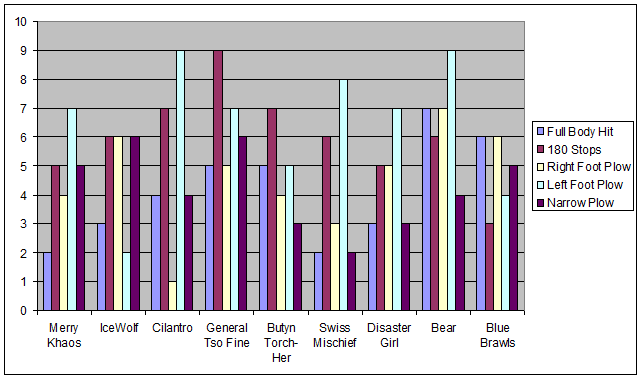
After you map the data, you can analyze it with your training staff. You’ll be able to see weaknesses very easily. Data doesn’t lie. Create the charts however your brain can deal with the data. After playing around a bit, I decided that I like the bar graph, since I can see distinct lines across. I just made up a mock chart for an example (I picked derby names at random, I didn’t actually rate people on things).
chart

From looking at the chart, you can see that some people have strengths, and some have extreme weaknesses. You do not want to use those as your focus. You want to teach to the median weaknesses. Note: This does not mean ignore the strengths, it just means you now know where to focus more of your training energy. Looking at this chart, I immediately notice that NO ONE has even a 7 on narrow plows. Next thing I see is that while we have a few people strong at left foot plows, the rest are not, and no one is strong at right foot plows.

If you have a team that is primarily new skaters, and you are noticing that in the corners of your house, the median score is 1-5 in most areas, than grade on the curve. So you can’t look at the data and go, “Oh man, there are only a couple 7s. WE MUST FOCUS ON EVERYTHING.” Right, ok, so, bring the top grade to 7 and look at the skills from there. If 7 is the top and you’re noticing some skills have more 4/5s and others have more 2/3s, focus on the 2/3s.

You do this with all four of your pillars. Identify your team’s overall weaknesses.

THE EXCUSES

“But we have too many new skaters to do this!” No. No such thing. If your skaters can’t complete skills they get a 1 on the scale. That’s it. Everyone can run, lift, jump on sneakers.

“But we don’t have any place to do the off skates benchmarks!” Really? You know that? I just suggested it and you’re already coming up with an excuse to not do it? Have you called the gyms in your area and asked about it? Tell them what you want to do. Offer them advertisement in exchange for use of their gym to do benchmarks. They can be the “Official Combine Location of the Blankety Blank Roller Vixens”. Local, privately owned gyms or franchises are the best place to start. You may want to approach CrossFit gyms about it, because they’ll usually have sprinting space too, and some of those coaches have experience in combines.

“But we already spend so much time at derby, we don’t have the time for this! We know how our skaters are, can’t we just use what we know?” Cancel practice for a week and do this. If you want to improve and you’re serious about focusing your training program, you need to know what you’re working with and you need to have an OBJECTIVE view of where you are starting. Without data, provided with the help of people who don’t know you from Adam, all you are doing is continuing old habits. Your current training is based on what you think you know about your skaters. Chances are your advanced skaters are not advanced. Chances are your fresh meat have skills you didn’t realize.

“But we’re not Gotham or Bay Area. We don’t need to train like a D1 WFTDA team.” Well I will respond with a Vince Lombardi quote:

“If it doesn’t matter who wins or loses, then why do they keep score?” You don’t have to be a D1 team to want to be successful or to train to be successful.

What it comes down to is that this is new, and new is scary. What it also comes down to is exposure. Exposure is scary. Skaters (especially self-proclaimed ‘vets’ and those who like to pop into practice when convenient) do not like being told that they need to improve at something, or that the ‘lowly fresh meat’ is actually better than them at a skill. This is not about belittlement. This is about recognition and understanding. Without it, you cannot move forward.

DON’T FEAR TO START AT THE START

If you have to grade on the curve, and you have noticed that you have that moment of “We have to work on everything”, then step one is take it back to the beginning. Begin training the TRUE fundamentals for individuals and teamwork:
The mechanics of roller skating & speed skating
New derby position (tailbone tucked, feet shoulder width)
Toe stop & duck runs
Holding a lane
Skating without using your arms or looking at the floor
Skating in a pack
Pace lines & Speed control
Lateral motion/Laterals using edges & leading with your knees Carves (short and long)
Narrow & One foot Plows
Stopping with edges
Making a wall
Moving as a wall
Anatomy of hitting
Sticky blocking
Transitions both directions
Communication & awareness while in motion

This is the start. These are the building blocks. You cannot do a box drill if skaters don’t know how to control their speed and skate close to other people. You cannot do a weaving pace line if your team doesn’t know how to do a basic pace line. This is your first check list. And honestly? I probably missed things. (I have walked away from this list and come back to it several times.)

Old derby position (l) - Butt out, weight middle of the feet/heels New derby position (r) -  back straight, tailbone tucked, feet hip to shoulder width apart You won't be as low in new derby position, but you have more mobility from this position, and a stronger stance for blocking and walls
Old derby position (l) – Butt out, weight middle of the feet/heels; New derby position (r) – back straight, tailbone tucked, feet hip to shoulder width apart
You won’t be as low in new derby position, but you have more mobility from this position, and a stronger stance for blocking and walls

“But my vets will be bored!” No, they won’t be. In any drill that involves team play, the vets should be focused on helping their team mates cover lanes, maintain position, and work on speed change. The vets need to be the coaches through the drills with the new skaters. For any individual skill, the vets need to be focused on cleaning up their own abilities. Encourage the vets to work on precision, quickness, reaction, depth of skill, and visualizing they’re in a game situation.

Your vets can plow? They should work on plowing narrower, sharper, stopping quicker, keeping their hips more square, their back stronger, and their head up and looking around while doing it. Your vets ‘know how to roller skate’? Encourage them to make their stride deeper, lengthen their pushes, and focus on breathe work and mental tricks as they go around the track that they can access during game play to calm themselves.

***THERE IS NO PERFECTION IN ROLLER DERBY***

Every skater needs to review and practice these fundamentals. These building blocks are not things to check off a list and never visit again. I recommend revisiting these fundamentals often, even after every skater on your crew can rank at an 8+ with them.

NOTE: Every skater is responsible for their own progress and should be empowered by their team and coaching to take responsibility for practicing fundamentals on their own time as well as whatever happens in practice. Just like with the health section at the end of the blog, it is not the coach’s responsibility to mother each skater to make sure they are keeping sharp on their skills on their own time.

DO NOT COACH DOWN

Just because you are working on fundamentals, it does not mean that you need to treat your skaters like 5 year olds, or offer them drills that do not challenge them. Create drills that push your new skaters. Do not assume that because they are fresh, that means they are incapable. Keep your pace lines challenging. Do not skip a drill that works on something that needs to be addressed because someone thinks the fresh meat won’t be able to do it.

When Mystery Violence Theatre came to HARD she couldn't stand on her skates. Through coaching confidence & her own hard work, she now skates for Gotham's Wall Street Traitors & Bronx Gridlock. Photo by David Dyte
When Mystery Violence Theatre came to HARD she couldn’t stand on her skates. Through coaching confidence & her own hard work, she now skates for Gotham’s Wall Street Traitors & Bronx Gridlock.
Photo by David Dyte

You do not get better unless there is a challenge. Making drills JUST above the median level or intensity will push your largest faction of skaters. Dotting in more advanced drills or more basic drills, will keep everyone confident and working hard.

For example:

Let’s say you are working on edgework! You can start with carving long and slow and then short and sharp. Time these for about three minutes, with all skaters moving around the track.

Next, put dummy blockers around the track, facing proper derby direction, near the inside and outside lines. Have them stand NEAR the line, but with some space. Have your skaters carve between the blockers and the line, showing their back to the blocker as they go through (they’ll have to twist their body). After everyone has done it for a few laps, have the dummies take an extra step away from the line, and have skaters get by them by bursting past with a 3 step duck run (which utilizes edges).

For newer skaters, put bodies about as far away as the green cone. For the more advanced skaters, go with the red.

Then put obstacles in the track – one in the middle of each straightaway, one at either end (trashcans or chairs work great). Have skaters rolling and approaching the object, then bursting around the object with the 3 step duck run. They can challenge themselves to get as close to the object (without touching it) as they can before they burst around it.

After this, bring the practice back down by practicing lateral motion, leading with the knees, from line to line across the track. You have started with something very basic, upped the intensity a few times, and then brought it back down to a lower intensity, more precision-based drill.

So the moral of the story is – don’t think that your new skaters can’t do it just because it’s harder. You can always offer ways to adjust a drill harder and softer to accommodate for all skaters.

MIXING LEVELS IN PACKS

“Do we have levels mix together in drills?” Yes and no. I will define who skaters should get with as we progress through a coaching plan. This is something that the coaches need to decide. I will say “vets with tots” or “Get with someone of your skill level” or “find someone on your home team” to define who I want them to work with.

You may want to rotate skater partners too, so that way the newer skaters get the advantage of in-drill coaching. Don’t be afraid to spend a longer amount of time on drills and skills. You do not have to rush through practicing; it’s through repetition, repetition that our bodies learn. It takes 5000 SUCCESSFUL repetitions to establish muscle memory. Let them practice in mixed levels, then switch them to equal levels to allow themselves to push and challenge each other.

LESS IS MORE

Less talking, less complication, less spending of energy: in roller derby, less is more.

Do not spend 30 minutes talking about a drill. Do not spend 30 minutes arguing about a better way to do the drill. Do not allow other skaters to try to bully the coach into doing the drill a different way. Explain the drill, demonstrate, try it, observe it, correct misconceptions, do it again, observe it, tell everyone what you’re noticing, do it again, bring everyone to the center, talk about what you observed, take quick questions, move on.

Do not think that you have to bring drills to practice that have 15 steps. Simplification is critical. One piece at a time, and build your blocks. Practice your one foot plows/chomps. Then practice stopping in a two wall. Then practice stopping in a three wall. The practice stopping a jammer in the three wall. Then practice stopping a jammer in the three wall, and having the wall step in front of the person blocking. Build.

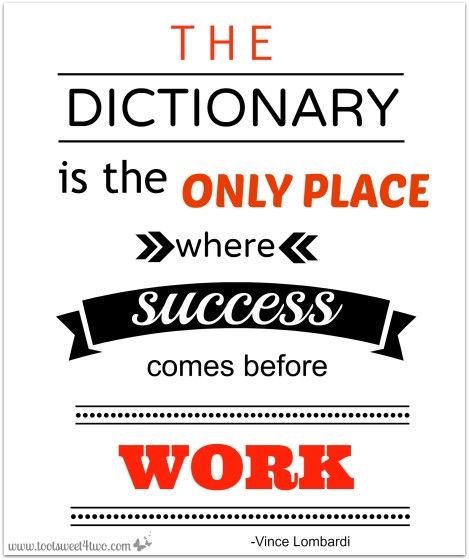
Do not think you have to be good at every strategy. Vince Lombardi is one of the most decorated NFL coaches of all time not because his Green Bay Packers could do ALL the plays. It was because they did a handful of plays SO WELL that no one could defeat them. By keeping things more concise, you will give your skater tots less to learn (less overwhelming), meaning they’ll be able to advance quicker and get to the level of working with the vets and having everyone be successful.

Teamwork, communication, being on the same page, and focus. Less is more.
lombardi success

3 FAVORITE PRACTICE THINGS FOR ALL LEVELS

Boxes: Everyone is in a tight box, on the whistle the box completes an action. You can either pick actions before the drill starts, or coach can shout the action before the whistle. Actions can be: rotate right, rotate left, inside line, outside line, hop, front to back, back to front, make a wall, make a line, make a box, speed up, slow down, 180 stop, etc etc etc. Start basic. Work up from there.

Double Pace Lines: Especially if your league needs some long endurance work, double pace lines can be beneficial to teach speed control, footwork, skating proximity, and awareness. You can have individuals weave, teams weave and lead, teams race, individuals block, teams weave and hit between the pace line, and more.

Games: Soccer (use an empty water jug instead of a ball), dodgeball, tag, and more! Get your team distracted from what they are doing by making them do something that isn’t roller derby. It’s amazing how the footwork, stops, awareness, avoidance, cuts, spins, toe stops, and communication improve after just one session. Plus – it’s really really fun!

Check out my Put the FUN in Fundamentals class notes from RollerCon 2014!

OUTSIDE OF PRACTICE

So that “health” corner of the house? Here’s the tough thing: You cannot make people do anything outside of practice time. If a skater wants to live on McDonalds and potato chips and watch 5 hours of television on their non-practice nights, that is their prerogative. Doing the benchmark combine may be the shock some people need to start developing some outside healthy habits, but you cannot count on that (You would think being winded after a lap and dreading the 27 in 5 would be enough motivation, but not everyone motivates the same).

YOU CANNOT WANT IT FOR THEM.

You can give all the Braveheart speeches you want, but each person makes their own decision of what to do with their body. If you are a decided rec team, what you can do is make recommendations as a training committee of how people can train for roller derby outside of practice. If this blog hasn’t tired you out completely, check out my SHIFTING PERSPECTIVE blog about training for our sport.

5efb67fd063f8dc613ff8ee4f8e830a0

Some leagues I have come in contact with have an ‘extra practice’ that they must complete each week on their own – it’s a set of workouts that they can do at home or in a gym. More serious leagues (or leagues that want to become more serious) are requiring their all-stars to have gym memberships (these leagues usually also have some kind of agreement with their local gym for discounted rates). In the future, some may require a level of baseline fitness in order to qualify for all-star rosters.

Every league is different. Do not be afraid to adopt these health requirements for your league, simply because it is unprecedented in your area. Do not be afraid to not adopt such policies because you do not believe it would be right for your league. Either way, it’s a discussion that the league as a whole may want to have.

My first league was not a D1 level of play, but it was understood that we did NOT drink alcohol the week of a bout.

Nutrition is as critical a part of fitness as the weight lifting, yoga, land drills, sprints, etc. As a Derbalife coach, I spend a lot of time simply teaching skaters what is and is not good fuel for the body. Creating a voluntary fitness challenge with rewards within your league could be a great way to get your skaters to do something good for them (and their skating) without the league instating rules and policies. It can be something people ELECT to do.

I guarantee the people who lift weights and do extra conditioning work outside of practice will, in the long run, excel past those who do not.

PROTEIN! HYDRATION! VITAMINS! EATING BEFORE PRACTICE! EATING PROTEIN AFTER PRACTICE! CUTTING DOWN ON SUGAR! These are things that can play a huge role in a skater’s success on the track.

CONCLUSION

Wow you’re still here? Well done!! I hope I have addressed your questions, concerns, and issues at least a little bit. This is a difficult problem for a league to have.

If your league is looking for bodies all the time, then you will continually have to rotate in fresh skaters into your tots. It’s imperative that you develop a new skater check list for each player to practice and complete and be tested on before they make their way onto the track with the vets. This way you can be sure that each player that is introduced to your team have spent time building up each corner of their house before they mix it up with more advanced skaters.

Remember that you are not the only league going through this training process. Pick goals, plan out your trainings a few weeks at a time, keep communication open, and evaluate and adjust after each chunk of training plans.

Skate hard, skate fast, be excellent to each other and do it for THE LOVE OF DERBY!!

Like me, Merry Khaos, on Facebook! Like DNA Coaching on Facebook! Want me to come out to your league to help with this stuff? Need nutrition and fitness help for you or your league? Drop me a line at DerbyAmerica@gmail.com and let’s chat about Derbalife.

So … About those 2013 All Star Articles….

So about 7 months ago I began writing All Star Articles for 2013 for several regions of the world. Then as I began writing them several things occurred: I realized I bit off FAR more than I could chew, the platform I was posting on (Examiner.com) changed a whole bunch of policies and it became miserable to post on (and unenjoyable to read), and the site also lessened the quality of photograph appearance, so many of my photographer friends were very upset at how their work was presented. For these reasons the articles fell to the wayside. I was frustrated and angry with the site and with the whole process.

Forty Ounce Bounce of River City Rollergirls


I am not going to write articles for each individual skater, but what I WILL do is release all the lists and include whatever pictures and quotes and snippets I have for those folks. I’m loaded up with Sugar Free Monster (ran out of my Herbalife LiftOff….) and have energy to burn so hang tight.

Cloudkicker Photo by Jeffery Kerekes
Cloudkicker
Photo by Jeffery Kerekes

This might be the way I release them next year too. I don’t want to let the All Star vote fall away completely, but I don’t know if I can handle the full shebang next year. I may do some pre-votes as well to help narrow down choices and actually get a lot of people voting. If you have recommendations on how I could streamline the process or increase voting numbers , please let me know! Last year I simply posted a lot on different social sites asking people to send me an e-mail with their list of favorite skaters. I know there is going to be a better way.


Wags of the PJRD Hooligans by David A Carter

Thank you again!

Put the FUN in Fundamentals – Merry Khaos Notes

I love this class. I love this class so much, and I will submit it again next year! I hope that it gets on the schedule more than once, because everyone has a blast. The point of this class is to do something OTHER than derby in order to work on fundamental skills.

Many of us get White Jacket Syndrome when we practice plows, hockey stops, edging, etc at training sessions. We have our coaches watching. We want to impress them. We want to get on that next roster. We’re worried about the skills of the people around us compared to our own. These games take that out of the equation. This is great to mix skill levels into, because you’re taking derby out of the equation – so EVERYONE is learning at the same pace. Though advanced skating skills can definitely be an advantage, there is more than pure experience on skates involved for most of these games.

Ultimate Roller Derby
Props needed: 2 balls larger than a baseball
Focus skills: Teamwork, communication, awareness, multitasking, periphery vision

This is the game closest to roller derby. Only with an Ultimate Frisbee twist.

Each jam is 2 minutes. Teams field the same players as usual, and we play on the derby track. Each team on the track has a ball. Players on that team must pass the ball THREE TIMES, successfully, between themselves in order to let their jammer try to leave the pack.

The ball must always be PASSED, not handed off and opposing players are allowed to block passes. If the ball hits the floor, or is caught by an opposing team member, the 3 count is reset. After 3 passes are successful, the jammer (and to make it more advanced, the jammer OR pivot) may attempt to break the pack. Your points are counted by how many times the jammer has left the pack.

So yes, when one team completes their passes, the other team should be trying to stop that jammer from leaving the pack!

Duck Duck GOOSE
No props needed
Focus skills: Speed, agility, endurance, speed control

While you can play this game in the classic “everyone sit on the floor” way, I like it better when it’s moving.

Get your team into a pace line. I recommend doing this at a moderate speed for YOUR team (obviously London Roller Girls’ All Stars would be able to do this faster than a start-up league). The person at the back of the line goes first to make it easiest. As the advance up the pace line, they call out “duck” for those who are not chosen. When they decide that someone is the “goose” they complete a legal hit on that individual. That begins the race around the track back to the goose’s position in the line.

Beginner version: It does not matter who makes it back to the goose’s place first. The GOOSE is now IT, regardless. They drop to the back of the line and begin playing.

Advanced version: Whoever reaches the goose’s place in line successfully first (as in, they’re in the line and matching the line’s pace), are safe. The other person is now IT and drops to the back of the line to start playing.

I will run this until everyone has been chosen at least once.

DODGEBALL
Props needed: As many balls as you desire. I like to do 4-6 of varying sizes.
Skills: Footwork, avoidance, awareness

Level 1 –
Split your players into two teams. Place the balls in a line directly between the two groups. Blow a whistle to release them and let the dodgeball commence!

Note: I had an interesting thing happen this year during this game. One team hung at the very back of the ‘engagement zone’ because they realized the balls wouldn’t fly that far. If you have players not participating in this way, don’t be afraid to shorten the boundaries they must stay within.

Level 2 –
No one is on a team. Every person is on their own team. Have all the skaters line up at one end (or you can split them into two ends). Those on the sideline each take a ball. The players are told that when the first ball hits the ground, they are released!

You can either play this to the end, or do it until there are 3-5 players left. These players step to the side and then you play another round. Eventually you do a “championship” round!

SOCCER
Props needed: A net, or other boundary marker for the two goals. An empty water gallon jug (you may want to have multiples for back-ups).
Skills: Footwork, edging, stops, avoidance, awareness, teamwork, short endurance

This is exactly what it sounds like: you play soccer on roller skates, but you use a gallon jug instead of a soccer ball (the jug does not roll the same way, so it makes the game actually playable).

Level 1 – NON CONTACT!
Level 2 – Legal contact

Feel free to have refs around to regulate things like low blocks, back blocks, illegal contact, and hand balls (it is soccer after all).

I play 5 v 5 and let the rounds go for 4 minutes OR until a team has scored 2 goals in that period. Then you switch out.

Blood & Thunder: Spin Edition
No props needed
Skills: Timing, strength, agility, transitions, backwards blocking, balance

Blood and Thunder. King of the Mountain. Queen of the Rink. Last Man Standing. There are a ton of names for it, but in derby most of us have played the game where we all get on the track and hit the snot out of each other until one person remains. This is a version of that.

Everyone starts skating, and when told to go, the carnage begins. When a skater is knocked down or goes out of bounds – they are out. In this version, do NOT have them stay on the track unless you have advanced skaters. You can also have refs calling penalties, and if anyone commits a penalty, they are also out.

With this version, when two skaters connect, if NEITHER skater goes out or down, than BOTH of them must flip to begin skating the opposite direction. Every skater will always skate DERBY direction, it’s just a matter of whether they are forward or backward. You should have people on the outside reminding skaters to spin around when contacted. There’s always one that just doesn’t understand/remember that they have to flip around whenever someone touches them.

This is another game that I like stopping each round when there are 3 people left, so that you can do several rounds, ending in a Championship.

MUSICAL CONES
Props Needed: As many cones (minus one) as you have people playing.
Skills: Stops, speed, awareness

Every person playing gets a cone, except for one person. Each person should place the cone on the inside or outside edge of the track. The person in charge decides what stop the round will focus on. You can do an entire game of ONE stop, if you want.

Everyone starts skating at pack speed. When the person in charge decides, they blow the whistle and everyone must get to a cone and use the stop APPROPRIATELY and without falling or advancing past the cone. If they are unsuccessful, a ref or wrangler should call them out and they must go to the NEXT cone and try it again.
Follow me on Facebook: Facebook.com/MerryKhaos1918
Twitter: @DerbyAmerica
Instagram: @Khaos24Fit

And if your league is looking for coaches and trainers, drop me a message at DerbyAmerica@gmail.com – DNA Coaching is currently booking boot camps and sessions and we’d love to talk to your league!

During Blood and Thunder
1972386_10152612655029770_3880944585047767912_n
Sliding out during Musical Cones
During Blood and Thunder

RollerCon2014 Merry Khaos New Skater Survival: Scrimmage Tips

I designed this class for beginners and intermediates (though advanced skaters could possibly get some tips and tricks out of it). Often, as you learn the sport of roller derby, there are little pieces that are missed. I’m talking about finesse pieces of the game; so you may be told “become a wall”, but you’re not told to “become a wall pretending there is a skewer through the four of you”. Little details make a skater great, and when you don’t have the little details [that no one told you about], you may be the one on the track getting yelled at by vets.

Before we got into anything we did a review of EDGING. Get into your proper derby form. Feel where the pressure is. Chances are it’s straight down through the middle of the wheel. We want to think about our wheels like the edge of an ice blade. Pushing through your EDGES, instead of the middle of your wheels, are how you get better at carving, stopping, and juking (and derby in general). Move around on your skates and feel where the weight goes when you’re on your edges.

General rules for roller derby that everyone should know and practice:
– DON’T LOOK AT YOUR FEET
– BEND YOUR KNEES
– YOUR ARMS ARE UNNECESSARY FOR ROLLER SKATING. Practice “Bonnie-Thunders-Floppy-Arms”
– GET NATURAL AT TRANSITIONS. Do them and do them and do them. Every chance, for hours, both directions
– DON’T SAY YOU CAN’T DO IT.  You can do it, you just haven’t YET

Proper Form

Often when we say “Drop into good derby stance”, people bend their knees, or lean over, and stick their butt very far out. For your form, you want to work on your legs being at 90 degrees, your tail bone TUCKED under your spine, and your back flat and strong. No, you will not be able to maintain this at every moment during skating, but we want you to develop that tucked tailbone and strong back. The legs at 90 degrees will build strength for you to use in skating.

Crossovers

Crossovers are critical to the ability to play roller derby because they are the basis of roller SKATING. You don’t just do crossovers when you are making a lap or going fast, you need to be able to do crossovers within packs, and have the confidence to keep your balance and make the moves during game play. Crossovers are two parts:
STEP WITH YOUR RIGHT FOOT
PUSH WITH YOUR BACK FOOT

If you are bad at crossovers right now, here are things to practice:
Getting lower: The more leg you have to use, the more strength you can put into your push.
Balance: Get a big push and then pick up a foot. The one foot glides we do for certifications are there for a reason
Confidence: Do Drunken Sailor steps. In this drill, you bring your leg as far and big off of the floor as possible, in order to crossover to the ground as far as possible. Then you do it with the opposite leg. When you get good at it, your legs will be making HUGE arches and you will continue in a straight line, despite veering off from side to side as you do your crossovers.
Back foot push: We have all done the ‘eggshells’ (when you keep all 8 wheels on the ground, and your feet go in an hourglass shape on the floor to propel). With the back foot push, it’s the same idea. All 8 wheels stay on the floor. Your front foot does ZERO work, it simply guides you. The BACK foot makes an S shape behind your front foot in order to propel you forward. Notes on this: Your back foot should not come next to you front foot at any point. If you can’t do it, bend your knees. You have to wiggle your hips a bit to make this happen and it is A VERY DIFFICULT DRILL – especially if your hips are tight.

Side note: here is what a basic ‘eggshell’ or ‘swizzle’ looks like: http://rdjunkies.tumblr.com/post/77807703036/blocking-backwards-balance-edges-and-swizzles

Crazy Legs Drill

Two lines of cones should be placed about every ten feet in a line, and just wider than the track. Skaters are to ‘lead with their knees’ and move their feet in small, edging motions to get across the track. Toe stops are not to be used (in fact, I would recommend doing this drill during a practice where no toe stops are allowed). This is not a shuffle step, or a crossover. They are small, sometimes gliding, steps and stops where you control your speed and balance with your edges.

Your hips are always faced forward. Once a skater has reached the cone by going across the track, they should move up to the next cone at a diagonal, and use a one foot plow stop at that cone, in order to move across the track again. The first time through, the crazy legs should be moving to the right, and they’ll be gliding to the left. Reverse it for the second time through.

ADVANCED VERSION:

Do it again, but this time, keep your head over your shoulder. Pick ONE shoulder to look over the whole time. Move across trying to keep your eyes on that spot behind you for as much of the crazy legs as possible. You can also reach your hands behind you, pretending that there is someone on your back, and you are just making a one second contact in order to know where they are.

The very last gif on this page has an example of the “3 second check”. This is Tony Muse (Peter Pan) of Your Mom executing in perfectly. Look for the gif with the description: The “less-than-3-second-hand-check” rule can effectively widen your wall by up to a few feet on each side. Just be careful it doesn’t turn into a forearm block.

http://rdjunkies.tumblr.com/tagged/defense/page/25

Start Low, End High

When jamming against a wall or individual that you are trying to get around on the edge, it is helpful to start low and end high. This was the best gif I could find, and though she trips at the end, she got all of her points and you can see she was starting to stand up into the block:

http://rdjunkies.tumblr.com/post/84231515222/jackie-daniels-is-telling-you-get-lower

The idea is to hug the blocker with your body as you come through. You want to be as close to them as possible so that way they have no space to wind of for a hit. This is not a hit from the jammer, you are curving yourself around the blocker to get by them.

As Jonathan R of NYSE comes in for jammer on jammer action, Don Juan of Bridgetown Menace gets lower, in order to put his foot in front of Jonathan, leverage against him, and stand up to push off.  Photo by Hispanic Attack
As Jonathan R of NYSE comes in for jammer on jammer action, Don Juan of Bridgetown Menace gets lower, in order to put his foot in front of Jonathan, leverage against him, and stand up to push off.
Photo by Hispanic Attack

Pair up and take turns being the ‘jammer’. Do this slow at first; have the jammer start an arm length from the blocker. The blocker should be in a defensive position. When contact is made, the blocker should lean into the jammer. The jammer needs to make contact on the blocker low, leading with the shoulder (NOT THE HEAD), and try to curve around the body of the blocker. It is difficult to do at low speeds, but we are looking for form and the feeling first. You can increase the speed as you go, so that as the blocker is leading in, the jammer has something to hit against. As the jammer makes contact with the blocker, they press into their legs to stand up, leveraging themselves against the blocker, and establishing themselves in front of the other person.

Getting By the Swing

When an opponent is telegraphing that they’re coming in for a hit you have two options: burst past them, or hit the breaks.

Burst past: In your pairs, have one skater take small swings at the ‘jammer’. The jammer’s job is to change their speed the moment before they are hit by hopping forward. It is a burst of acceleration to get them past. I couldn’t find a gif. But watch Quadzilla of Puget Sound skate, he does it often.

Hit the Breaks: The swings will continue here, but this time, instead of the jammer bursting past the blocker, this time you will practice coming out of your derby stance, and (essentially) standing straight up in order to let the blocker swing by you. The goal is not necessarily to hit your toe stops, you are just putting all your weight into your toes to slow your momentum.
DISCLAIMER: Even when you’re good at this, sometimes you misjudge and you end up with an ass in your quadriceps and it hurts like hell. Often, even if they hit you, they will continue to move past you, however, so you can then begin running like hell again and escape them.

Hit the Breaks and Hop: This time, instead of the jammer just stopping dead in order to let the blocker swing by, they are going to hop the other direction, parallel to the blocker’s motion. So if the blocker is swinging from outside to inside, the jammer will hop from outside to inside. The jammer wants to be as close to the blocker as possible when they do this. These are last ditch moves.

As the Dutchland blocker moves to the outside, Rainbow's Revenge hops to the in, where a huge hole is waiting for her. Photo by Jim Rhoades
As the Dutchland blocker moves to the outside, Rainbow’s Revenge hops to the in, where a huge hole is waiting for her.
Photo by Jim Rhoades

Roll Off of Hits

This is something you see often in derby now, but no one tells you how to do it. Look at Mace as she rolls off of the hit by Akers:

http://rdjunkies.tumblr.com/post/80789091770/jammer-blocker-teamwork

In your pairs, start with a ‘jammer’ who will be moving around the blocker. Do this first at a standstill so skaters understand the physics behind it. The jammer will be tight to the blocker, the jammers’ shoulder against the blocker’s shoulder. The blocker needs to offer resistance, and the jammer is to snap their hips perpendicular to the blocker and push through their outside edges of the back foot to propel around the blocker.

Jammers want to keep contact through the push. This is a way to use the leverage of another skater to get them through on an edge of the track OR if a blocker has caught the jammer, and the jammer is trying to move around them. After both players have practiced this in slow mo, have them do it moving.

GETTING THROUGH WALLS

Shoulders as Jack Hammers

This:

http://rdjunkies.tumblr.com/post/85921179065/the-kaiju-bump

Blockers will use their shoulders to put a player down, or knock them to the side or out of bounds. Jammers can use them to break walls. Please note that if the blockers you’re coming up against are bent over (that is to say, there is no back to nail), than this is not a useful technique.

To practice using your shoulders independently of your arms, start by grouping into three skaters. Have two skaters sit on the floor back to back, tight. Then, the third skater should sit down, their spine in the gap between the other skater’s arms. Their legs out, it should look like a T. The third person should then practice her can opener hit by throwing her shoulder backwards (one side at a time) into her partners. After some time, have them rotate. This will help skaters learn how to JUST use their shoulders and if they can do it backwards, they can do it forwards.

To practice breaking through a wall, have two skaters form a wall and the third is playing the role of jammer.

NOTE: When doing drills like this, the walls should be tight, but not ridiculous; especially when a skater is just learning the skill. We want everyone to get reps in and know what a successful rep is like. As they improve, the wall can get tighter and more challenging. This falls under Rule #1 kids.

Jammers will hit the LEGAL piece of the wall with their shoulders to break open a gap and stop through.  Blockers need to be engaging their core, tucking their tailbone and giving their jammer a strong back to hit!

See Through the Hole

Have a wall of two blockers, and one jammer, for this. The goal is for the jammer to make as LITTLE contact with the wall as possible. Start this drill at a standstill, with the jammer tight to the wall to replicate a jam start. Jammers should focus THROUGH the wall, not looking at either of the blockers. They should then work making their bodies perpendicular to the blockers, and side step through the wall. It’s most effective (I have found) by focusing on edges, but utilizing toe stops to push out and away from the wall.

Once you do this for a bit and become successful at it, have the wall roll, and let the jammer get a little bit of speed to try this. Again, at first, the wall should be tight but not impossible. As people get better at this, the wall can become tighter. Remember, this is NOT A HIT.

CREATING SPACE WITH BLOCKING

That two wall is now going to get hit by the jammer. Just like with the last drill, you will do this first at a standstill, then moving. Up the intensity as you see fit for your own team. For all of these, you want to start close to the walls. When you do them rolling, the jammer can get a little space.

Hit in the Ribs

Have the jammer aim for the “notch” that exists in every body. It’s approxiametly where the natural waistline is/the bottom of the rib cage. The jammer should be starting low, and completing this sharp, strong hit by pushing downwards into the floor as hard as they can, in order to launch into the ‘notch’, as they move their feet to get through the small gap created.

Hit in the Hips

This time, jammers will not be starting super high. Sometimes when blockers line up, there is a bottom that is sticking out of the wall a little bit. You want to aim for that with your hips. Jammers should practice stepping forward and into the wall in order to hip check the exposed ass out of the way. You are essentially stepping through the wall and assisting yourself through with one sharp, well placed hit. When the blocker is moved, the jammer should then quickly finish stepping through the hole.

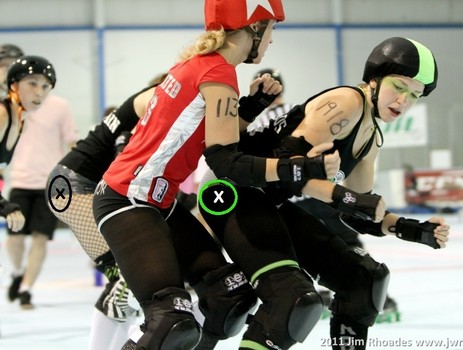
Goosing the Line

Disclaimer: Not for every jam!! Not for most jams, actually. If you do this moving, do it slow at first.

Here is your target zone:

Look at how much ass is available!  Photo by Jim Rhoades
Look at how much ass is available!
Photo by Jim Rhoades

If you are having a hard time breaking through a wall, or you know that you are coming up against defenders who have beaten you and you need to play the ace in your sleeve, this is it. You use the boniest part of your shoulder, as you are in a deep squat, and then aim to the fleshy part of the SIDE of the blockers ass. This only works if there is a significant piece exposed. There are a bunch of nerves in the ass, and if you strike it sharply, you’ll get a reaction from the blocker. Yes, it’s legal, as long as you hit where the Xs are (not the tailbone!). Make sure to keep your head out of the way. If you’re using your right shoulder, tilt your head to the left as you strike.


PHEW. I think that’s it!!! If you took this class at RollerCon and you know that I missed something, please comment on the blog so I know and so that others can see it too! I’m sorry that it was so wordy, but I wanted to make sure I explained thoroughly for anyone who didn’t get to come to the class. I hope you enjoyed it, and make sure you tell RollerCon in the feedback form that you want to see more classes with me next year, and make sure you like my athlete page on Facebook. Also, DNA Coaching is booking boot camps all the time! Contact me at DerbyAmerica@yahoo.com if your league would be interested in hosting us.

Atlantic Coast Derbalife Domination: WEEK 1 Recap

I’m a week into my adventure. There has been so much that has happened in the last week. There has been a lot of driving, a lot of Herbalife shakes, a lot of crashing at people’s houses.

So let me say that the first half of my adventure was a little bit more loosely planned than the second half. So I knew that there was going to be a little more, “Wait, what am I doing today??” at first. I’ve gotten a chance to meet a LOT of roller girls (and boys) in the last seven days. I need paparazzi so I can remember all the awesome things we’ve done!

Day #1: Atlantic Coast Roller Girls – Coaching

Day #2: Harm City Homicide (vs. PVRD’s Dirty Dozen) – Bench-coaching

Day #3: Harm City Homicide (vs. Mass Maelstrom) – Bench-coaching/Party at JBeast’s!

Day #4: Penn Jersey Bank Track – Practice

Day #5: Strong Island Derby Revolution – Coaching

Day #6: Red Bank Roller Vixens – Coaching

Day #7: Day off – evening at the Franklin Delano Roosevelt Skate Park!

Notes on Coaching Days:

Ok, so let me say that every single league has been amazing. Some leagues have gotten to see more of my “Snap to Attention” style of coaching than others (sorry, Strong Island!) but I am super proud of EVERY skater that took part in practices.

I work with smaller leagues. That’s my passion. I love helping skaters gain confidence when they are still rookie to intermediate level skaters. I love helping people improve their fundamentals and learn how to incorporate those fundamentals into game play. I love hearing skaters say, “I never thought of that!” or “I’ve never heard it broken down like that!” or “That makes so much sense!”

I love seeing skaters accomplish new skills and build the confidence to try old skills at a more advanced rate. Every single skater, by the end of practice, was stronger at SOME skill or had a better idea of how to deal with an on-track scenario. I also thinking the coaches and captains had a greater perspective of how to incorporate skills and ideas into practice. At least – that’s what I am telling myself!

I also have to say that I love hearing, “That was the hardest practice ever.”

Throughout my days coaching, I got to hang out with some awesome folks. The AC girls had a great perspective on their league since they came from a MADE rule set previously. For those of you in the southern PA area … I met a skater who, I swear, is the love child of Verbal Assault (independent ref) and Scruff (skater from Mason-Dixon). Yea. Think about that one, Friends!

Scruff + Verbal = Awesome.
Strong Island Derby Revolution!
Myself and Trinity of Strong Island


A note about Bench Coaching:

This was my first time bench coaching boys! I was so happy when Hittsburgh and Sin Diesel asked me to help the men of Harm City Homicide during their New England bouts. HCH knew they would be skating short for the weekend, and at the last minute, there was a family emergency for one of our skaters, so we competed with 9 guys.

We went into both games with a positive attitude and a strong sense of team. We were going to fight, regardless of the score. My job was to keep the guys calm and happy on the sidelines as I rotated in skaters who were less tired than the others.

The Dirty Dozen were a great team to skate against (I like that I also got to bench coach against my friends MikeOpathic and JBeast from Maelstrom!), and even though it was extremely hot and the floor was like ice after a while (Yay puddles of sweat) everyone seems to have had a really good time during the bout.

This was the first bout I’ve ever won as a bench coach! This was also the first time I ever got a chance to challenge a penalty (and I won!).

Sunday morning was a really, really tough bout for HCH. The Mass Maelstrom have played MANY hard competitions in the last few months. Though they don’t have many official wins this season, a 12 point loss to Shock Exchange at ECDX is nothing to scoff about. Their team work has been ever improving, their backwards blocking is intimidating and their ability to bridge backwards really is soul crushing.

Did we do well against them? No. We lost by over 500 points. Am I proud of the 12 points we scored? Hell yes. They fought and earned each one. We had one skater throw up, two others who I thought had seriously injured themselves. Almost all 9 guys wore the star at one point or another. There were a few fires to put out on the bench, but when sat down and told to ‘play nice’ or ‘shut the f*** up’ they listened. When I told them to breathe, they did.

Some of the guys thought I was a little nuts when I started sending out packs of jammers as blockers, but when you’re down hundreds of points, you want any advantage you can get. The agility of our jammers really showed when they were given a chance to block, and some of our blockers got a chance to shine with the star. Well…as much as they could. (Ogden totally got lead jammer over Jurasskick Park!)

Harm warming up before the Dirty Dozen
Harm before the Dirty Dozen bout
I didn't get to eat much on my way up, so this was the "During the Bout" fuel for the Dirty Dozen
I didn’t get to eat much on my way up, so this was the “During the Bout” fuel for the Dirty Dozen
Against Mass Maelstrom the goal was to remain happy and animated on the bench. "Hey! I don't care what you do, just do it as a team!"
Against Mass Maelstrom the goal was to remain happy and animated on the bench. “Hey! I don’t care what you do, just do it as a team!”

A Note About Everything Else:

This has been awesome so far. Strong Island was a last minute booking that resulted in me crashing with my friend Mystery Violence Theatre in her Brooklyn digs. We skated together at Harrisburg, and it was awesome getting to catch up with her.

The chance to skate on the Bank Track with my Penn Jersey friends was fantastic. It was my first time taking part in one of their weekday practices, with their regular coaches (old school guys … the one dude’s roller skates may have been older than most of the skaters on the She Devils). It was a billion degrees in the warehouse, but the chance to bounce around the track and even get in some scrimmage time – was totally worth it.

I got a chance to visit FDR skate park a couple times as well and I am stoked to know that every time I go I am getting a little better and a little braver. My time yesterday involved a few bowls where I was actually able to get some height.

Yesterday I got to hang out with a group of skate boarders who were there – these guys have been riding for over 20 years. The one was from San Fran area, knows Cruz of Cruz Skate Shop, and was “glad there was derby girl to show off for.” (“Look at you, you’ve even got little shorts on and you’re not afraid to fall. Awesome.”)  **SWOON**

What? I’m not proud. I’ll admit it.

While I was up in Massachusetts, I got to hang out at Brohalla with Rottie and Jack Hammer’d and the fabulous JBeast had a small pool party post-Maestrom bout that I got to attend. I am a fan of small gatherings so we can actually talk to each other, but I am sad that more of my buddies from the team didn’t make it out. Regardless, we had a great day of food, talking about Goldie’s allergies, drinking, convincing JBeast’s non-derby friends to start skating, attempts at one handed handstands and daredevils jumping from the roof to the pool, and beer pong (Jack and I were the team to beat). Overall, an excellent party (despite the hangover the next morning), and I was glad to have attended!

So what’s next?

For the next week and a half: more derby, more Herbalife, more skating and more amazing experiences. Tonight I will be making my way up to the Jerzey Derby Brigade for an open scrimmage. From there, I will travel back up to New England where I will have a table at the Mass Attack LADIES FIRST double header.

I will be hanging out with MikeO and WifeOpathic for most of the week, so that way I can strike out from their house to work with: Mass Attack, Worcester Roller Derby and Bay State. I will also be doing the Mass Maelstrom Co-Ed Scrimmage, there is the Herbalife Leadership Conference in Boston and possibly other coaching gigs while I’m up north. Then … one day and I’m off to ROLLERCON!!


The Skate Park
The Skate Park
Skate park takeover
Skate park takeover
Post Skate Park
Post Skate Park


Brooklyn with Mystery Violence!

To get me there I am working with as many people on nutrition as possible in the next week – I’m taking Rollercon PRE-ORDERS and I want to help you get your nutrition straightened out to give you the edge you need in life or in athletics. Contact me at KGreyActiveNutrition@gmail.com to talk about your goals and get on your plan today.

If you think what I’m doing is amazing, guess what? You could do it too. Becoming a health coach allows you to choose your own vision for your business to make it into whatever you can dream up. Contact me and let’s get you started on an amazing business where you feel awesome every day because of fantastic nutrition.


Ruckus. A giant bunny who lives with Peter Rottentail (also known as Hasselmann, of Maelstrom)

The difference a year makes

It’s amazing how the entire course of your life can change in a year.

Last summer, ECDX was a week earlier (ECDX, for those not in the know, is EAST COAST EXTRAVAGANZA – 3 days of roller derby hosted by the tenacious Philly Roller Girls). So let’s rewind one year and one week…

I knew I had one more year of school left. I was preparing for a Team USA boot camp and 2 WFTDA bouts with Harrisburg Area Roller Derby. I was writing for my Examiner semi-steadily and I had picked up a job at a local pizzeria for cash, and was still working for a fruit farm at a Thursday Farmer’s Market. Matt and I were doing well and we were looking forward to a Florida vacation later in the summer.

I earned MVP of Providence, but it was one of the toughest games I've ever played!
I earned MVP of Providence, but it was one of the toughest games I’ve ever played!

I was unhappy with my skating; I wasn’t completely unsatisfied, but I knew I could be better. I had done moderately well against Dominion and had earned MVP against Providence (which was huge for me*). However I was full of doubt. My quick endurance and strength wasn’t where I wanted it. My footwork was improving but clunky. I never had energy at the end of a jam and I was ALWAYS sore. I thought I was doing everything right, and I was just on the biggest plateau ever. When I looked at it – my body hadn’t changed in nearly TWO YEARS. Annoying.

Team USA boot camp Thursday. 3 Hour black and white scrimmage Friday. Sore. Spent. I met so many skaters that made me want to be better than I was (thank you, Gunder N Lightening, Fifi Nomenon and the ladies of the Columbia Quad Squad).

Then I meet Krissy Krash at her Derbalife booth. I’ve talked about this before so I’ll just fast forward.

One year and one week later, I am different.

Coming into a Cape Fear pack (photo by Juan Paden)

Not only is my body completely different, but my mind, attitude, outlook and future have shifted so drastically. I’ve been through a major injury. A break-up. A career change. A graduation. A sponsorship. I’ve played new rule sets, played a bank track tournament and am now pushing myself with the challenge of skate parks. I consider myself a runner now. And I’ve been back to rock climbing.

Using the rail and avoiding the hit.

Today, still write, but I do it for my blog as well as Examiner as well as for a book. Now I am in a house in Lititz, shared by myself and two friends. My diet is high performance to match the intensity of my roller derby and Crossfit schedule. I’m a successful Herbalife coach with a HUGE vision of creating online support communities, pockets of local derby support and a series of training centers up and down the east coast. I talk to people from all over the world on a daily basis, and I have skaters contacting me and telling me what an inspiration I am to them.

The Pivot Center in Virginia is one of the training centers I'm so excited to be working with!
The Pivot Center in Virginia is one of the training centers I’m so excited to be working with!

I run boot camps and guest coach fairly regularly. I have people now seeking ME out. I am building my classes for Rollercon since this year I am teaching business classes, off skates workouts and on skates fundamentals.

I no longer have the limiting beliefs that I had at this time last year. I prepare for ECDX with my new team: the Dutchland All Stars. Instead of a Team USA Boot Camp, I will be going to a Team USA tryout. Last night at practice, I was able to not only keep up, but perform consistently throughout practice in a rink with no AC, no air flow and after having done a Crossfit open class an hour and a half before.

I no longer believe that I’m defective. That I’m unworthy of love and that I’ll never be ‘good enough’ for a man to want more than my body. Though, I’m pretty proud of that body, let’s be real. *winks*

I am strong. I am determined. I am a force. Despite the struggles. Despite the hardships of the moment, they will not define me. They do not define me. Not anymore. I am stronger than my struggles. I am the one who will be victorious in the end.

I don’t need a diamond – I am one.

If this is where I’m at this year – almost one year into being an Herbalife Health Coach, almost one year into being a Dutchland Roller … who knows where I will be at this time in 2014. I’m excited to find out.

TAB_Team_Pins_215

If you have a big vision for your life, and think this whole Health Coach deal sounds as awesome as I thought .. drop me a line at KGreyActiveNutrition@gmail.com