Creating your 90 day eating and cross training schedule

When talking to derby folk about nutrition I hear the same things over and over:

“I don’t know what to eat.”
“I don’t know when to eat”
“I try to eat healthy” OR “I eat terribly and I know it”
“I drink plenty of water” OR “I don’t drink water and I know it’s bad”

I’ve been doing this health coaching thing for a little while now and I can almost predict what people are going to say before they say it. It is part of why I’m so passionate about Derbalife – I want to help my friends answer questions.

Because honestly, it can be really confusing when you’re trying to figure all this out on your own! There are a billion fad diets and trends, and everyone has a different idea of how much you should eat and what you should eat. And then the SCHEDULING? WOOF. That can be rough.

meal prep

So, while my method isn’t perfect by any means, and there is still some trial and error that goes along with creating plans for yourself, I wanted to share with you what I have created for myself.

Some notes:

1) This is my 90 day plan. As I approach the end of 90 days, I will re-evaluate, tweak, and create a new 90 day plan (that won’t look too far off of this one, probably).

2) Bout weeks will change up my schedule. I will do a deload leg day on Thursday, and will rest at least a day and a half before a bout; more than that for a more competitive game, or for a weekend competition.

3) I have eased into this schedule. I did not just decide one day to work out this much. This has been a two and a half year process. Do not just try and hop into a two a day program. Work with a sports trainer if you’re unsure of how to plan out your cross training.

4) I have nothing to do other than work, train, and play/ref/watch derby. Do not look at my schedule and think “Wow. I could never do that.” **kick stones** “I guess I just won’t do anything”. No. That is not the point here. The point is to show you how you can break down every day of your week into an intentional plan.

Mon to Thurs

Screenshot 2015-04-18 13.37.54

Screenshot 2015-04-18 14.38.00

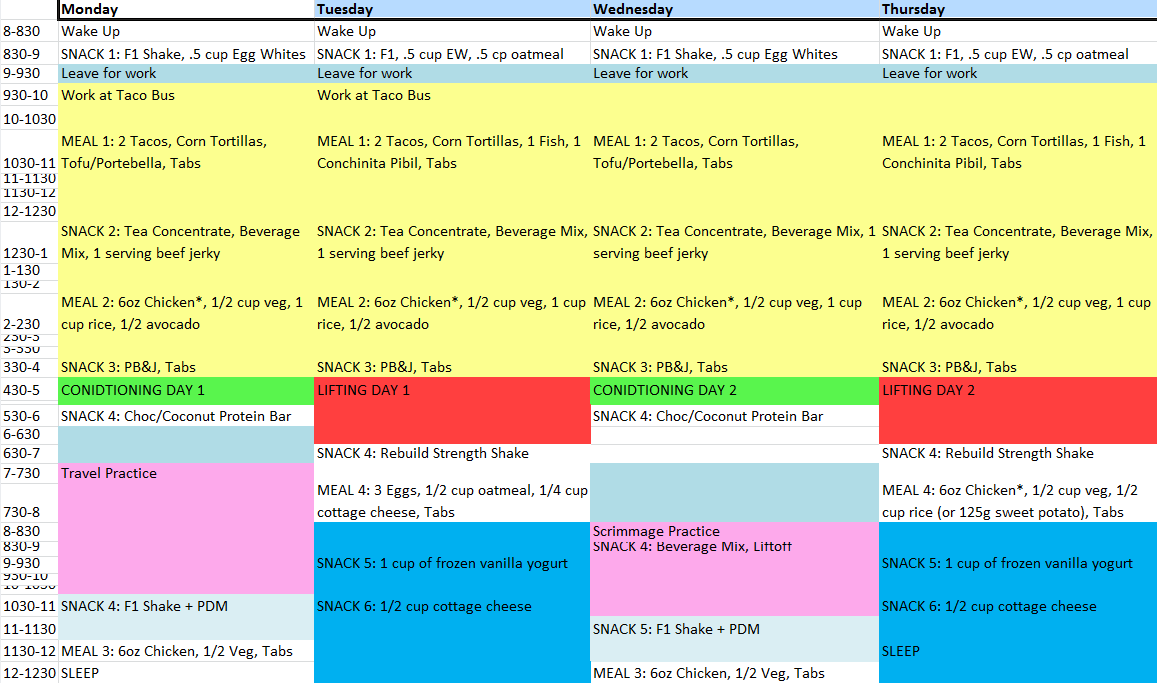
So the first thing I did was color coding. I broke my day into half hour bite sized increments. Then I went through and blocked out the scheduled pieces: work time, drive time, practice time is all set. I can’t change them, so they go in first. From there, I could build my cross-training schedule. After that, my extra stuff could go in.

bruise crew photo
Bruise Crew at The Blood Shed in Austin, TX, getting ready to play The Firing Squad. Practice times are not negotiable, so I make sure they’re a part of my plan before my plan has fully formed. Photo by TXRG

Once I could see what my days look like, I could build my meal plan. I know that when I work at Taco Bus I can only eat meals during certain times. I also know that I get employee meals. The goal is to eat every 2-3 hours, starting with eating within 30 minutes of waking up. I walked through my day, and found times that I thought I’d be able to eat. I typed in  what I thought would be good snacks and meals. I put in as many snacks and meals as I thought would hit my desired calorie count… which… originally… I thought was 2000 calories. As you can see, below, it is NOT 2000 calories.

So after I planned out Monday, then I went onto a calculator program on If It Fits Your Macros. When you walk through the calculator, I always encourage people to use the athlete formula (since it factors in your exercise amount, not just your body fat). I, personally, am on a plan to help me gain conservatively. Everyone’s goals are different, and that’s ok! I would recommend, for derby athletes that you choose either the “Recommended” for WEIGHT LOSS, the MAINTAIN, or “Cautious” for WEIGHT GAIN.

PS Macros are : Fat/Protein/Carbs/Fiber. How I got my numbers? I’m 32 years old, 5’4”, and 145#, looking to GAIN CONSERVATIVELY and working out “everyday”. I also did the formula where I eat 1g of protein per 1# of body weight, .4g of fat per 1# of body weight, and I had it calculate for 7 meals a day.

Right, so it gave me numbers listed just below this paragraph. Next I went into FatSecret.com and plugged in the day I had planned out to see what it gave me. I found out that not only was I about 600 calories short, but I was 25g of fat short! Good fats are super critical for muscle creation and is also awesome for your joints and your brain. Once I saw that, I could go back through my Monday and adjust my meals! I had them broken down in my tracking program, so I could see that a snack only had 11g of protein and I could add some jerky to it to improve that. Or that a meal was only 150 calories, so I needed to add some avocado. 😀

workouts

I want everyone to know that while I am super excited about the above schedule of cross-training … I also get a little vomity looking at it. I am not a cardio kind of girl. If you know me, or have been keeping up with this blog, than you know that I would rather deadlift every day than run. EVAR. However, too high of a focus on weight training for too long can weigh someone like me down (especially since I cameo jam now and again). So I’m moving my focus to some explosiveness. On my lift days, I’m using a modified 5×5 program, that I have preached about in the past! More about lifting and 5×5 here.

You may look at this schedule and say, “But Khaos! You said that running for long distances doesn’t do much for derby!” And it is true. It doesn’t. However, my long endurance has been slipping since I am on a team that doesn’t do endurance practices. Since I am not doing a speed practice, I am utilizing my conditioning training to help keep my long distance endurance strong, which is linked to recovery over the course of a bout. (So it may not help me from jam to jam, but over the course of a whole game, I want my large muscles to still be able to respond.)

khaos theory motivation

How to build your meals?

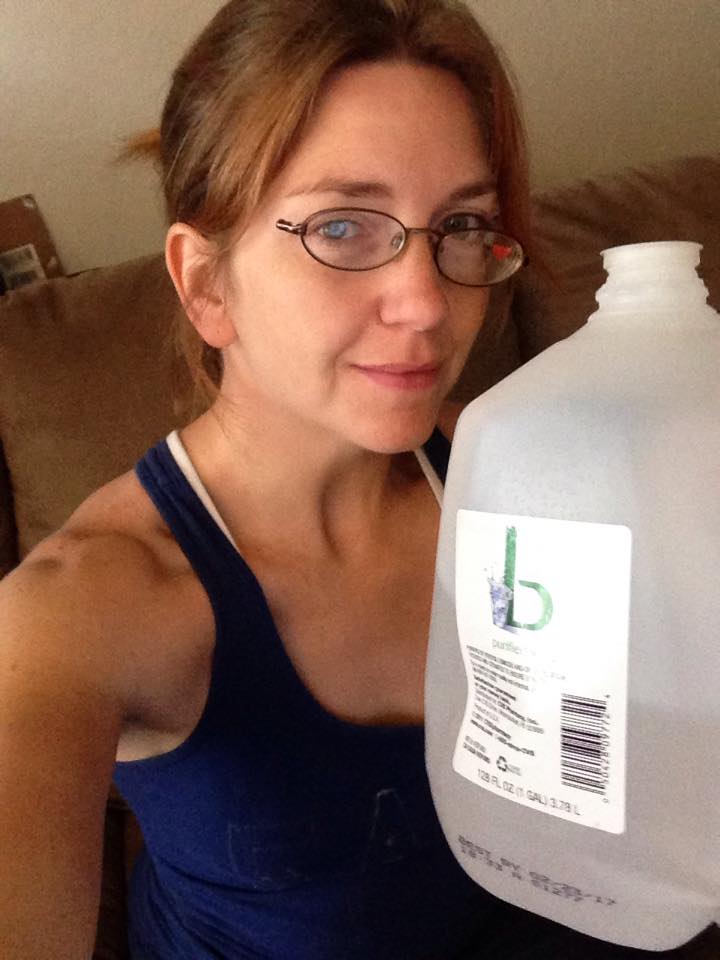
Look at your macros, use your tracking devices to understand the compositions of your food. Whenever I eat, I make sure there is at least 10g of protein in what I’m eating. Otherwise I pick something else, or add protein to the thing I’m already eating. I also drink a gallon of water a day. I also take vitamins 3x a day. Doing those things helps to keep the metabolism running and helps your body absorb all the things you’re giving it!

Feel free to use my meals as a starting point! If you want specific help please feel free to message me at DerbyAmerica@gmail.com. I have a good bit of Herbalife in my personal plan, but I can help you figure things out for you with or without the Herbalifle. ^_^

It’s a lot. It’s confusing. It’s overwhelming. Break it down piece by piece. Map it out. Then, all you have to do it is follow it and be awesome! The nice side effect of mapping out your nutrition and fitness this way? You’ve just made a road map for your daily schedule. Watch your productivity go through the roof!! And don’t be afraid to schedule in “FUN TIME” or “TRAVEL TIME” or “READING”. Do it up! It’s your plan.

11156947_10155428650020494_417367387_n

Alcohol and its Effect on Athletes (Blog Reboot)

Alcohol is the enemy of the athlete.

This is not a self-righteous rant against imbibing. If you are over 21, you are more than capable of making decisions. For competitive athletes, it is good to know everything about what you put into your body. How many of us labor over the protein content of our bread, or spend hours deciding between the benefits of certain pre-workout drinks, yet do not know the full range of side effects of drinking. There is a plethora of studies that show that alcohol is altogether bad for an athlete’s progress, so while the news should not be shocking, I feel that it’s important to explain WHY you should avoid that  weekend binge.

Side note: I’m not a biochemist. I am translating here the research I have read over the course of my studies and have sited sources at the bottom.

Drinking casually is often seen as a way of relaxing; it’s a social experience. Drinking after an athletic competition, like a derby bout or scrimmage, is often associated in the brain as a reward for a job well done. Many of us in the community have trained our brains to crave the alcohol as a way to bring the body down. We arrive at our after party spot and our sense memory is activated. Suddenly, all we can think is, “And now we order a Water Gap Wheat!” Drinking is also, sadly, part of the derby ‘tradition’. What is a bout or tournament without a raucous after party? How many teams brag as much about their after party ‘wins’ as they do about their ACTUAL wins?

Most athletes are uneducated (or flat out ignore) the biology of alcohol. If more knew what was happening, more might turn down that pint the day before a competition.

Your nutrition can be the reason why your training plan is (or isn’t) working out for you. That’s great that you lift and do plyo 4x a week. However, if you are living on fast food and tequila and expect to escalate quickly to the ranks of the Gods, you need to re-evaluate. The likelihood of you raising to elite athlete levels is much lower on this nutrition plan than someone who is training as hard, but pays attention to the daily macros.

So what’s the big deal about booze?

Did you know that alcohol can effect the body even 48 hours after consumption? While it may be gone from the digestive tract, the aftermath lingers in cells and systems. It can effect rationale, balance, and dexterity.

Alcohol is metabolized differently than other foods. Unlike sugar, fat, or protein, the body has nowhere to store alcohol. It’s only option is to metabolism immediately. So let’s say you are eating food after your competition and have a few shots. The body will place priority on digesting the alcohol to move it along, instead of the food, thereby preventing the body from properly converting food into energy. When calories are not metabolized into energy, they are stored as fat for the body to ‘deal with later’.

Are you not eating anything with your drink (also is not wise, but let’s just pretend for a moment)? Unless you’re taking straight shots, your drink will have additional sugars and carbohydrates that will also not be processed into energy; this is Beer Gut City. Though to be fair, if you’re taking straight shots at the after party with no food in your system after you have competed… there may be a secondary discussion that you need to have with your coach.

Beer spring
Spring Roll 2014 after party

Along with inhibiting metabolism, alcohol saps away Vitamin A (which is the driver of the immune system bus) and Vitamin C from the body. These vitamins are critical in many cell making processes, not the least of which is protein synthesis and new muscle cell creation. Calcium is processed from the body at twice its normal rate during intoxication. Remember, vitamins do not just live in our system. Like food and water, our body absorbs vitamins, uses them, and then needs more. Basically your body burns through calcium way quicker than normal when you are drinking. Women already have trouble absorbing this nutrient, so putting yourself at a further disadvantage is not a wise choice.

Calcium does not just “make for healthy, strong bones” [though it does, and roller derby is a contact sport so let’s not weaken our skeletal structure more]. Calcium helps blood to clot, wounds to recover, and helps to regulate in muscle contracts, like the heart beat. Wound recovery happens after every hard training session. Your muscles are not just sore from a magic chemical in your body, you are sore because you have damaged muscle tissue. You build muscle when your body repairs that damage.

The moral of this story: muscle and tissue recovery is directly effected by alcohol consumption. If your body is lacking the ability to repair itself because of a lack of calcium, you will not get stronger. Also, for as sore as you were going to be anyway? You’ll be sorer, and possibly for a longer period of time.

Dehydration! Every athlete’s least favorite word.

The kidneys and liver are key in the metabolism of alcohol. In order to assist the kidneys, the body diverts water from other parts of the body to flood these our kidneys. All athletes should understand the importance of water to their health and recovery processes: water keeps cells healthy and replicating properly. We are 70% water and even without the alcohol, most of us do not drink enough water.

The liver is what produces glycogen. When it is busy metabolizing alcohol, it cannot be producing the regular rates of glycogen. It is glycogen that the body relies on for most bodily functions.

It is the glycogen that brings energy to our muscles, but our source has been disrupted. This is the metabolism-inhibition process. To make it more fun, without the hydration and glycogen, the byproducts of lactic acid will build up in the muscles. It is that acid that causes the “burn”, and the byproducts that cause the DOMS. If you drink days before your competition, fatigue will occur far quicker. If you drink after your competition, your water intake will be diverted from your muscles to your kidneys, glycogen will not help you to continue to have energy in your muscles to make new cells, and the vitamins will not be there for the wound recovery anyway.

See how it’s all tying together?

In the realm of cognizance, most know that alcohol impairs the brain. In what way, and how quickly though? Since alcohol is so quickly absorbed into our systems (about 20% while in the stomach, the rest while in the intestines), the effects happen within five minutes of ingestion. So that “one for the road” that people do is a really bad idea, regardless of training status.

What basically happens in the neurological system is this: Neuron receptors in the brain are numbed by the metabolized alcohol, which reaches your brain as acetate (yes, acetate, the same stuff we old timers used to develop film). The alcohol slowly shuts down the cerebral cortex, the center of the brain that is in charge of functions like rational thought. In its place, the limbic system calls the shots to keep things running. This is the most primitive part of the brain. It is purely emotional. It is the reason your friends take your cell phone away from you after you begin drinking Mojitos.

Aside from placing beer goggles on you, the shut down of the cerebral cortex means that you have lost some control over your balance, reflexes, and dexterity. Do you really want to be lacking these three pieces of the puzzle the day before you play a bout?

Oh and just for funsies, here’s another great side effect. Alcohol in the blood stream causes blood pressure to go up, causing abnormal heart rates and changes. Also, the synthesis of cholesterol increases when you have alcohol in your system; so more cholesterol is finding its way to the heart than normal. Yes, more of that blood pressure stuff.

Ever drink a couple days before a practice and your cardio conditioning is shot? You feel like your head is pounding and your heart is racing the whole time? That would be from that elevated blood pressure. Plus the dehydration. Plus everything else we’ve talked about.

But wait! You say ABC News told you beer is great after a workout? It’s “more hydrating” than water? That’s what you’re going to write in the comments, right? Yes, beer has grains that would, in theory, help the carbohydrate replenishment your body needs. Yes, booze does spike your blood sugar the way sugar does (and the way your body needs to begin the processes of repair).

beer

However, the ALCOHOL in beer will dehydrate your body, and it will inhibit testosterone secretion.

Ladies, you may think you don’t need test in your system, but you do! We all make testosterone naturally and lifting weights will increase the testosterone production. So guys that suffer from Low T? Try a few months of 5×5 stronglifts before reaching immediately for medication. Ladies that are low on sex drive? Let’s get you deadlifting!

What else does testosterone do? It not only increases the size of muscular cells, but also encourages the production of new muscle cells (Greenfield). Larger cells means an increase in power capacity. More cells means greater power and quick-twitch strength (Greenfield).

So …. what?

So consuming alcohol even semi-regularly, will have an adverse effect on training and progression. It slows muscle recovery, makes cardiovascular endurance harder to build, decreases the rate of muscle cell production from normal rates, and keeps the body from performing normal functions.

Drinking a few days before a game could change your performance the day of competition. Drinking after a workout could negate some of your progress for the day.

Will having a drink destroy everything you have worked for? Absolutely not. However, exercising true moderation and limiting your consumption will have visible results whenever you lift, run, or compete.

To help combat the effects of your favorite beverage, make sure are properly hydrated throughout the day. When in doubt, drink a gallon. That’s my motto! To keep it up with booze, drink an extra 12 oz of water to every 8 oz of liquor (or equivalent). Take vitamins throughout the day, and eat plenty of leafy green veggies.

The best combatant is to not make drinking a habit, or drink alcohol at all.

Want the atmosphere, but not the alcohol? There are a lot of great books with non-alcoholic drink recipes out there! Pick up Zero Proof Cocktails: Alcohol-Free Beverages for Every Occasion and The Ultimate Party Drink Book: Over 750 Recipes for Cocktails, Smoothies, Blender Drinks, Non-Alcoholic Drinks, and More for delicious recipes that won’t kill your gainz.
10703505_10154577957895494_16893029534571617_n

Resources:

Greenfield – http://www.quickanddirtytips.com/health-fitness/exercise/should-you-take-testosterone-to-get-fit
http://www.rippednaturally.com/bodybuilding_effects_of_alcohol.htm
http://www.medicinenet.com/alcohol_and_nutrition/page2.htm
http://m.active.com/get_enough_protein_after_your_next_workout.htm
http://www.thehockeywriter.com/training-day-what-nhl-players-do-in-the-off-season

Eat Big, Play Big – Merry Khaos Notes

If you were in my “EAT BIG/PLAY BIG” class at Beat Me Halfway, you know we jumped around a little bit. This is not going to be a thorough explanation of the notes nearly as much as a bullet point list of what we covered. For more information, explanation, or to work with me on your nutrition plan, message me at DerbyAmerica@gmail.com

I will remind you that I’m not going into all the biochemistry of this. You don’t care about it anyway, you just want to know the what and the basic why. So this is like 1st grade chemistry when we are told “This is how it is!” and then in high school they say “Yea, ok BASICALLY that’s how it is, but it’s actually more like THIS.” So keep that in mind.

The 5 ‘Pillars’ of Athlete nutrition
– Calorie Count
– Metabolism
– Protein
– Water
– Vitamins

You must eat for YOUR goals. Roller derby is a contact sport, and a high energy one.  You should not be designing your food plan in order to meet society’s view of beauty. If your personal situation demands weight loss, then eat for weight loss. If you already are low body fat percentage, then don’t obsess over six pack abs, worry about your strength and progress instead.

I am going to focus on strength and athletic performance, not ‘weight loss’. Note – if you eat for sports performance and pair it with a proper training program, chances are you will lean out anyway. So it’s a win win.

METABOLISM

Basic idea: your metabolism is your energy mechanism and how your body gets vitamins distributed around the body. So if the metabolism slows, then your body can’t burn as effectively or get the vitamins you eat around to the places it needs to get to.

We keep the metabolism running by eating. Your body is like a bonfire. If you stop feeding the fire, it dies. If you stop feeding your body, the metabolism slows to a crawl. Think of simple carbs (like bread, sugar, rice) as newspaper, leafy greens as large branches, and proteins as giant logs of oak.

If you are doing heavy lifting (which we all should be doing) you can and should eat more simple carbs than someone who is primarily doing cardio.

CALORIE COUNT

You’re not eating enough. I’m making this judgment call based on the fact that you were interested enough in this topic to read. But chances are: you’re not eating enough.

How much should you be eating? Step one is to find out your “RMR” (Resting Metabolic Rate). There is a big long equation that you can google or go to my favorite cheat sheet right here!

To make it easier for you, I went and did some EXTRA research to see if I could find something a little more uniform. What I found they most for athletes that participate in an intense training routine:

MEN: 23 – 30 calories per pound of body weight
WOMEN: 19 – 25 calories per pound of body weight

If you are weight lifting at least twice a week with heavy weights, you should be at the higher end of the spectrum. On your rest days, go on the lower end of the spectrum.

If you’re eating 3000 calories a day, you should be breaking down your calories into many meals and snacks, not trying to eat three 1000 calories meals each day. If you plan out six meals, that means 500 calories per meal! These can be protein shakes, full ‘classic’ meals, bars, snacks, etc.

How do you know what to eat to hit that intake? Here’s a quick cheat:

1g of Protein = 4 calories
1g of Carbs = 4 calories
1g of Fat = 9 calories

I like to give myself a range, so I’m 150# right now. That means I should be eating between 3000 and 3400 calories. (Which means even I haven’t been eating enough!) Giving yourself just a ceiling can cause you to not hit a minimum. I’d rather you say “I’m going to eat at LEAST __________” as opposed to “I can’t eat more than ________”.

THE DIRTY BULK

Here’s where it comes in. We talked about “The Dirty Bulk” – the time where you just eat whatever you want (primarily brownies and fast food) and then you get ‘huge and strong’. Guess what? It kind of works in the temporary, but not for long term results, and not for what we are focused on. If you are a strict powerlifter, a dirty bulk is appealing. You don’t have to be strict on what you’re eating, you can stuff your face, you get big, you pull big numbers.

Powerlifters don’t have to try and catch The Smacktivist on wheels occasionally. Powerlifters don’t have to be as quick as Gnat King Kill. Powerlifters don’t have to out skate Mercy.

For roller derby skaters (and any athlete that treasures their cardio health), the dirty bulk packs on fat, cholesterol, and poundage that weighs you down instead of pushing you forward. There are times you could dirty bulk (a true offseason), but you would have to counter it with a very specific, strict period of eating afterwards.

Should-I-Dirty-Bulk

PROTEIN

We are made of protein. If you do not give your body protein, you cannot build muscle. You cannot repair or create new cells with optimal performance. If you don’t give your body protein to burn during competition and training, your body will burn the protein it can find – your muscles.

Is your hair thin, skin flakey, nails weak? Part of your problem could be a lack of protein.

Here’s your easy equation: Athletes need to eat 1g of protein per 1 pound of body weight.

Eating more will certainly not hurt you!

Because protein is the biggest piece of your caloric puzzle, you want to calculate that first! I’m 150# … I want to eat between 150 and 175g of protein per day. So that means 600-700 calories of my day come from protein. BAM. Now I know that about 2300-2700 calories have to come from carbohydrates and good fats.

Side Note: Good Fats = mono- and poly- non-saturated fats. Nuts, avocados, beans, etc.

BULKING MYTH

Ok, so something I hear all the time is “But Khaos, I don’t want to get big”. Guess what? You have to be super super dedicated for many many years to get big and bulky (especially women). You know what actually happens when you increase your calories and you start weight lifting and doing a hefty training routine? You lean the hell out. Your body takes the fat on your body and makes it into muscle.

Srsly. Your body needs fat to make muscle. It’s part of the process. So don’t worry about the “I’m going to get big”. You may gain some weight at first, but keep with it! A year from now you will look like a different person.

Not eating protein, not lifting weights because “I’m going to become a bodybuilder” is like not driving a car because “I’m going to become a Nascar driver” … it just doesn’t happen that way.

muscle_thumb

SOY MYTHS

Yes, there are some studies out there that say that soy is bad. However, there are just as many studies that say that you would have to eat SO MUCH SOY to get those effects that … well… I hope you have stock investments in Silk. I can show you photos of men and women who have been consuming soy protein as part of their meal replacements and snacks (edamame!) on a daily basis for a long time and they do not have extra fat. They do not have breast cancers. Coincidence SHOULD NOT imply correlation. If you’re allergic to soy, don’t eat soy. If your doctor tells you not to eat soy because ‘it’s bad’ then … well…

DOCTORS AREN’T NUTRITIONISTS SO HE PROBABLY GOT HIS INFO FROM THE TV.

WATER

We are 70% water. If we do not give ourselves enough water, our body will not have anything to use for…

Cell creation processes, our joints, our brains, our endocrine system, our blood, to flush out extra stuff in our digestive tracks, etc etc

Have you ever gone to practice and you tell your feet to do things and there is some kind of disconnect? You can usually do the things, but you just feel like there’s a lag? Could be dehydration.

Here’s your equation for athletes:

75% x body weight = Ounces of water to drink daily

A gallon of water is 128oz of water.

If you are more than 170# this means you must drink more than a gallon of water per day. If you have never drank that much before, and are super nervous about doing so, go to the grocery store. Buy 7 gallon jugs. Label with a day of the week. That’s your water for that day.

You will hate me for the first few days. Your body won’t know what to do with the extra water you’re taking in. KEEP AT IT! The water you drink today hydrates you a few days from now. You have to keep going.

urine_color_chart

WATER DROWNING MYTH

Ok, here’s the time of the day where people send me nasty messages about ‘not needing that much water’. When it comes down to it, I don’t know the exact, precise number of ounces my body needs from day to day. It could be 87.7oz. Do I get water from the veg I eat? Sure. But guess what? It’s easier to just drink my gallon a day and be done with it than to overanalyze and hope that I got enough in that day.

To think that every person can drink eight 8oz glasses of water and be good is silly. My body needs less water than Spectral Abyrration. He’s a dude. He’s bigger than me. For us to use ANY of the same measures for nutrition is odd.

ALCOHOL

Sorry guys. Alcohol is bad for you. No matter how you try and frame it. Is there carbs in a beer that are great for recovery post bout? Yes. But there’s also ALCOHOL. And that saps your body of water and vitamins. The negative outweigh the positive. Subscribe to my blog, I’m going to be rebooting my article about this pretty soon.

VITAMINS

Vitamins are what your body uses to create new cells. They are molecules that your body needs to initiate certain processes. Most vitamins and nutrients cannot be made by your body, your body cannot hold onto vitamins, and your body needs them throughout the day.

So moral of the story? You need vitamins all the time.

Why take a multivitamin? Mostly because we have such high vitamin needs as athletes (think of all those chemical processes going on in your body ANYWAY – then add all that training in? Your body is a madhouse of cell creation), that eating your vitamins through food sources only is damn near impossible. Considering that our food supply is much less nutrient dense than it used to be due to over-farming, picking before ripeness, and shipping long distance.

You can argue with me if you want, but seriously, it’s true. You can tell me that you “eat frozen, and buy local, and do all the things that make me wrong”, but guess what? Still not as nutrient dense. Sorry. And again, if you can take a multi and cover the gaps in your vitamins that you may not know you had: Why wouldn’t you?

I don’t know about you, but I don’t analyze myself for vitamin and nutrient intake through bloodwork daily. I’d rather just take my multi 3x a day, eat veggies, drink properly balanced meal replacement shakes, and not have to worry about it.

Yes. 3x a day. If your multi is one a day, you need to change multis.

WHAT YOU’RE EATING

So supplements are exactly that – supplements. You should build your whole foods, healthy diet and then fill in the gaps of what you’re missing with your supps. Some basics that I make sure I have?

Multivitamin, Meal Replacement shake (it’s an easy snack), my Cell Activator keeps my digestive track healthy and happy, pre-workout, post-workout, 24 Hydrate is my electrolyte supplement, and my fish oil/heart health for injury recovery (mine is flavored with vanilla so I don’t get fish burps).

Otherwise, my food involves a lot of rice, eggs, pasteurized egg whites (for protein shakes), PB2 (also for shakes), black bean pasta, all the veggies, chicken, ground turkey, wheat pasta….

I eat the same things all the time. MAKE A PLAN. Make a plan and know what you’re eating every day.

If you don’t make a plan, then you won’t know what you’re eating at 3p, which means when that time rolls around and you’re hungry – you’ll grab whatever you can. If you know on Sunday that at 3p Wednesday you are eating a protein bar, you better believe you’ll have that protein bar in your desk at work.

Also, this allows you to meal prep! Take a couple hours at the beginning of the week to pre-make and pre-portion all of your meals… or at least everything that you need to take with you.

3c482de5550c12bda796a8c02de6cdbe

You know what else this does? It gives you a very specific grocery list. Now you will be saving money because you’re not grabbing everything that sounds kind of appealing. You will buy what it is on your list.

Get with me to talk about pre- and post-workout shakes, but in the meantime… what I like to do is eat a meal about 2 hours before training, and then something small right before I train. After, I get 24g of protein RIGHT AWAY (you have a 45 minute “window of opportunity”) and then eat a meal within 2 hours.

One of my favorite shakes right now!
One of my favorite shakes right now! Great after a workout.

GMO TALK

Here’s the point where I start making friends. We talked about GMOs during the clinic. First of all, only about 3 people knew what the O in GMO stands for: “Genetically Modified Organism”.

Here’s what’s up people: We are not pulling a Jurassic Park on our food sources. We have been selectively choosing strains of fruits and veg to replant since the start of farming. Are there some foods that have been tweaked in a lab? Yes. But guess what… natural selection and our own farming practices have made EVERY FOOD SOURCE genetically modified.

I have two apples. One apple is SUPER JUICY but is kind of small and not perfectly red. The other apple has that perfect apple shape, and is much larger, but doesn’t taste as good. Guess what? The larger, perfect apple sells better! WOOT! MONEY! We’re going to replant the apple that people BUY.

The small apple does not get another growing season. The large apple does. BOOM. GMO.

ORGANIC SOAPBOX

This is the other place I make friends.

Organic is just a label that farms buy. There are a lot of things about “organic” that you may not think about … like the fact that arsenic is on the approved list (it’s natural!), or that runoff from the farm next door is common. So just because your big farm doesn’t spray that specific pesticide on your green pepper, doesn’t mean that the neighbors don’t use that pesticide on their apples… which wash off in rain. And get on your peppers through water transfer.

Also, just because it says organic, it doesn’t make it healthy. A lot of big farms have hopped on the “organic” bandwagon because they charge a lot more for [essentially] the same veg.

Want to know what you’re buying? BUY LOCAL! Go to farmers markets, become a part of a CSA. Research other labels, like “Food Alliance Certified”. Talk to the people growing your food. Or [gasp] start growing some of your own. Not all of us have the space for it, but there’s something rad about never-ending kale and tomatoes from your backyard.

FINAL THOUGHTS

Ok! So that’s the gist of things. I can help you create a specific plan based on ALL the things. I personally use Derbalife products, but that’s me. If you wanted to hop on Skype and talk about YOUR training plan, and YOUR nutrition, than let’s do it!! Drop me a line at DerbyAmerica@gmail.com or send me a message on Skype at KMGrey.

There is a little bit of trial and error involved in nutrition. Even the days when you’re “bad” you’re probably not doing THAT bad. I also incorporate nutrition in my in person coaching, so if your derby/football/soccer/softball/any other sport team is looking for classes, training, nutrition – let’s get it set up!! Let’s do it!!

You can also visit my website to check out Herbalife at http://www.GoHerbalife.com/K.grey and do some research at http://www.Herbalife24.com for our sport line (we have so many Elite Athletes on our list that it’s insane).

Eating well makes you strong! Just ask my buddy, Pixie Panzer of Harrisburg Area Roller Derby! <3
Eating well makes you strong! Just ask my buddy, Pixie Panzer of Harrisburg Area Roller Derby! ❤

The holiday season and health

Yesterday was the day of turkey and stuffing. And mashed potatoes. And biscuits. And sweet potatoes. And pie. And wine and beer .. lots of it. And if your family is like mine, lots of canned vegetables. Thanksgiving is the kick off to Christmas and all the goodies associated with it. Though, we can’t forget that we’ve been battling the pumpkin pie, gingerbread frappaccinos and chocolate treats for almost a month already.

How do we win the battle against the holiday calories? It’s easy, if you’re willing to try. No, seriously.

MOAR WATER!

Yes. More water is STEP ONE!! Why are you not listening to me on this one?? Water does a lot of things: it keeps your cells hydrated so they can do their job. It flushes toxins from the body. It keeps your nervous system in working order. It also is what makes up YOU.

Your body has no way of telling you that it’s thirsty so your body will send the only signal it can. So when you’re thinking, “Wow I’m so busy and hungry.. weird I just ate lunch … oh well, a cookie will solve it.” NO! BAD! Put the cookie down and pick up your water bottle.

Remember: Your goal is 1/2 of your body weight IN OUNCES of water per day for health. For weight loss, or on work out days knock that up a notch. “But bottled water is expensive!” … Yes, but a water filter is not. You can even get one for your office and fill up your filter in the office bathroom.

There are solutions everywhere if you’re just willing to look.

PROTEIN POWER!

Take a look at the meals you’re eating. How much protein is in each meal? Protein not only keeps you full, but your body needs much more in a day than we usually like to recognize. Also, proteins take longer for your body to burn. So, if you eat a Greek yogurt instead of the cookie, than you are not going to have a spike and crash in blood sugar the way you will after eating a carb heavy snack or meal.

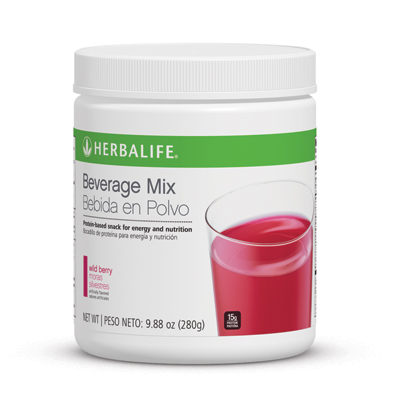
Need protein on the go? Herbalife Beverage Mix kind of tastes like jello and mixes with water for a quick snack midday.

Herbalife Beverage Mix is a great, quick snack for the middle of the day.

MAKE YOUR TREATS HEALTHIER

You won’t feel as guilty about grabbing that cookie if there is protein and fiber in them. When you make mashed potatoes, make it mashed cauliflower. Use stevia root as your sweetener instead of sugar. Crisp up kale or eggplant for your chip snack at night instead of potato.

This is just a small list of things you can do to make your daily consumption better. Something else that will improve your snacking habits? Get rid of the junk food. You’ve seen shows where they toss out everything that’s brown or high in fat. Yes. Do that. Trust me, it’ll be liberating.

Herbalife’s Personalized Protein Powder can be added to foods to increase the protein. Add the Active Fiber Complex as well to really pack a healthy punch.

SET SMALL GOALS THAT ADD UP & TELL THE WORLD

It’s very easy to set really lofty goals for ourselves. When we do that, it is very easy to become disappointed. Set small goals at first: To take your vitamins daily. To get in 20 minutes of cardio per day for 2 weeks. To do 10 push ups a day.

After you set a few goals, declare it to others! Post it on Facebook, Twitter, Tumblr… If you are going on a journey of weight loss, start a blog (like this one!) so that you can keep an updated log of how you’re doing and what you’re doing. Take pictures, log your measurements and it will help keep you on track.

TRACK YOUR CALORIES

There are lots of great ways to track your calorie consumption or burn. I use iChange, and others use MyFitnessPal. There are lots of exercise sites too like Fleetly.com and Nike+. Whatever you want, use it. Not only will it give you a good idea of how much you are (or aren’t) eating, but it will show you your protein intake, fat and calorie burn. Also… you might think twice about that 3rd piece of pie if you know you’re going to have to tell the interwebs about it later.

For more on Herbalife visit my Herbalife Website!