The life and times of Merry Khaos and her alter-ego, Kristie Grey. A romp through the inner workings of a mind in roller derby athletics, training, and business management.
On January 29, 2012 I published this article. It’s funny that the argument is still going. Not only the old school versus new school skaters but the idea that the rules of new school are broken. The argument that if it “ain’t fast it ain’t derby”. Yes the Puget Sound v Your Mom game was an awesome one at MRDA Champs last weekend. However, the more staccato, stronger-yet-sometimes-slow Southern Discomfort against Bridgetown Menace was no less exciting. Anything italicized, ps, is different from the original article, I didn’t want to re-write this. It was popular for a reason the first time around. The photos have also been updated.
So with that I bring you my next reboot:
Old School vs. New School. Strategy vs. Smash ‘n’ Grab. Jammer Line vs. Pivot Line. Booty Block vs. Big Hits. Rules vs. Free Form. Beer & Camaraderie vs. Cross Training & Team Commitment. Sharp, Strong, Stops vs. Fast, Fluid, Sweeping.
These are the dichotomies that have bubbled to the surface of the sub-culture of derby. A generation gap has arisen between the vets of “the good ol’ days” and the skaters of the modern culture.
Since the new revolution of roller derby started (back in 2001), the landscape of the sport has shifted considerably. When it was first gaining momentum, skaters and leagues were looking to the tradition of 1970’s over-the-top antics for inspiration. They had to learn how to play the sport from the only people that had played the sport.
The result was a show of big hits, cages as penalty boxes, personas and spectacle. Game play was spotty during the early years. Leagues were figuring out through trial and error what worked, what did not; what was dangerous and what was just fun. The game was unrefined. Those who were drawn to roller derby wanted to together with friends, to hit things and drink beer. It was not about refining strategy and being at your healthiest. The ultimate goal of roller derby was to have fun, skate really fast and hard, and maybe, be a little bit of show.
WFTDA Derby looked a little different in 2010.
When leagues started (the boom of flat track roller derby really started at the end of 2005), girls who are now legendary did not know how to skate. Everyone was new. Other than the speed, jam or artistic skaters that joined the ranks, few girls were adept at the art and skill of roller skating. Forget putting a sport on top of that! This is what made the game unrefined for a while. Everyone was still learning their balance and stability on eight wheels, so being agile and clean on a grand scale was near impossible.
Times, they are a-changing.
It is common now for leagues to have skaters with six years of experience on wheels. From just that one element, the game has changed. Girls who are now coming into the game must train more seriously in order to compete with the vets who have simply been wheels for years. At a boot camp by the Gotham Girls, Suzy Hotrod stated to skaters: “Yea I can do a lot [on skates]. I’ve been doing it for seven years. If you put up with this sport for that long, you’ll be just as good.”
Suzy Hotrod is a modern legend of derby because of the hard work and dedication she has given to the sport on and off skates. Photo by David Dyte
Most skaters do not want to wait seven years, and they realize that if they cross-train, improve their diet and treat their body like a professional athlete, they will accelerate exponentially. There has been a health revolution! More leagues are partnering with gyms and personal trainers. More skaters are paying attention to their nutrition and workout routine off the track, because they realize it will have a direct impact on their performance during game play.
Lifting. Yes. It’s a thing I do to get better at derby. Deadlifts are awesome for all the things.
Support groups and workout routines focused on derby have emerged. The Roller Derby Workout Challenge ran for three years. The Derbalife Big 5 Challenge has operated several times; both are challenges designed to teach and motivate. Derbalife is skater-centered nutrition that includes skater-to-skater coaching. Learn about Derbalife.
Winning is fun, and the way to win in 2012 (and even more now in 2014!!) is to be strong of body and of mind.
Speaking of ‘mind’, game play and strategy have changed dramatically in the last three years (five years!). Since the inception of W.F.T.D.A., skaters and refs have taken note about what works on the track and what are health hazards. While the rule set that has evolved over the years can be confusing to the untrained reader, it is so because it has developed organically. If an established rule continually gets challenged, interpreted differently at different bouts, or has shown itself to not protect the skaters, it has been changed. One of the best features of the W.F.T.D.A. set up: voting member leagues have been able to shape the sport itself over the years. Modern Note: And for the M.R.D.A. the ability to look through the rules and make any further clarifications or adjustments as their organization feels is needed.
Now, we get to the crux of it. Because skaters have shaped the sport over the years, skaters have been able to control how they want the game to be played. The best leagues are able to look at the rules and understand the implicit meaning behind the rules. Most leagues look at a rule set and understand what it says. The winning leagues are the ones that understand what the rules DO NOT say. From what the rules do not say, a league can exploit the loopholes and skate circles around leagues that do not understand the implicit meanings.
Definition of stop blocks and direction of game play and all rules are determined by the member leagues. It has shaped the game to be what we see now (Rolling Stone R backwards blocking Captain Obvious during the MRDA Championships, a move we did not see [often if at all] pre-2012). Photo by Danny Ngan Photography 2014So, this causes a bigger need to pay attention to detail. In order to compete, every league must understand the new loopholes and strategies being used by the leagues around them. It means watching bout reels. It means watching other bouts. It means extra strategy sessions. It means extra hard training at practice. Those skaters who do more outside of practice to understand the game and new skills and tactics will be the ones most successful in scrimmage, and therefore in bouts.
Five years ago, girls could walk into a league and party. They could practice twice a week, play dirty and laugh about it later because they would still make the all star team. They would still win games. They would still be super stars. No more is it the case. Drinking teams with a derby problem do not exist in the modern world of roller derby: it is an ‘adapt or die’ sport.
What does dedication look like? There’s a reason these 3 teams have gotten medals at champs in 2013 AND 2014. Photo by Danny Ngan Photography
Skaters who do not care about their craft simply do not skate on high level all star teams, and even the smallest leagues are becoming highly competitive. Leagues that do not care about their strategy do not win. When you do not win, you do not have fans. You lose skaters to more serious leagues, your sponsors drop off. You perish.
So are “the good ol’ days” of derby gone? Maybe, but the motto of “Skate hard, turn left” endures. There are still bruises to show off, rink rash to brag about and beers to buy after a hard fought bout. Rivalries still happen, and what happens on the track still stays on the track.
Mass Maelstrom and New York Shock Exchange are known for their rivalry on the east coast. As two of the oldest men’s teams they have seen the changes of derby – and they still play just as hard and fast as ever. (Bill Coulter dances around Chris Szabo in the first round of the MRDA Championships 2014). Photo by Danny Ngan Photography
The game may feel different than it did in 2006, and the training may be far more intense, but it does not make any of it less awesome. Whether beers and brawlin’ or hydration and smarts, roller derby is a uniquely intense sport. The vets should be proud of the foundation and history they created. The current generation should be just as proud of how they have cultivated their craft and shaped modern roller derby.
REBOOT: I’m slowly moving some of my more popular articles from my Examiner.com site over here to WordPress! Some of the photos are from a couple years ago, some of the info may be referencing events from a few years ago, but the info is still awesome and useful! (at least I think so). Every now and again I make a more modern note, but I’ll let you know where I’ve added in. 😉
BUILDING YOU AS A BETTER SKATER
At the Northeast Derby Convention this past weekend, common questions among attendees included: “How did she get so good?” “Has she been skating forever or is she just naturally talented?” “Will I ever be that good at derby?” “How can I improve quickly to an elite level of gameplay?”
As you progress through the lists, thoughts and derbys please remember that the background for all of this should be enjoyment. Drop the ego and HAVE FUN! It’s just f***ing roller derby, and I think we all forget that sometime.
Everyone has a tip to offer, and some of these probably sound familiar. Being in my fourth season, I have been through a lot of ups, downs and across many plateaus. So here is my humble insight.
Photo: ParaNorma of the Susquehanna Valley Derby Vixens has fun during an open skate event hosted by As the Bearing Turns. Photo by Toxic Shock.
Be a goofball on your skates
Step one to getting better is spending time on your skates. Any vet will tell you that. What they may forget to tell you is that it’s not just a matter of skating circles. Getting better on your skates means that you are challenging your balance and your confidence; it means you are pushing yourself to improve.
The easiest way to challenge yourself is simply to goof around when you roller skate! Throw yourself forward and backwards. Hop. Go to open skate or an outdoor rink with your friends and skate backwards, turn, play games. The more comfortable you can get on your skates in odd positions or pulling a balancing act, the better you will be able to control yourself during drills and gameplay.
Photo: The flat track mash-up, Team Rogue, took on MADE skaters in the Derby Ink Tournament in April 2013. We all learned a few things about physics. Photo by JPaden Photography
Play and watch ALL the derby
When I say “ALL the derby” I mean beyond your own scope of derby. Yes, if you’re a WFTDA skater, you should absolutely be eating up WFTDA game play to understand how the mechanics and flow of game and strategy work (also to see how skills are being newly applied to the game). That being said, I cannot express how much I have learned in the last three months because of:
Playing MADE rules on a bank track, watching junior derby, watching men’s flat track, scrimmaging men with MADE rules on the bank track, going to open flat track scrimmages, watching the All Star bout at NEDC.
Being a woman, playing derby with boys really helped me to challenge my own perception of strength and balance. It can be intimidating to go up against a man who is a head higher than you and significantly bigger (and has a bit of a temper, but I still love you Yosemite Slam) AND you’re on a bank track against him… But then you play anyway. Then when you’re on the flat track against another team – they don’t look nearly as scary or intimidating. (Note from today – I feel like I can take on anyone now that I’ve gotten past Sutton Impact and Tink as a jammer at RollerCon.)
You never learn when you’re in your comfort zone. Just like with going to open scrimmages with new people and throwing off your balance at open skate, playing and watching unfamiliar types of derby will teach you techniques and strategy more than you think is possible. Seriously. I love that damn tri-block.
RollerCon has some awesome classes for skaters of all levels.
No. Really. Go to the events and trainings.
The world of roller derby is so much more expansive than it was when I joined in 2009. Back then, we felt lucky to get a guest coach for the night and we all dreamed of having the money to make it out to the only collection of trainings available – Rollercon. The times, they are a-changin’!
Not only are there a ton of boot camps and trainers available (DNA Coaching, Derbalife,Getsome Athletics, Left Turn Coaching among others), but there are more conventions and events than ever! This past weekend the Northeast Derby Convention had a successful second year. Beat Me Halfway promises to be an awesome time, as does the addition of classes at Virginia is for Shovers. And this is just a small piece of the training pie.
Leagues are now able to bring in guest coaches or boot camps whenever they want. Elite leagues also hold camps throughout the year to train and coach skaters. And just because you’re a vet doesn’t mean you can’t benefit. I did a Team USA boot camp last summer next to Holly Go Hardly (most would say she ‘doesn’t need’ training , but there is no perfection in roller derby and some of us always strive for more). At NEDC this weekend, when coaches weren’t coaching – they were in other classes!
Do you know how many friends were geeking out about being in a class with Demanda? Or Punchy? Always strive to be better and take the training when it is available – if it’s not available, seek it out or bring it in!
Photo: DNN may be gone, but DerbyLife and other publications (like mine!) still are around. Photo by Ryan Starr.
Read and absorb
Bout recaps, new skill explanations, boot break-downs. Read it all. Absorb it. Seek it out. Funny memes. Blogs. Discussion groups. The more knowledge you have about derby off the track, the more you can apply to your footage viewing, your live consumption of derby and your own on-the-track game.
Derby News Network, DerbyLife, FiveonFive Magazine, Rollout Magazine, Blood & Thunder, Inside Line, Elektra Q Tion, RollerDerp Tumblr, Khaos Theory and more… they are are all great places to hear about thoughts on derby, derby related life and how derby works itself into other aspects of the world. Go and read some stuff.
Photo: The Dutchland Rollers take on a new physical challenge with theCrossfit Collective
Do that thing you hate
When I joined roller derby I decided that suddenly, I didn’t have to do cardio outside of practice. I thought I could use the occasional weight machine at Planet Fitness – and that would be enough. I avoided anything outside of derby, made faces at it, and was absolutely convinced that I could just skate more and that would be enough.
In 2012 I decided, finally, to become a runner and cross-trainer. And in 2012 I became the derby player I should have been previously.
Cross-training gives your body a chance to develop the muscles and stabilizers that derby doesn’t work on. It doesn’t work on them, but can utilize them. Incorporating strength, interval training, plyo metrics and other sports (I’m a fan of rock climbing and kick boxing myself) will give your body extra balance, strength and endurance that you can use on the track. Show me one elite skater that hasn’t cross-trained.
That’s what I thought. Want to learn more about real crosstraining for derby means? Check out my Shifting Perspective article.
Southern Discomfort gets together to watch footage. I’ve heard that they watch other teams as well as themselves (may have something to do with their quick rise in rankings) Photo by Matthew Sutton
Watch yourself play through footage
Watching yourself can be brutal.
Don’t get me wrong, I know it. Nothing like having a game that you feel awesome about only to watch the footage and think to yourself “Why didn’t I go there? What was that? How come I didn’t do ______” and so on. It’s also very easy to get caught in the trap of “Why didn’t the ref call that?” or “Did you see that terrible call?”
Watching video should not be an exercise in negativity. It should be an exercise in study and analysis. You need to be able to watch what you and your team mates did and deduce what worked and what didn’t. To be able to think about how you could move or position differently in the future. To think about where you are and what you need to work on next.
Visualization after you watch video can really help you incorporate your findings. Take 10 minutes after you watch bout footage (and you can do this with any team’s footage, not just your own!) and play out the scenarios in your head. Imagine your reaction, the quickening of your breath, the sliding of your wheels against the floor. Create the images of what you see and how you feel and what you do next in different situations that you saw in the footage. Imagine yourself conquering the situation and bursting past the blocker, spinning through a wall or blocking a jammer out of bounds. Visualization is an amazing tool to give to your unconscious.
Remember that watching bout footage with your team mates of OTHER bouts is super important too! Not only will it help you talk through the strategy of other teams, but it’s a bonding experience for you to all know derby a little bit better. You can talk about what teams did that work, didn’t work, or what you think you could incorporate into your own blocking or jamming styles. Team derby-time is awesome.
Jerzey Derby Brigade have great scrimmages available once a month. Photo by JPaden Photography
SCRIMMAGE NIGHT!!
We all love scrimmage night. All of us. It’s why we put on our skates and deal with freshmeat training and months of knee fall and hip checking drills. We may say that there are other reasons that we do the roller derby thing – but let’s call a duck a duck. We do it for the PLAY TIME. Taking advantage of your scrimmage team with your team I very important: here you learn how to interact with each other. You build bonds of trust and you learn how to react and rely on each other.
Another important piece of this puzzle is taking advantage of OPEN scrimmage nights that other teams have. Why? At open scrimmages you can learn how to react quickly in new situations. You can learn how to adjust to new floors, new opponents and new obstacles. Also, it’s a great way to make friends in derby and learn how opposing skaters play (could be useful in future games, don’t you think).
Plus, remember why we are part of derby? PLAY TIME!
A zebra pow wow at Spring Roll IV. Photo by Mr. McWheely
Embrace your inner zebra
Wait, what?
Yes. I said it. Go visit another league to get practice at it. Volunteer to help your league if you’re team doesn’t have a bout coming up. Reverse the roles now and again so that you can see the game from a new perspective. Remember, you aren’t learning anything inside your comfort zone.
Not only will you get a new perspective on gameplay, but you’ll have a new found respect for refs. Part of being a ‘better derby skater’ is keeping your cool on the bench during a bout. Not getting riled over penalties will help you keep an even demeanor and a clear head in each jam.
Best way to understand the refs is to put yourself in that spot. I bet you’ll be surprised at how hard it actually is. Aside from that all, you get to give back to the sport that has given you so much. When you’re not skating, help others to skate! Don’t have the attention span for a zebra huddle? The NSOs could use a hand, too.
Goals are your friend
I have found that setting goals is best to do with a buddy. Captains and coaches are preferable, but if you have someone in your league that you trust that you want to go on this journey with, that’s awesome too. Remember that goals should be SMART (specific, measurable, attainable, realistic, time-specific).
To set a goal such as “Block better in the next bout” is a goal that you cannot hope to measure and it’s certainly not specific. Say instead: “Practice blocking techniques 3 times a week for a half hour for the next 4 weeks.” Through the practice of it, you will become sharper and thus, “Block better in your next bout”. It’s a matter of phrasing and giving yourself something to focus on.
For example, the photo is from May of 2012. I had decided that I wanted to be the top scorer for Harrisburg Area Roller Derby against Providence Roller Derby. (In 2010, I had the star taken from me because I couldn’t break their walls. This was redemption year.) Instead of making the above statement my goal, I worked on the strength in my legs, running and plyometrics. The photo is me and Craisy Dukes getting our MVP awards for that bout. And yes, I was top scorer.
Vision boards are awesome too. I’m a big fan of writing down your goals and putting them in places you can see them so that you’re reminded of them daily. Mixing that with positive images and mantras, your goals will crumble under your powerful skates!
Nutrition nutrition nutrition
Nutrition nutrition nutrition
Just like with cross-training, I thought I had my pulse on “good eating”.
Truth be told, 90% of us in derby have no idea what we’re putting in our bodies or why it’s not good for us. Yes you have some folks that are uber informed (I am now) and then others who like making a joke out of their lack of nutrition (go ahead and have that burger and Red Bull, I want to see how many times I can lap you).
I thought my diet of farm food and whole grain was awesome. I couldn’t figure out why, after 2 years of skating, NOTHING happened with my skill level or my body.
Turns out I didn’t know everything.
There are lots of diets, regiments and philosophies that have been coming into the world of roller derby. It was only a matter of time. The health and wellness industry in America alone is a multi-billion dollar one. Some programs are based in science and research, some really are not. I, personally, confine myself to dietary restrictions for performance reasons that I have imposed on MYSELF. We all have different goals, and your program should reflect those goals and desires.
Here’s what I will say about nutrition (and yes this is coming from a Derbalife coach – this is our philosophy):
Protein. 35-40% of your calories should come from protein. If you’re really looking for a quick adjustment to your diet and want to go at things hard? Think of consuming 1g of protein for every pound that you weigh.
Hydration. Half your body weight in ounces. Minimum. Daily. When in doubt, drink a gallon. We’re made of water. How can we function as humans if our cells don’t have water? How can our body flush toxins (like the by-products of lactic acid) if we’re not hydrated? This is just good sense, people. No, you will not be at risk for water overdose. Unless you drink that gallon in a very short period of time.
Vitamins. Guess what? You’d have to eat about 3500 calories of fruit and vegetable to get your recommended daily amount of the 65 vitamins and minerals the body needs for function. Now couple that with the fact that your body needs it throughout the day (it flushes vitamins it can’t absorb at the time), so that one-a-day you’ve been taking is mostly ending up in the sewer line. Oh yea, if you’ve been eating poorly for the last X number of years, it means your body isn’t even able to capture all the vitamins you put into it because, chances are, the good bacteria in your body isn’t healthy. Vitamins need to happen 3x a day MINIMUM in a dose of about 30% of your RDA.
Metabolism. Keep the furnace going throughout the day. You should be eating small meals 4 to 8 times a day (depending on your size and activity level). When you go 5 hours without eating it means the metabolism shuts off. Vitamins aren’t being distributed. Protein isn’t being used. Calories aren’t being burned. No good at all.
Quick burning carb are bad if you’re trying to lose fat. Complex carbs are good – like in vegetables, sweet potatoes and quinoa. Quick burning carbs like bread (yes, even stone ground, whole grain), pasta and corn spike your blood sugar and turn to fat in your body more often than are burned off. That being said, in sports like roller derby, it doesn’t hurt to have a little extra padding. If you’re weight lifting or doing lots of activity, don’t be afraid of adding in carbs.
Look, if you want to talk nutrition more (Derbalife or not) send me an e-mail at DerbyAmerica@yahoo.com. It’s kind of what I do when I’m not writing things like this.
Cutandjacked.com
Have an amazing mindset!
The biggest piece of the derby puzzle is confidence.
If you do not believe in yourself, then you are never going to be successful. I’m sorry if that is harsh, but I have seen too many people self-sabotage because of their own self-doubt or because of toxic influences coming from their personal life.
You are good enough to play this sport. Every single woman, man and child can be as successful and strong as they want to be. It just is a matter of time, effort and having the mindset to go along with it. You are not going to be Suzy Hotrod overnight. It takes a combination of all the things listed here (and more) to get you to that level. It takes years of dedication and focus. If you want it to come quicker, you have to work harder.
If you quit the moment you get tired, or your feet hurt or you sweat … guess what? Your league has plenty of Non-Skating Official positions that are ready for you to help with. Everyone has a different gauge on accomplishment and everyone has a different bar they want to conquer. What commitment is really necessary for you to hit yours? Take a hard, honest look at what you are doing now.
Take a good, honest look with how you handle situations. Do you invite negativity into your life? Do you spend more time complaining about the stuff that happened or looking forward to the way you’re going to overcome it? Do you have the attitude of “This will make a great story one day!” or “Why do bad things always happen to me?”
In life and in derby, the cancer of negativity will kill your hope, drive and spirit. You must be diligent to be a happier person with a positive outlook. Maybe you can’t do a 180 toe stop. Do you say “I try really hard but I can’t do it.” Or do you say, “I’m going to work on it UNTIL I can do it.” That’s the difference. That’s the key.
Need a help with this part of the puzzle? Personal development readings, audios and videos are amazing for your mind. May I suggest some Les Brown, Jim Rohn or Eric Thompson? May I suggest TED Talks? Reading books likeThe Slight Edge and The Big Leap.
Believe in yourself the same amount your coaches do and you will do amazing things.
Two time MRDA champion, Your Mom Men’s Roller Derby is a collection of some of the most talented skaters in the world who also just happen to be phenomenal at roller derby. Disclaimer: I talk about roller derby pretty real at a couple points in this blog. This is not meant to make anyone #butthurt (as Elektra Q Tion would say), but if a blog about derby can’t say it, who can?
Your Mom is known for fast skating, and intense walls. When you watch them, they are not hard hitters – they don’t have to be. Their non-verbal communication and self-awareness is so sharp that if they rarely have to hit opponents to contain them. Their work is smooth and effortless. Hits are not short strikes, but rather elongated motion that carries the intended target out of bounds, or drives the target behind the blocker’s hips. Edges, edges, edges. Study it. Their bursts. Their control. Their awareness.
Against Mass Maelstrom at Spring Roll. Photo by DeFord Designs
Your Mom knows what you’re going to do before you know what you’re going to do. They aim for where you’re going, not where you are, and they rarely have to catch the jammer, because the jammer is so commonly ensnared in their net.
How do you know that their blockers are interchangeable and their rosters fluid beyond measure? Think about this: Who are their big hitters and which jammer has the best differential? Sure, Seahorses Forever and Sugar Boots stand out because of their height. Yes, everyone knows Frank NotsoHotra. Otherwise it is hard to picture any skaters that are exceedingly more important than the others. On every other team you can look at a line up and pick out ‘key pieces’. Sure, every team SAYS they don’t have any players that are more important than the rest, but we all know that’s not true.
Close the gap. Photo by DeFord Designs
Double Excel. Magnum PIMP. Jonathan R. Szabo. Dilly Dally. Speed Dealer. Cozmo Damage. Shreddy Mercury. Richard Gaudet. Wes Turn. Sutton Impact. Reaper. Keith Rucker. TJ Binkley. Are these the only players that matter on their teams? Absolutely not! Do you want to beat that their teams would be a tad concerned about overall performance if one or both of these skaters were missing from the line up? Yes, I honestly think so.
On Your Mom they don’t have to worry about it as much. No Cleveland Stever? You’ve Dirty Larry. No Tony Muse? You got Dante Muse. No B Stang? You got Rollomite. No Sugar Boots? You’ve got Seahorses Forever. No Lily Pad? You’ve got Suicide Snow Cone. You getting the idea? There is no one on the roster that Your Mom can’t respond to with a “But we’ve got these 5 people that CAN do it”. And they have up and coming skaters that they’re training so that the tradition of winning continues.
Frank Notsohotra – commonly referred to as “The fastest man in roller derby.” Photo by DeFord Designs
“But Khaos!” You say, “You can’t really appreciate Your Mom.” (giggle) “They fly in all their skaters!”
Untrue.
There are 3 remote skaters that I know of. And by “remote” I mean living more than 3 hours away. And even if there were more, so what? Charm City, Philly, and Tampa Bay Men’s (for example) all have skaters that travel upwards of 3 hours to play with their teams. Those skaters could play for Charlottesville, or Suburbia, or Brevard Area Men’s, but they have chosen a different league and has made a commitment to the league of their choice. It is a hobby, we don’t get paid, so why should anyone feel that they are not allowed to play with the league of their choice? Why do we not hear about the skaters that travel across state lines to be a part of PRG or CCRG or TBMRD?
Because they’re not world champions.
As soon as a team starts winning division titles (Oly) or champs (YMMRD), suddenly it’s an issue. Jack Hammer’d lives in South Carolina (everyone in the MRDA knows that he moved, so I’m not exactly revealing a scandal). He is here with Maelstrom this weekend. Why? Because he fulfilled the attendance requirements set forth by his league, and thus qualified to play at Champs with Mass Maelstrom. Here is your tiny bit of beeswax so that you can mind your own.
And guess what? We saw from the WFTDA championships in previous years that sheer talent doesn’t win titles, teamwork, and practice time does. Your Mom Men’s Roller Derby has teamwork, communication, and ‘synergy’ (that’s for you, Austintatious). That doesn’t come from a bunch of people randomly showing up on bout day and not ever practicing with one another.
Positional control. Photo by DeFord Designs
This weekend is going to be tough for teams to oust Your Mom as champions. Many of the men on the roster are very accustomed to a sticky hardwood floor like that of the Tacoma Armory. Several of the skaters were GLOWING at the opportunity to play Champs on such a surface.
Every team that faces Your Mom is going to have to bring the strongest walls, the ability to multitask, awareness like woah, and the endurance of a Champion.
Check out YOUR MOM (giggle) on Facebook to get continually information about them. They play Denton County Outlaws in the opening bout of the tournament at 9a PST on Saturday. Yes. That means in about 9 hours. Get some rest, and if you’re not in Tacoma check it out on WFTDA.tv! Thank you DeFord Designs for all the photos in this article. Hey Photogs! YMMRD needs more pictures taken of them next year. #JustSayin #BloggerinNeed
The GateKeeper defense are the thing nightmares are made of. Like the 2000 Baltimore Ravens of eggball, the GK have line-ups of monsters that have one objective: Ruin your jammer’s day [and do it as a team].
Another old dog of the MRDA, GK has been growing since Magnum PIMP and Bat Wing decided to form the league in 2009. With over 50 active members, the GateKeepers (and their highly competitive B team the B-Keepers) strive to bring a balance of speed, communication, airtime, and pure pain to the roller derby track.
This season, GK appeared at Spring Roll and RollerCon. From an outside perspective, ti seemed that they approached these two events with one goal: Establish unquestionable dominance over every team they meet. And, for the most part, they did.
Gnat King Kill getting it done at Spring Roll against Southern Discomfort.
If you’ve ever seen GK play than you know that they rely on super strong blockers who are huge AND have amazing lateral motion across the track. Coming up against a wall of Monster Jam, Double Excel, and Neil Death Experience is a terrifying prospect [and I am not even skating this weekend]. Not only does each take up the entire track by themselves, but they know how to seal holes to prevent jammer breakthroughs and their timing is all excellent.
Mixing in blockers like Bane-Ana, Debaucherous Prime, and Gnat King Kill into lines help to keep the GK diamonds fluid and fast. These are the blockers that can dart out of a pack and pick off a stray jammer or destroy an opponent’s brace to give Shane Bower some space to run.
“The Totes Adorb” Bane-Ana and Wrecking Bill team up to hold Jonathan R at RollerCon. Photo by Brangwyn Jones.
In every article I have talked about teamwork. The GateKeepers exemplify what it means to have teamwork. What it means to understand how your allies on the floor skate, and how to pick apart an opponent as a two or three wall, instead of as an individual. BUT if the time comes where an individual needs to make a quick save, they know who is bridging, who is chasing, who is baiting the pack to speed up, and how to recycle back to that massive concrete wall.
The only time the GateKeepers get in trouble is when they start landing in the box. Yes, obvious statement, but true nonetheless. I don’t have the stats packs to prove my point, but I remember GK getting into some penalty trouble against Shock Exchange, and that’s when NYSE starting getting a little more ahead. When they finally took hold of the NYSE game is when they calmed down, worked as a wolf pack, and ate the NYSE jammers and blockers alive [while NYSE let them at least].
Flight. By Screecharound. Photo by Mr. McWheeley
The jammers of GK are not to be forgotten because they are majestic to watch. Remember how I said that they mix in ‘airtime’ to their strategy? These guys eat apexes for breakfast. In fact, if we can have a contest this weekend to have Screecharound from GK and Reaper from Southern Discomfort have a head-to-head ‘jump off’ battle, I’d really appreciate it. (Ironic note: It wasn’t until after I was coming back through and editing that I realized that Screecharound is #66 and Reaper is #666. Obviously there’s a connection.)
While Screecharound and Shane Bower both have the long, beautiful legs that allow them to take flight each bout [without effort]. Both skaters are able to switch up between long, loping strides and the small, controlled edgework to fake out opponents.
Shane Bower has a little more experience under his belt, and you can see it when he comes up against stronger walls. He’s deft at playing offense for himself by simply shifting his weight as he approaches a pack and trying out different spots in a wall until someone over commits and he can easily glide through. He seems to find holes in defenses unperceivable to the human eye on the physical plane.
Magnum P.I.M.P. hops another apex at Spring Roll. Photo by Mr. McWheely
Then there is GateKeeper founder, Magnum P.I.M.P. Magnum is to be feared with the star. He is strong, he is light on his feet, and he has a head for the game. He understands his blockers, and how they move on the track. His offense understands him and can create the smallest distraction for him to take full advantage of. He is definitely a utility jammer.
In the first round the GateKeepers will be coming up against a relatively green Southern Discomfort. While the men from England are ready to make a statement, they are going to have to pull out all the stops and have a stellar game to make a dent in the GateKeeper strategy. GK’s jamming bench is deep and wide, and their blocker rotation is so versatile that the SD jammers are going to have to continually readjust to the styles thrown at them. Do I think So Disco could come out with a surprise for the GateKeepers? Absolutely.
Neil tells Ballistic Whistle: “You Shall Not Pass”. Photo by Mr. McWheely
“But Khaos! The Gatekeepers already beat So Disco by 200 points this year!”
True. However, look at the circumstances: SD played GK the last game of Spring Roll in Fort Wayne, Indiana. The GateKeepers had a 6 hour drive to the venue, and had only played two other games that weekend. Southern Discomfort was 6 hours out of their normal time zone, and had already played six games in the previous 8 days (including games against Mass Maelstrom and Your Mom). So Disco did not come into that bout as they will come into this one: Fresh, studied, and hungry.
However, there is still the fact that they’ll be facing off against the St. Louis GateKeepers who are on a mission for Your Mom.
You know your quiet friend? That one that hangs out, but doesn’t say too much, but just when you start wondering why they haven’t spoken they say something hilarious that reminds you why you are friends. Weird comparison maybe, but this is how I feel about Bridgetown Menace. You’re never sure what they’ve been up to, or if they’ll be able to handle the bout you’re about to watch. And then when they step onto the track, you’re reminded: “Holy sh*t, these guys don’t f**k around.” I also think, “Wow. Look at those beards.”
I first saw Bridgetown play at Spring Roll 2013, and fell in love with their hard hitting style of smash ‘em up roller derby. Every Menace player skates like they’re 6’2” and 220 pounds of pure muscle and agility. They made a very good showing at Champs last year, muscling through opponents and letting Shreddy Mercury dance around the opposition. You could tell their wall work needed some time, and that there were some overall trust issues on the floor that did not play to their advantage against Puget in the 5th place game.
Unleashing the power of the beards. Photo by Brangwyn Jones.
Fast forward to RollerCon.
I was super stoked to see Bridgetown play live again. I am a fan, it’s absolutely true. Cozmo Damage is a monster blocker who always seems to be one step ahead of the jammer, Juke Blocks Hero is a force of reckoning in a pack, and Don Juan the Devaskater is just pure fun to watch with his power-jam skating maneuvers (he and No Big Deal of Maelstrom have a very similar strength-jam style).
What I had noticed in their bouts against the GateKeepers and NYSE is that their teamwork and trust has increased unbelievably since the last time I saw them play. They always had good teamwork, but they actually seemed to move as one unit in their fluid diamonds. Also, I was reminded of HOW HARD AND FAST AND SHARP every skater on the team is. Her-man Munster said of Menace’s experience at RC:
Having a packed audience of people who are all derby literate is the best live experience you could ask for. It’s awesome knowing that the RC volunteers are turning people away at the door because they can’t fit any more people in that room. It was a good thing for men’s derby because so many people got to witness some really competitive match ups. It was a good opportunity for people who might not normally watch men’s bouts to see how great it can be at a high level. Playing against the #2 and #3 teams as the #6 team is a win-win situation. We have nothing to lose there, and get a chance to see where we fall against the best teams. It’s a bonus that we get to play against people that we like. It was great to feel where we excelled and nice to have St Louis exploit a weakness with a couple months to fix it. The timing of those competitive bouts were invaluable in preparing for Champs.
Putting on the defense at RollerCon. Photo by Brangwyn Jones
For me. jammer Elysium made a huge impression with his maneuverability and endurance in both bouts. He was able to crack walls and twist around the super-strength of the GateKeepers. Rob Lobster, who had only recently returned to derby, looked like he hadn’t been out on injury at all (much less something draining like chemotherapy). His non-verbal communication and trust in his teammates meant that when a wall had him in it, the opposing jammers had to work much harder. Side note: Rob’s actually receiving chemo treatment THIS WEEK, and will still play at Champs this weekend. For more info on all of that, please go and join the #TeamLobster Facebook group and then visit Left Turn Clothing to order Team Lobster shirts.
Cosmo Damage makes himself even bigger to stop NYSE. Photo by Brangwyn Jones.
The first round of Championships finds Bridgetown facing an old friend: Puget Sound Outcast Derby. Like NYSE and Maelstrom on the east coast, Menace and the Outcasts have found themselves toeing up several times a season for a few years. This year these two met at the Big O and at the Rat’s Nest, after having finished the season 2013 in the battle for 5th place at MRDA Championships.
So far, the Outcasts have come out victorious in each battle, but their margin of win is diminishing. At champs in Sioux City, Menace lost by 35 points. At the Big O, they lost by 21 points. At the Rat’s Nest in August, Menace lost by TWO POINTS.
Bendy Jamming. Photo by Brangwyn Jones.
Bridgetown Menace is hungry. Many of their skaters have only been playing derby for two or three years, so each time they come out to play, they learn more about themselves and their teammates. Each time they face off against a stronger opponent, they leave the other team gasping for air and showing off new bruises. This time at Champs, we could see the little brother finally win. For new fans of men’s derby, or if you haven’t seen the team play before, Munster says there are some you should look out for:
Shreddy Mercury is the first. He’s absolutely one of the best jammers in Roller Derby. I believe Cozmo Damage has elevated to an all-American blocking level. He has some of the best blocking technique in men’s derby. Sam Miller of course is always so fun to watch. He has a style unlike anybody else, and makes our team very dynamic.Some other fan favorites are Juke Blocks Hero and Demolition Man. So much charisma there. However, the real star of our team is our teamwork. If there is any reason to be a fan of Menace, it is the way we play together. I think we have the strongest team-play among the top teams.
Cozmo Damage. Photo by Masonite Burn.
Check out the Bridgetown Menace facebook to keep up to date with them, and to request to buy some of the merch that they are (apparently) going to be selling hella cheap this weekend at Champs!! If you’re not going to be at the Tacoma Armory for the event, make sure you tune into WFTDA.tv at 3p PST to watch the epic battle between Bridgetown and Puget Sound!
The Boys from Boston are coming in with something to prove, and there is nothing more dangerous than a group of committed individuals that feel a bit slighted.
Mass Maelstrom is coming to champs in a lower seed than they may have anticipated, and two places lower than how they finished out last year’s championship despite only suffering losses to Your Mom’s Men’s Roller Derby and New York Shock Exchange this season. Coach Rich Gaudet (also known as Stryker) says that Maelstrom is coming into champs:
“To prove that we were robbed of our 4th place ranking going into championships and to get our new skaters playing against the best in the MRDA.”
Maelstrom is no stranger to fighting for recognition. They started off as part of a co-ed league and split off in 2010 to do their own thing. Stryker says it was through hard work and dedication of the core of the team that Maelstrom was able to debut at #10 in the MRDA in 2012 and break into the Champs seeding the same year by landing at #8. While other teams are chuck full of experienced skaters, that isn’t the case with Maelstrom:
“Maelstrom’s strength is directly related to both our ability to play as a team on the track and to implement and counter the most current winning strategies on the track. Since maelstrom is one of the smallest competitive teams (stature/size wise), and because many of us did not come from skating backgrounds our style of game play is directly tied to that: we play in tight walls and use game play strategy to make up for our lack of bulk and skating skill. Although we have some stand out skaters who can dominate a jammer on their own, most of the time we contain jammers behind a solid wall of small guys.”
Maelstrom isn’t all little guys. Bill Coulter is pretty infamous for making a statement on the track. Photo from ECDX 2014. By Tyler Shaw – Prints Charming Derby Photography
When you compare the stature of Mass against most MRDA teams – they do look generally small. Critical pack directors Terry Hasselmann (Peter Rottentail), R Pickering (Smiteochondria), and Mars Travolta are average height (at best) and certainly not hefty – they rely on deftness of movement to even the odds against opposing jammers. Overall, a fluid diamond formation or “around the world” style of play is very present in the Maelstrom blocking strategy, in order to give every blocker the best chance of leveraging their body weight against bigger opponents. Jammers like Cilantro and No Big Deal are not breaking any height barriers either. NBD uses brute force and quick, hammering edges to break packs wide open while John Collentro (Cilantro) falls back on pure acrobatics to obtain lead jammer (The kid is made of silly putty, I swear).
Wes Turn (Conlin) uses his edge to block during the Mohawk Valley Cup. Photo by Hispanic Attack.
Ok, side note: you’re probably wondering why I’m using up your valueable time with making you read multiple names for all these guys. There was actually a bit of confusion during Champs last year for those streaming the Maelstrom bouts. The rosters were submitted with derby names, but [most of] the jerseys have real names on the back. Viewers at home weren’t sure which skater the announcers were talking about based on jerseys, and the announcers even confused themselves during their commentary.
Why the real names? Some of the guys are just done with derby names (I know a certain bunny who is particularly done with cheek of the fake names), while others see it as a way of really claiming the work they put into their skating and into their league. They are all very proud of what they do with Maelstrom and with smaller leagues in the greater Boston area; using their real names brings them a sense of professionalism and ownership for their accomplishments.
Alright, I’m back from the tangent.
2014 has been the season of ‘injures and real life’ for the Vikings of New England.
Terry Hasselmann usually blocks, but every now and again he gets to wear the star when the team needs him. Photo from Mohawk Valley Cup. Photo by Hispanic Attack
Everything from a car accident kept two heavy rotation blockers out of the first half of their ECDX bout, to a series of key skaters getting injured, to a few skaters simply tipping their hat and taking a leave. It is roller derby. This is a contact sport, and injures happen. It is a hobby, and sometimes people must bow out for personal reasons. That does not mean that the team gives up, the deeper a bench, the more effective a team can be, even in a time of struggle. Gaudet commented on Maelstrom’s roster changes:
“Since we sustained injuries to half our roster over the course of this season our newest skaters had to step up and fill some big shoes, which they have done with flying colors. We have picked up two strong hockey skaters that are helping to round out our jammer rotation; all we need now is to get them some more skate time.”
The acrobatics of Jurasskick Park as captured at ECDX by Tyler Shaw – Prints Charming.
Maelstrom’s first bout of Championships is against an old, familiar face: New York Shock Exchange. This will be the second year in a row that Maelstrom will face NYSE a total of 3 times [in 5 months]. Last year, their final match-up of the season was at the Mohawk Valley Cup, in the finals, and Maelstrom took the win by 20 points after having lost the previous two match-ups.
The first round of Champs could prove a similar Cinderella story. At ECDX and Mohawk Valley this year, NYSE proved too dominant for the Vikings. Despite not having a “full strength” roster, Mass does not consider themselves out of the competition. With two bouts against NYSE under their belt, and with the return of Coulter and Pickering to their bench, Maelstrom is restored to much of it’s 2013 strength. Both vet and newbies to the roster are ready for the classic rivalry match-up in the first round.
Vet Colleran holds onto returning skater Deep in Cider, while Velawesomeraptor and Mikeopathic Chiller hold the inside line. Mohawk Valley Cup. Photo by Hispanic Attack 2014.
Fans (and NYSE) will be get to see new and old faces on the roster this weekend, including Deep in Cider who has returned to the Maelstrom line. Aside from the vets, you should keep an eye out for fresh faces Cormier and Velawesomeraptor as well as those who have worked their way up from the Bzerker B-Team such as the agile Mikeopathic Chiller and power blocker JBeast. Gaudet says of the team:
“Every one of skaters that step onto the track is a critical piece of our strategy puzzle, and thus [new fans] should be watching the overall cogs that make up the Maelstrom machine.”
Mars Travolta, Colleran, and Keith Webb work in unison to hold back NYSE at ECDX. Photo by Tyler Shaw – Prints Charming Derby Photography
If you love Vikings and want to pick up merch, get info on upcoming clinics, or just to follow their season, you should definitely check out their Facebook page. Also, Mass Maelstrom has some wicked rewards going on right now on the MAELSTROM GOFUNDME so … Go Fund Them!! And make sure you tune into WFTDA.tv all weekend to watch the 2014 MRDA Championships. Thank you to Tyler Shaw and Hispanic Attack for the photos used in this article.
As a side note, Richard Gaudet would like you all to know that:
“No big deal is actually kind of a big deal.”
No Big Deal takes the outside lane at the championship bout of Mohawk Valley Cup. Photo by Hispanic Attack.
How the hell do you run practices when your league has practicing membership from Level CobraSnake to Level NewbornFoal? THIS is the biggest question asked across the world by coaching committees in roller derby right now. How can we keep our vet skaters challenged and satisfied with the training process [so they don’t transfer out] while bringing new skaters up [quickly] to a level to be able to play with those vets?
I had such a huge response to the blog I posted two days ago, about League Rebuilding that I wanted to make sure that my blog about training the leagues that are rebuilding went up quick!
There are fundamental corners to The House that Derby Built: Skills, Teamwork, Strategy, and Health. Without one of the corners, the house will not fall, but it will lean a little funny. Without two of the corners, you don’t have much of a house.
TESTING THE FOUNDATION
First you need to understand where your league is at with each of these fundamental pillars. The first step is to take an honest look at where each skater is individually and as a league. For Skills and Health you can actually do measurable tests to help you with your mapping process.
Set up a practice to set benchmarks and test skills, and I would recommend asking coaches from nearby leagues to come in and help with the ranking process, since the will be more impartial in the process. Create a list of skills (crossovers, one foot glides, lateral motion, hip checks while moving, jumping, counter blocking, 180 toe stops, blocking to the line, etc) and have them ratable 1-10. Move your way through drills, as you would when doing a certification, but make sure you have more advanced skills on the list than a strict certification process.
For Health, you simply create a list of ‘events’ like a football combine. You can test squat strength, bench strength, 100 yard dash, 400 yard dash easily. You can create short ‘obstacle courses’ and time each player through it while rating their cuts, bursts of speed, jumping, and footwork. You can do one foot balance, long jumps, pull-ups, or anything else you think would be applicable to strength and endurance needed for derby.
Once you have your 1-10 data points you can put them into a spreadsheet and simply create a point chart! Boom. You now know where people are. This is not to make anyone feel bad. This is simply a way to benchmark individuals so that the training staff can develop upcoming practices and make recommendations about cross-training. This information is also a great starting point for goal setting! Part of setting goals is that they have to be MEASURABLE. With benchmarks in hand, captains can meet with skaters to create a real list of SMART goals for the skater to focus on in upcoming months.
To benchmark Teamwork and Strategy is harder. Teamwork, though very easy to see the presence (or lack of) teamwork, it is not easy to quantify. You may want to ask those coaches to come and observe your team in a scrimmage against another league to rate overall Teamwork and Strategy. When you map, you will not be mapping for your team, but you will be mapping for groups of skaters, or the team as a whole.
Things to rate from 1-10 in Teamwork could be: Proximity of skaters, holding lanes, communication, mobility of walls, awareness, recycling, and protecting edges.
Things to rate in strategy could be: Offense, O to D/D to O switch speed, Bridging, Jam line start, power jam defense, preventing recycling. Watch some bouts and make notes of how to describe strategy and teamwork and create your list to test (use the words and ideas that I listed as your example).
CREATING THE PLAN
After you map the data, you can analyze it with your training staff. You’ll be able to see weaknesses very easily. Data doesn’t lie. Create the charts however your brain can deal with the data. After playing around a bit, I decided that I like the bar graph, since I can see distinct lines across. I just made up a mock chart for an example (I picked derby names at random, I didn’t actually rate people on things).
From looking at the chart, you can see that some people have strengths, and some have extreme weaknesses. You do not want to use those as your focus. You want to teach to the median weaknesses. Note: This does not mean ignore the strengths, it just means you now know where to focus more of your training energy. Looking at this chart, I immediately notice that NO ONE has even a 7 on narrow plows. Next thing I see is that while we have a few people strong at left foot plows, the rest are not, and no one is strong at right foot plows.
If you have a team that is primarily new skaters, and you are noticing that in the corners of your house, the median score is 1-5 in most areas, than grade on the curve. So you can’t look at the data and go, “Oh man, there are only a couple 7s. WE MUST FOCUS ON EVERYTHING.” Right, ok, so, bring the top grade to 7 and look at the skills from there. If 7 is the top and you’re noticing some skills have more 4/5s and others have more 2/3s, focus on the 2/3s.
You do this with all four of your pillars. Identify your team’s overall weaknesses.
THE EXCUSES
“But we have too many new skaters to do this!” No. No such thing. If your skaters can’t complete skills they get a 1 on the scale. That’s it. Everyone can run, lift, jump on sneakers.
“But we don’t have any place to do the off skates benchmarks!” Really? You know that? I just suggested it and you’re already coming up with an excuse to not do it? Have you called the gyms in your area and asked about it? Tell them what you want to do. Offer them advertisement in exchange for use of their gym to do benchmarks. They can be the “Official Combine Location of the Blankety Blank Roller Vixens”. Local, privately owned gyms or franchises are the best place to start. You may want to approach CrossFit gyms about it, because they’ll usually have sprinting space too, and some of those coaches have experience in combines.
“But we already spend so much time at derby, we don’t have the time for this! We know how our skaters are, can’t we just use what we know?” Cancel practice for a week and do this. If you want to improve and you’re serious about focusing your training program, you need to know what you’re working with and you need to have an OBJECTIVE view of where you are starting. Without data, provided with the help of people who don’t know you from Adam, all you are doing is continuing old habits. Your current training is based on what you think you know about your skaters. Chances are your advanced skaters are not advanced. Chances are your fresh meat have skills you didn’t realize.
“But we’re not Gotham or Bay Area. We don’t need to train like a D1 WFTDA team.” Well I will respond with a Vince Lombardi quote:
“If it doesn’t matter who wins or loses, then why do they keep score?” You don’t have to be a D1 team to want to be successful or to train to be successful.
What it comes down to is that this is new, and new is scary. What it also comes down to is exposure. Exposure is scary. Skaters (especially self-proclaimed ‘vets’ and those who like to pop into practice when convenient) do not like being told that they need to improve at something, or that the ‘lowly fresh meat’ is actually better than them at a skill. This is not about belittlement. This is about recognition and understanding. Without it, you cannot move forward.
DON’T FEAR TO START AT THE START
If you have to grade on the curve, and you have noticed that you have that moment of “We have to work on everything”, then step one is take it back to the beginning. Begin training the TRUE fundamentals for individuals and teamwork: The mechanics of roller skating & speed skating New derby position (tailbone tucked, feet shoulder width)
Toe stop & duck runs
Holding a lane
Skating without using your arms or looking at the floor
Skating in a pack
Pace lines & Speed control
Lateral motion/Laterals using edges & leading with your knees Carves (short and long)
Narrow & One foot Plows
Stopping with edges
Making a wall
Moving as a wall
Anatomy of hitting Sticky blocking
Transitions both directions
Communication & awareness while in motion
This is the start. These are the building blocks. You cannot do a box drill if skaters don’t know how to control their speed and skate close to other people. You cannot do a weaving pace line if your team doesn’t know how to do a basic pace line. This is your first check list. And honestly? I probably missed things. (I have walked away from this list and come back to it several times.)
Old derby position (l) – Butt out, weight middle of the feet/heels; New derby position (r) – back straight, tailbone tucked, feet hip to shoulder width apart You won’t be as low in new derby position, but you have more mobility from this position, and a stronger stance for blocking and walls
“But my vets will be bored!” No, they won’t be. In any drill that involves team play, the vets should be focused on helping their team mates cover lanes, maintain position, and work on speed change. The vets need to be the coaches through the drills with the new skaters. For any individual skill, the vets need to be focused on cleaning up their own abilities. Encourage the vets to work on precision, quickness, reaction, depth of skill, and visualizing they’re in a game situation.
Your vets can plow? They should work on plowing narrower, sharper, stopping quicker, keeping their hips more square, their back stronger, and their head up and looking around while doing it. Your vets ‘know how to roller skate’? Encourage them to make their stride deeper, lengthen their pushes, and focus on breathe work and mental tricks as they go around the track that they can access during game play to calm themselves.
***THERE IS NO PERFECTION IN ROLLER DERBY***
Every skater needs to review and practice these fundamentals. These building blocks are not things to check off a list and never visit again. I recommend revisiting these fundamentals often, even after every skater on your crew can rank at an 8+ with them.
NOTE: Every skater is responsible for their own progress and should be empowered by their team and coaching to take responsibility for practicing fundamentals on their own time as well as whatever happens in practice. Just like with the health section at the end of the blog, it is not the coach’s responsibility to mother each skater to make sure they are keeping sharp on their skills on their own time.
DO NOT COACH DOWN
Just because you are working on fundamentals, it does not mean that you need to treat your skaters like 5 year olds, or offer them drills that do not challenge them. Create drills that push your new skaters. Do not assume that because they are fresh, that means they are incapable. Keep your pace lines challenging. Do not skip a drill that works on something that needs to be addressed because someone thinks the fresh meat won’t be able to do it.
When Mystery Violence Theatre came to HARD she couldn’t stand on her skates. Through coaching confidence & her own hard work, she now skates for Gotham’s Wall Street Traitors & Bronx Gridlock. Photo by David Dyte
You do not get better unless there is a challenge. Making drills JUST above the median level or intensity will push your largest faction of skaters. Dotting in more advanced drills or more basic drills, will keep everyone confident and working hard.
For example:
Let’s say you are working on edgework! You can start with carving long and slow and then short and sharp. Time these for about three minutes, with all skaters moving around the track.
Next, put dummy blockers around the track, facing proper derby direction, near the inside and outside lines. Have them stand NEAR the line, but with some space. Have your skaters carve between the blockers and the line, showing their back to the blocker as they go through (they’ll have to twist their body). After everyone has done it for a few laps, have the dummies take an extra step away from the line, and have skaters get by them by bursting past with a 3 step duck run (which utilizes edges).
For newer skaters, put bodies about as far away as the green cone. For the more advanced skaters, go with the red.
Then put obstacles in the track – one in the middle of each straightaway, one at either end (trashcans or chairs work great). Have skaters rolling and approaching the object, then bursting around the object with the 3 step duck run. They can challenge themselves to get as close to the object (without touching it) as they can before they burst around it.
After this, bring the practice back down by practicing lateral motion, leading with the knees, from line to line across the track. You have started with something very basic, upped the intensity a few times, and then brought it back down to a lower intensity, more precision-based drill.
So the moral of the story is – don’t think that your new skaters can’t do it just because it’s harder. You can always offer ways to adjust a drill harder and softer to accommodate for all skaters.
MIXING LEVELS IN PACKS
“Do we have levels mix together in drills?” Yes and no. I will define who skaters should get with as we progress through a coaching plan. This is something that the coaches need to decide. I will say “vets with tots” or “Get with someone of your skill level” or “find someone on your home team” to define who I want them to work with.
You may want to rotate skater partners too, so that way the newer skaters get the advantage of in-drill coaching. Don’t be afraid to spend a longer amount of time on drills and skills. You do not have to rush through practicing; it’s through repetition, repetition that our bodies learn. It takes 5000 SUCCESSFUL repetitions to establish muscle memory. Let them practice in mixed levels, then switch them to equal levels to allow themselves to push and challenge each other.
LESS IS MORE
Less talking, less complication, less spending of energy: in roller derby, less is more.
Do not spend 30 minutes talking about a drill. Do not spend 30 minutes arguing about a better way to do the drill. Do not allow other skaters to try to bully the coach into doing the drill a different way. Explain the drill, demonstrate, try it, observe it, correct misconceptions, do it again, observe it, tell everyone what you’re noticing, do it again, bring everyone to the center, talk about what you observed, take quick questions, move on.
Do not think that you have to bring drills to practice that have 15 steps. Simplification is critical. One piece at a time, and build your blocks. Practice your one foot plows/chomps. Then practice stopping in a two wall. Then practice stopping in a three wall. The practice stopping a jammer in the three wall. Then practice stopping a jammer in the three wall, and having the wall step in front of the person blocking. Build.
Do not think you have to be good at every strategy. Vince Lombardi is one of the most decorated NFL coaches of all time not because his Green Bay Packers could do ALL the plays. It was because they did a handful of plays SO WELL that no one could defeat them. By keeping things more concise, you will give your skater tots less to learn (less overwhelming), meaning they’ll be able to advance quicker and get to the level of working with the vets and having everyone be successful.
Teamwork, communication, being on the same page, and focus. Less is more.
3 FAVORITE PRACTICE THINGS FOR ALL LEVELS
Boxes: Everyone is in a tight box, on the whistle the box completes an action. You can either pick actions before the drill starts, or coach can shout the action before the whistle. Actions can be: rotate right, rotate left, inside line, outside line, hop, front to back, back to front, make a wall, make a line, make a box, speed up, slow down, 180 stop, etc etc etc. Start basic. Work up from there.
Double Pace Lines: Especially if your league needs some long endurance work, double pace lines can be beneficial to teach speed control, footwork, skating proximity, and awareness. You can have individuals weave, teams weave and lead, teams race, individuals block, teams weave and hit between the pace line, and more.
Games: Soccer (use an empty water jug instead of a ball), dodgeball, tag, and more! Get your team distracted from what they are doing by making them do something that isn’t roller derby. It’s amazing how the footwork, stops, awareness, avoidance, cuts, spins, toe stops, and communication improve after just one session. Plus – it’s really really fun!
So that “health” corner of the house? Here’s the tough thing: You cannot make people do anything outside of practice time. If a skater wants to live on McDonalds and potato chips and watch 5 hours of television on their non-practice nights, that is their prerogative. Doing the benchmark combine may be the shock some people need to start developing some outside healthy habits, but you cannot count on that (You would think being winded after a lap and dreading the 27 in 5 would be enough motivation, but not everyone motivates the same).
YOU CANNOT WANT IT FOR THEM.
You can give all the Braveheart speeches you want, but each person makes their own decision of what to do with their body. If you are a decided rec team, what you can do is make recommendations as a training committee of how people can train for roller derby outside of practice. If this blog hasn’t tired you out completely, check out my SHIFTING PERSPECTIVE blog about training for our sport.
Some leagues I have come in contact with have an ‘extra practice’ that they must complete each week on their own – it’s a set of workouts that they can do at home or in a gym. More serious leagues (or leagues that want to become more serious) are requiring their all-stars to have gym memberships (these leagues usually also have some kind of agreement with their local gym for discounted rates). In the future, some may require a level of baseline fitness in order to qualify for all-star rosters.
Every league is different. Do not be afraid to adopt these health requirements for your league, simply because it is unprecedented in your area. Do not be afraid to not adopt such policies because you do not believe it would be right for your league. Either way, it’s a discussion that the league as a whole may want to have.
My first league was not a D1 level of play, but it was understood that we did NOT drink alcohol the week of a bout.
Nutrition is as critical a part of fitness as the weight lifting, yoga, land drills, sprints, etc. As a Derbalife coach, I spend a lot of time simply teaching skaters what is and is not good fuel for the body. Creating a voluntary fitness challenge with rewards within your league could be a great way to get your skaters to do something good for them (and their skating) without the league instating rules and policies. It can be something people ELECT to do.
I guarantee the people who lift weights and do extra conditioning work outside of practice will, in the long run, excel past those who do not.
PROTEIN! HYDRATION! VITAMINS! EATING BEFORE PRACTICE! EATING PROTEIN AFTER PRACTICE! CUTTING DOWN ON SUGAR! These are things that can play a huge role in a skater’s success on the track.
CONCLUSION
Wow you’re still here? Well done!! I hope I have addressed your questions, concerns, and issues at least a little bit. This is a difficult problem for a league to have.
If your league is looking for bodies all the time, then you will continually have to rotate in fresh skaters into your tots. It’s imperative that you develop a new skater check list for each player to practice and complete and be tested on before they make their way onto the track with the vets. This way you can be sure that each player that is introduced to your team have spent time building up each corner of their house before they mix it up with more advanced skaters.
Remember that you are not the only league going through this training process. Pick goals, plan out your trainings a few weeks at a time, keep communication open, and evaluate and adjust after each chunk of training plans.
Skate hard, skate fast, be excellent to each other and do it for THE LOVE OF DERBY!!
Like me, Merry Khaos, on Facebook! Like DNA Coaching on Facebook! Want me to come out to your league to help with this stuff? Need nutrition and fitness help for you or your league? Drop me a line at DerbyAmerica@gmail.com and let’s chat about Derbalife.
I know my friends within the Mid-Atlantic Region have been antsy for this list, so I’m going to publish this one first. The Mid-Atlantic included any Maryland/DC/Delaware teams. All voting was based on where the skater PLAYED, not where they LIVED. As long as they played as an active member of a team from the region in that season (regardless of rule set) they were eligible for vote.
I am writing from the perspective of 2013, keep in mind! Most of the people on these lists have had pretty incredible seasons thus far as well. With all of these articles, remember – maybe not everyone gets a picture. Sorry. You have no idea how much time it takes to find photos for 60 skaters that are 1) good and 2) from a photographer I have permission to credit. ❤ PS THANK YOU ALL PHOTOGS FOR THE HARD WORK YOU DO!!! You are awesome, we love you, and I highly suggest that everyone who reads these articles check out the photogs listed [and buy things from them].
RESERVES:
Serious Snowflake – Salisbury Roller Girls
Long of leg and strong of hip, Snowflake uses muscle to get by her opponents. She’s not afraid to jump an apex, but often you’ll just see her push right through a blocker (sometimes with a pirouette just to be sure she gets by). Snowflake is one of those skaters that brightens a bench; always excited to learn and play more. She got a chance to try out the bank track on the East Coast Outlaws this season versus the Penn Jersey Hooligans, and her skills have earned her a spot on the Maryland All-Stars.
Uvetta Work – Charm City Roller Girls
This woman is terrifyingly gorgeous on the track. I love watching her be a rock in front of jammers and when she jams for her home team I can’t help but giggle (and be glad I’m not the one bouncing off of her). She is a critical, dominant piece of the Charm City blocking core.
T – Free State Roller Derby
You’ve gotta be good to have your derby name be just a letter. Almost pixie-like in her jamming, T is around you before you realize she was there to begin with. The apex is nothing more than a small obstacle to jump over for her, and before you know it, she’s back around the track and taking your point.
O’Chit (Rebecca Simon) – Charm City Roller Girls
Power. That is Chit. Watch her hit someone. Chit has mastered a bursting pop that will take girls off their skates. Her control with her edges is amazing and her positional blocking is nothing short of pure intimidation. Watching her jam is fun simply because of the amount of strength she can put into her wheels to cut back and forth and through walls. It’s no wonder she’s a member of the Maryland All-Stars.
ALTERNATES:
Jackie Treehorn – Free State Roller Derby
Standing 6’Forever on her skates, Jackie is still considerably new to the sport of roller derby. The amazing thing about Jackie is not her ability to take up half the track or her booty blocking – it’s her adaptability and her eagerness to learn. She is a Maryland All-Star who once was top heavy with blocking, but no longer relies on her shoulders for strength. She understands that her hips are where the magic happens, and is a rock in any wall.
Thee Mighty Isis – Mason-Dixon Roller Vixens
Isis makes an impression whenever she is on the floor. Like Treehorn, Isis commands attention in a wall and is a leader on the floor. Far more agile than teams will give her credit for (before the bout), she is able to recycle through packs to punish jammers. With the star she is a battering ram who also can roll off of hips and duck past opponents. She is a secret weapon in the Maryland All-Star arsenal.
Isis and Treehorn work together on Team Maryland Photo by Keyesboard
ROSTER:
13. Warren T Voider – Harm City Havoc
Still relatively new to the sport, Warren is a key jammer in the Havoc roster. While other jammers on his team rely on pure agility, Warren is able to jam like a blocker to get through heavy walls. His footwork is just as good, and as a blocker, he is starting to become a real leader in the pivot position.
Photo by Jason Walter
12. Battery Operated – Charm City Roller Girls
“Bops” (as she is known to her team mates) has been an important player in the All-Star line-up and to her home team, The Modtown Mods. As a blocker, she is a leader on the floor, a strong piece of wall work, and has the feet to always be waiting for a jammer at the front of the pack. She is also a wonderful team mate – serious and pointed when the time calls for it. Joking and laughing when given the opportunity.
On the Mobtown Mods.
Photo by Tyler Shaw
11. Dual Hitizen – DC Rollergirls
Dual is another skater who can blend into the crowd sometimes, because she is so good at her job when she’s blocking that you don’t notice her. The jammer just can’t get through. When she jams, she doesn’t even do anything too magical. She simply gets by you. No no, don’t worry it’s not you. It’s her. She’s magic that way.
10. Sin Diesel – Harm City Havoc
This man has been around for a while; he was one of the founders of MDC, Harm City, and has coached for several women’s teams (including Team Maryland). He has always been strong in blocking, and quick footed with the star. Being a member of the Cinderella Team Argentina at the MRDWC leveled him up. Before he was a part of the pack, but now you can see him play as a pack member. Regardless of the experience of his pack, he no longer takes all the responsibility onto himself, but rather directs and trusts those around him. Harm City has benefitted from Sin’s experience and leadership far beyond what I can express in a short paragraph. He looks like a new skater. It’s really awesome to watch.
Sin Diesel Photo by Down N Out Photography
9. Susy Pow – Charm City Roller Girls
A member of Team Australia, Susy Pow made her way onto Charm City All-Stars easily with fast feet and agility in her blocking. She made the biggest splash when CCRG made their way to Salem, OR and used Susy as a primary jammer. Susy’s jamming style is unusual: she is light and fluid when she takes a hit, but extremely solid when attacking a wall. She also jumps apexes like it’s her job. Maybe it is! In Salem, she jammed 41 times over the three games. Her lead jammer average was 61%, and she scored 146 points during the tournament.
Susy Pow isn’t concerned about blockers. Photo by Tyler Shaw
8. Frightmare (Stephanie Griffith) – DC Rollergirls
I love Frightmare: hilarious off the track, aggressive as hell on the track. She doesn’t care who you are, she’s getting past you. And you’ll just have to learn to live with it. When she pivots, she commands her pack. When she hits, she is able to nail those little nerve spots with her hips and shoulders; she is able to stop the blockers that look like they should blow her up. I love Frightmare.
Frightmare Photo by Tyler Shaw
7. Lady Quebeum – Charm City Roller Girls
(It’s pronounced ‘Kaboom’) Here is another skater that makes me happy to be on the track. “LQ” has been around CCRG for a long time, and the all-stars have utilized her long legs and head for strategy effectively. She is able to keep skaters focused on the track, and is amazing at following direction from others. Her leadership on Team Maryland helped the skaters grow as a unit quickly. CCRG is happy to have her back on her wheels too – at the end of last season she suffered a tib/fib fracture. Cleared to skate again, her tenacity will surely get her back on the All-Stars quickly.
6. Truth Hurtz – Harm City Havoc
Feet of fury and will of fire: this is Truth Hurtz. A critical piece of the Havoc jamming crew, but powerful in a blocker position, Truth’s footwork is blinding. He is able to squeeze through cracks in the wall you didn’t know were there and can outrace opponents on the outside line all day. He’s menacing at his least, he’s impossible to handle when in his groove.
Truth Hurtz Photo by Mr McWheeley
5. Buster Skull – Salisbury Rollergirls
If you’ve read my writing about Buster Skull in the past than it’s no secret that I am a fan. Buster is absolutely tenacious on the track, whether blocking or jamming. Her work as a blocker within the pack has evolved significantly over the years; now she is able to trade blows with the biggest skaters without flinching. When she jams, she fearlessly attacks walls and has an ability to break packs without looking like she’s putting in much effort.
Buster Skull Photo by Jim Rhoades
4. Hittsburgh – Charm City Roller Girls
Have you ever been hit by truck? If you would like to be, Hitts can provide that experience for you! Solid on the track, her can-openers can easily put the opposition on their ass. Backwards or forwards, getting by her with the star is challenge, her mobility is top-notch, partially because she is excellent at working within pairs and diamonds. Her blocking has also been super useful to the ranks of Team Maryland. When she wears the star…well… she likes the edges. It doesn’t matter if I tell you that though: she’ll still able to tip toe past you.
3.Nuckin Futz – Charm City Roller Girls
The woman is made of vapor (very, very quick vapor). A student of herself, Futz was able to study her own patterns and make huge leaps in 2013 in her jamming. The Salem WFTDA Divisional playoff had no idea what it was in for when she stepped to the line. She found the smallest crevices in walls, patiently waited for her blockers to create a little chaos, and juked behind teams of blockers so quick that they weren’t sure where her hips even were (much less know where she was going). You want to study a jammer who can be lighting quick to the side and then stretch her stride long out of the pack? Go study some Nuckin Futz.
Nuckin Futz doesn’t worry about blockers. Photo by Tyler Shaw
2. IM Pain – Charm City Roller Girls
Co-Captain of the All Stars, Pain is known for her strength in jamming and effortless ability to rack up points. With a background in speed skating, it’s no wonder that she can outrun most of the blockers she comes against, and has extra-sensory vision for the inside line that reveals holes that the rest of us mere mortals cannot perceive. I watch her and wonder how she gets through packs sometimes. She makes everything look effortless. When faced with injury at the end of the season, Pain shifted her leadership role to one off track. Her persistence and dedication also earned her a spot on Team Maryland.
IM Pain helps Holly Go Hardly on Team Maryland. Photo by Side Track StudiosIM Pain has no time for blockers. Photo by Tyler Shaw
1. Holly Go Hardly – Charm City Roller Girls
Not everyone understands Holly’s level of dedication, drive, and determination of the 2013 CCRG co-captain. Holly is an absolute monster blocker on the track; I have never met someone who can hold her balance in such awkwardly appropriate ways while still being completely effective against opponents. When her walls are as strong as her, she is solid block that doesn’t move. When her team is not as experienced, she can arrange blockers into walls, and direct and brace as the game progresses. Her body awareness also allows her to use her hips in ways that many people have not figured out yet. She is able to make herself long across the track as she drags opponents to an edge, or knocks them out of bounds with a bursting, backwards strike. Now again she puts on the star, usually for funsies, and she spins and maneuvers around blockers; always when they think they have her in their trap.
Holly is never afraid to push herself to failure. She falls. She’s struggles. She improves. She never goes 50%. She never backs down. Yes she can be a little intense and overwhelming when you’re in a high stress situation, but yes, I admit it: I may have a bit of a derby crush on Holly Go Hardly. And I’m super stoked that I got to play with her on Team Maryland.
Holly Go Hardly uses her assest, Hittsburgh is coming up to help. Photo by Tyler Shaw
Backwards blocking is this thing she does VERY well. Photo by Tyler Shaw
Living in a house with powerlifters and bodybuilders, and going to a ‘sweat on the walls’ gym has opened my eyes about training in the last eight months. Not just training for personal gains, but the way roller derby, as a sport trains itself on the track and off. There have been many conversations breaking down the conventions of training in roller derby, and comparing to the conventions of other sports.
Along with rhetoric, I have seen my own progress jump dramatically since beginning a 5×5 powerlifting scheme. I was able to track a noticeable difference in a new league from January (first practices) to May (home team champs), and for me the proof is in the pudding.
Me powering past Allie B Back – a thing I could not do when I came to Charm City. Photos by Tyler Shaw – Prints Charming
We are a new sport. We’re still trying to figure out how to play the game, much less how to train for it. I’ve noticed some habits and some structure about our training process that is not helping us improve ourselves and will not help the sport as we pass it on to our daughters and sons. I wanted to share some things, quickly, that I have been pondering. I’ll be doing expanded writings and I am restructuring the training book I was writing to reflect these new insights.
I think I’m going to get a lot of finger waving at the end of this article. We, as a community, have not be super stoked to hear that we may need to change things. We certainly don’t like hearing that there are ways outside of our league to look at training, business, or the basics of derby. Trust me. I have seen the wrath of derby girls faced with change. However, here I go again, putting my ‘radical’ ideas out there. Feel free to post at the bottom how much you disagree with everything. 😀
Background
When looking at our history, I believe the protocol of training today is largely based on what the women of 2008-2010 did for their own training. Stick with me on this one: This is when the sport started to boom. Suddenly, women of all ages and skills were coming into a rapidly evolving sport. At this time, the average age of the derby skater was PROBABLY between 28-32 years old.
Many of these women had never played a sport before; their way to train to improve was to simply skate more (and that definitely has to be considered in a training plan when you have no experience on roller skates). Some of us caught on that we needed better fitness in order to compete with the women who already had a few years jump on us. This led many of skaters to begin using that derby buzz word: Cross training.
Most of us didn’t know what cross training really meant, or how to approach off skates training for roller derby. So this misconstrued system of Insanity training, land drills, and long distance running started cropping up as part of our system of preparation for bouts.
Myself and Trixie Twelvegauge were the first at HARD to hit the workout bandwagon. She was doing P90X, I hitting weight machines and cardio at the gym.
This brings up my first point:
We need to stop training for fitness
Most of the derby skaters I meet do their ‘cross training’ in the form of high fitness workouts (CrossFit WoDs 4x a week, P90X, elliptical training, Zumba, hours of yoga). Ok, before you get angry let me explain where I’m coming from:
If you are skating 3 times a week at practice, and then going to the gym and doing 2-4 days a week of high cardio work, you are really just burning muscle (and some fat) and [if you’re eating right] getting cut muscles. To look cut is rad, but does not help your explosive power or your recovery from one burst of power in a jam to the next (and it certainly does not help when you get slammed by that 200# blocker looking to take your legs out). Elliptical training does not help prevent bone injury. P90X won’t help you break a wall.
Training like you’re trying to lose the Freshman Forty is not the way you should train for roller derby to be successful in the long term. Training in a way that is purely fun or aligns with your social conventions does not make you better at any sport. These workouts that we’re talking about should be done as secondary conditioning and accessory work. They should not be your primary source of training off skates.
From my instagram in 2012: “Woke up early. Was slightly dehydrated from drinking last night. Went running anyway. Goal: Patrick Aitforce Base. There and back: 9.67 mi. One hour, 55 minutes. No one thought I’d do it.” Though impressive .. WHY DID I FEEL THE NEED TO RUN 10 MI FOR DERBY TRAINING?
We need to redefine ‘beauty’ within our sport
Oh yea, roller derby loves say that “every shape is beautiful.” Our at home ‘lose weight’ training mentality shows that we are more generally more concerned with 6 pack abs and long, lean limbs than any of us realize. We are fighting the conventions of beauty, especially those of us over 30; we get easily concerned with the myth of a slowing metabolism and how our younger team mates, or the folks at the pool of ECDX will view us. We are more concerned with society’s vision of beauty than we are with what it means to be strong and at low risk for injury in a contact sport (ie having some cushion and mass).
And it’s not just women. Men are not safe from these social norms of beauty and sex, and I have many friends that end up questioning themselves over it, regardless of their strength or abilities.
At RollerCon, there was a very short challenge bout with shirtless men: Magic Mike v Chippendales. On social media sites, admittedly, I was part of the sexist storm of commenters. (One, it’s fun. Two, men in our sport is still pretty new. As a derby-obsessed, straight, single woman of not as many years – it’s nice to be able to turn the male gaze away from the sexy derby girls in fishnets and pigtails and put the female gaze on the shirtless men sweating and hitting each other.)
Side note: I was just excited to see an all-male challenge bout. The shirt off thing was just an added bonus.
The men of Magic Mike and Chippendales (and there was about $1000 raised for charity too!) Photo by Jill “Jilljitsu” Dickens 2014
Leading up to it, I had several men contact me asking if there was any way to adjust their fitness or nutrition to get better abs in the couple weeks leading up to RC. (I had to disappoint them and say, “unless you want to do some drastic changes and not drink before the bout, there’s no magic pill to shed all the fat in a week”) After the bout, I was asked a question by a skater who is arguably one of the top 5 male skaters in the world: “Did I look gross out there? You know, with my shirt off.”
**Mouth Gaping Open**
First of all – do you know who you are? Are you sure? Secondly, yes, you look great! (I was trying NOT to look too much, actually. I know many women who did NOT restrain themselves.) I wanted to yell at him: “You may not have the photoshop-crafted abs of an Ambercrombie ad, but that’s ok. Know why? DO YOU KNOW WHO YOU ARE?” Seriously! That bout was sexy in every way, but mostly because highly skilled men were playing roller derby. They could have been playing in parkas and it would have been an amazing bout (though you’d probably have to burn the parkas afterwards due to all the sweat).
The men of Magic Mike v Chippendales – all shapes, sizes, but all beautiful and skilled. Photo by Jill “Jilljitsu” Dickens
We need to release the ideals of Western beauty and embrace the awesome of each of us. If you’re skinny: fantastic! If you’re not: fantastic! If you’re jacked naturally: great! If you have skinny arms: that’s cool! Now let’s lift some heavy shit, flip some tires, put on our skates, and hit each other without worrying about being judged by our team mates about our body.
I have written about this before. It’s a struggle for me big time. I’m single in a growingly co-ed sport. I also powerlift. I am trying to be highly competitive at roller derby. I had the internal conflict months before RollerCon: do I want to look awesome in my bathing suit, or do I want to be able to get past Tink on the track?
There was a moment where I thought to myself, “Oh wait.. it is hella sexy to be able to get past Tink on the track. So, in theory, if I accomplish THAT, I will look AMAZING in my two piece, because it’ll be ME.” (At least that’s what I keep telling myself)
When I really think about it, beauty conventions vs training modes may be our biggest adversary.
Also, friends don’t care what friends look like in bathing suits. Right, Icewolf?
We need to start training for a contact sport
No football player is doing 5000 burpees to prep for the season. No rugby player is only doing yoga to prepare for the pitch. No hockey player is trying to cut to a ridiculous body fat percentage mid-season. Roller derby is a brutal, physical sport. We need our training to reflect that physicality and hardness.
A CONDITIONING day at CrossFit is awesome. Remember that time the smallest team kicked everyone’s ass in tire flips? I do. Joc and I did 115 of the 154 on our own. BOOM.
Like any other sport, there are a variety of pieces to the training puzzle. I am not implying that anyone should cut their WoDs, or their yoga, or their P90X completely. To be successful, the incorporation of weight training and conditioning must be included in our system of norms as the primary ‘cross training’ piece, with the other stuff as accessory work. We need to train for strength, not weight loss.
Side note: Many skaters come in, as I had said, with no athletic background. Many come in overweight and out of shape. For many skaters, fat loss does need to be a part of their training consideration. Too much weight in a roller sport means extra strain on knees and hips, and the higher probability of injury. However, let’s not get obsessed with getting from 23% body fat to 19% body fat [like I was].
Was I proud of my 135# runner body? Yes! Could I survive a hit? NO.
“The improvement of performance in athletics over the past few years has been phenomenal. For example, twenty years ago the average football lineman weighed 250 pounds and ran a 5.2-second 40-yard dash. This was considered to be nearing the genetic limit for a player. Now running backs that weigh what the lineman used to weigh are running 4.4-second 40-yard dashes! Strength training has made the single, most positive contribution to this type of improvement. Today strength training influences every athletic program in the country, no matter what the sport – male or female. Athletes now find it necessary to lift weights and participate in conditioning programs to better prepare themselves for the competitive rigors of the athletic season.
Just a short time ago, most coaches thought that strength training would cause athletes to become muscle-bound and would be counterproductive to good technique. Now it has been proven that athletic performance depends either directly or indirectly on qualities of muscular strength. We must remember that strength builds the foundation for ALL other athletic qualities. For example, if you do not possess great relative body strength (strength in relation to your body weight), you will never be able to run fast. This is due to the fact that all aspects of proper running technique require high levels of muscular strength. In other words, if you can’t achieve the proper knee drive, arm swing, posture and push-off, you can’t be fast.” (DeFranco)
You call it extreme, I call it “what it feels like 185# on my back”
Let’s be real honest here: Weight training isn’t fun. It’s fun when it’s over. It’s fun when you successfully lock out twice your body weight on deadlift the first time. It is fun when your friends tell you that your arms are awesome (Your derby friends will say this, of course. Your lifter friends will comment about the improvement, but will never imply that you are at the pinnacle of your journey). Not every hockey player likes to lift weights, but they do it because it is necessary for improvement. Every player of every competitive sport lifts weights because it is necessary.
“But Khaos! We’re on roller skates. Look at how successful all the speed skaters are in our game. They don’t lift weights. If we just spend more time on our skates, we’ll be successful.”
“Weight training for speed skaters is not all that different from what you see in other athlete strength programs. The key for skaters is to build up strong legs and core. They also put quite a bit of emphasis on balance.As for the legs, squats of several varieties are important, as are leg extensions and hamstring curls (and so much more). The upper body work is also important and typically includes a tremendous amount of midline work. It is typical to see these athletes utilize some basic strength programming including supersets and dropsets in different capacities and arrangements.” Read the whole article here (it’s got a lot of good training tips in it!!) (Chasey)
Also, can I make a note that the top men’s team in the world, Your Mom, does not spend all THAT much time on their skates? They don’t have to train their skaters how to do crossovers, they can do that on their own time (and I’m talking the none speed skaters too, folks). And Gotham? They have weights in their warehouse so they can make weight training part of the weekly program. The focus is more on the strategy, the training, the understanding of the game than it is on using practice time to go over 360 turns.
We need to properly warm-up and cool down for practice time
A 2 minute dynamic stretch is not enough to get our bodies primed for the hell we put it through on roller skates. We are not teaching our new skaters how properly warm up before activity and subjecting all of us to the probability of injury. On the other side, it is rare that I have been a part of a practice of any league that has a proper cool down.
Full Commando is disappointed at your lack of cool down.
When I was with Harrisburg Area Roller Derby, we had an amazing volunteer who was dubbed Full Commando. He was our Yogi. At the end of each practice, we would spend 15 minutes doing yoga designed to bring down our heart rate, stretch us out, prep us for bed (Harrisburg practices ended at 11:30p), and prevented future injury. When our sister-in-arms, Stella Stitc’Her broke just above her ankle, she had minimal ligament damage. She told us that the doctor had attributed to the flexibility developed through skating and yoga at the end of practice.
We need to understand that sometimes, less is more
I came from the P90X-obsessed mentality of “If I’m not wasted at the end of my workout than it wasn’t a good workout”. I have come to learn that you can put in excellent work, and an appropriate amount of excellent, hard, teeth-grinding work … and sometimes you feel like you have more to give at the end of the workout. And that’s ok. In theory, everyone should be running a specific program (do what the numbers on the sheet tell you – don’t make it up as you go). Programs are designed for certain things on certain days. Deload weeks in weight training may be boring, but they allow your body to rest so that you can perform stronger the following week.
This also touches on the subject of CrossFit. Those of us who have done work in a CF box may have the thought ingrained that you have to go until failure. True progress does not [always] require that. Look, imam just leave this editorial (written by a certified CrossFit coach) RIGHT HERE about the “keep going” culture created in CF gyms. There should be pain and struggle and a question as to whether you’ll finish your rep, but having been lifting for a while now – that last set of 10 pause squats feels SIGNIFICANTLY different than that last 5 minutes of “Super” Angie.
The CF mentality. While kind of funny, and kind of motivational, when you look at the core: it’s scary. You’re EXPECTED to pass out. There is a difference between pushing to limits and pushing to unsafe measures. PS I know not all CFs encourage that culture. But a lot do.
If I didn’t get enough people riled with that section, let’s see if I can stir the pot with:
We need to restructure our season
And in turn, how our rankings are created. Have you ever encountered any sport where athletes train 11 months out of the year?
Roller derby athletes do not have the benefit of the pre-season/season/post-season/off-season structure that other sports have firmly in place, that determine their intensity and type of training. Derby is forced to ignore the season and mash all of their training, as best as possible, into each week of the year.
Strictly home team players are the only ones that [seem] to get any kind of break from gameplay, but it is the travel team skaters that you want to be fresh. January through June is when most travel teams smush most of their game play into, right?
But now with the new WFTDA rankings, more all-star teams are pushing their seasons later into the fall to be sure they maximize the equation in place currently. Plus, if you do make a divisional tournament, your now have an extra 3 game week of intense play put onto the end of your season [a month or two later]. If you make champs, you again have another intense weekend ahead. If you play on a home team (which most leagues require of their travel teams), then you have extra competitions layered into your already intense season.
2014 WFTDA Divisional Post-Season Photo by the WFTDA
Men are running into this too. The MRDA ranking system is still shaking out its bugs, and as of right now the majority of rankings come from the January – June season. However, July and August are the months where you get your final shot to break that Top 8 for champs. There are teams playing tournaments into these months for a shot to increase their rank. Then? They won’t play until October.
From what I understand, USARS has a similar schedule for their championships. Oh, which some flat track teams have been participating in. Add one more piece of your season in. Then there are also the extra tournaments…
The last couple years we have another element to think about: mash-up teams. All-Star mash-up games and tournaments are being placed in the only off season that organizers can find: the winter. This means that players on your top tier are never resting. Their only chance for a recovery period is if they actually injure themselves.
Battle of the All-Stars. State Wars. World Cup. All extra tournaments played by top tier athletes on non-ranked teams.
This is a real problem. This is seriously going to hinder our sport from achieving maximum levels of top competition. We are destroying our athletes. This needs to seriously be taken into consideration. We are the only sport I have found where ranking competition can (and does) take place in any month of the year.
Recently, I took a couple weeks off to start to heal up my ankle. I skated a scrimmage here or there, but really nothing major. I was concerned about getting to RollerCon and having no idea what I was doing. They say you lose it a bit as you stay away from the sport. You know what actually happened? 7 out 9 bouts I felt on top of my game like never before. Coincidence? Maybe. Rested? Definitely.
SUBTOPIC: Rest is cool
In general, derby doesn’t like to rest. #NoRest. But recovery in your weekly routine is critical for healing, progress, and injury prevention. Teams that play a 4 game event on Saturday/Sunday and then turn up for practice on Monday BECAUSE IT’S REQUIRED are at a greater risk for injury. Your muscles need to a chance to rebuild after a game. Teams really need to look at their practice schedule and include ‘deload’ time before a game (like not scrimmaging), and recovery time right after a game (like canceling practice or doing a couple days of non-contact, lighter skills, and team work basics).
We need to stop encouraging a culture where unhealthy eating is cool
That’s great that you got cheese fries and a beer after practice. It won’t help you recover. That’s awesome that you’re taunting your friend who is drinking her shake for the first time that you’re eating a burger while they’re trying to limit saturated fat. You’re making her feel bad for a healthy decision just because you don’t want to make it.
Not everyone is going to be into eating like an athlete, and I understand that. But can we please stop this culture of “Doesn’t bending over for a cupcake count as a squat?” No. It doesn’t. It’s fine that you don’t want to be at the peak of your game, but don’t mock others for their athletic nutrition. And if you do mock? Don’t be offended when they lap you during cardio, start getting more play time on the team, or transfer to a better league because the current league has encouraged the bully culture.
The sad thing is that it’s usually our friends making the jokes. They think their being funny. It’s not funny.
One more thing to make me unpopular… our AFTER PARTIES. Can we please talk about not encouraging our athletes to drink copious amounts of alcohol, while providing fried bits of vegetable-like substances, and dinner rolls? Can we talk about an after party that is for the fans, not for the athletes so much? You can try and tell me (and yourself) all you want that beer is a fine post recovery drink, but guess what? It isn’t. Plain. Simple. It doesn’t count. Here’s a short read for you.
Final thoughts
Ok, this blog ended up being WAY longer than intended, but I needed to start putting these things out to the universe. I feel very strongly about starting this health and strength revolution, and I’m glad to know I do have some other people on my side. For our sport to get to the next level of athleticism, and to be one step closer to professional play, we must take a hard look at our training: How it is structured, why it is structured that way, the culture that supports/negates it, and our behavior to our fellow skaters. We need to put these things on the table within each league so that, one by one, we can revolutionize roller derby for the betterment of the sport and our athletes.
Strong, unafraid to have guns, eating healthy, lifting weights. Watch out WFTDA.
My name is Merry Khaos, I am a member of DNA Coaching and a health and wellness coach with Derbalife. We are currently booking boot camps for the next 15 months. Send me an e-mail at DerbyAmerica@gmail.com to get the ball rolling on having us come to your league. Want to incorporate a “how to train for roller derby” day? Let’s do it! I am also available to help you piece together a nutrition plan and training schedule so you can smash through your goals. Let’s work hard together!
I hear this all the time as a health coach with Derbalife. It’s what we do. We help people ‘get better’ at roller derby. I spend a lot of time thinking and researching what that really means to each individual person who contacts me. A 200lb female is going to have different challenges than a 135lb male in the sport.
Static Shock of the Carolina Wreckingballs has very different goals than Hittsburg of Charm City Roller Girls; each must train (and eat) appropriately. Photos by ShutHerUp and Tyler Shaw
I’m going to do a series of blogs about how to “get better at roller derby” off the track, and I’m going to do my best to include science (or at least link science articles for you to read up on and try and translate the jargon).
Training for any sport is not simple. If you decide to compete in a marathon, you may think, “Oh, I’ll just run!” but there are different philosophies, different styles of running, different techniques to prepare for the marathon.
Charm City White Star RoadRunner knows that training for distance running takes more than just mileage.
With contact sports, you must train your long endurance, short endurance, capacity for large muscle power, stability and strength in tiny ligaments and minor muscle groups, coordination, sensory reaction, mental power and cognitive understand, and the recovery time from constant impact. “Oh, is that all, Khaos?” No, it is not all. Within each individual piece are an infinite number or focuses you can take. So I like focusing on a few things at a time.
Themes of upcoming blogs:
Can’t Knock Me Down (Balance and Core Strength)
Big Power (Power lifting and large muscle group leg strength)
Feet like Hands (Busting power, acceleration, and agility)
Hands like Feet (Training and using your upper body)
Skittles Don’t Count (Pre- and Post-Workout Nutrition)
The Forrest Gump of Roller Derby (Long endurance training)
So I Had a Bad Practice (Mental recovery and forgiveness)
If Only I Had Better Wheels (Overcoming fear and mental blocks in training)
Wait it’s that Thing! (Mental understanding of the game and translation to muscle movement)
The Mighty Ducks Approach (How to prep your body for impact)
Again! Again! (How to train multiple times a day safely)
Gallons and Gallons (Hydration and the importance of water to the body)
Micro and Macro and Phyto, Oh My! (Nutrients, Minerals and more)
If you have any other themes that you’d like to see me research and write about, please do comment and let me know! Also, if anyone would like to see these turned into Rollercon classes or seminars – let me know if I should submit. I’m always looking for cool things to teach that are inspired by blogs. I figured I’d list them out here so that I know what I’m writing about in the upcoming weeks! I need to plan out and put it out there, otherwise I lose focus sometimes.
Remember, every person has different thoughts, opinions, and techniques for training and improving. I hope to offer up some information from within the community of roller derby. The information will be useful for many sport disciplines, but hopefully these blogs will help us all get a little more awesome in upcoming months.
Stopping power, bursting power, agility, quick thinking and pure strength all exist in this ONE SHOT of two power house all star teams. Photo by Tyler Shaw

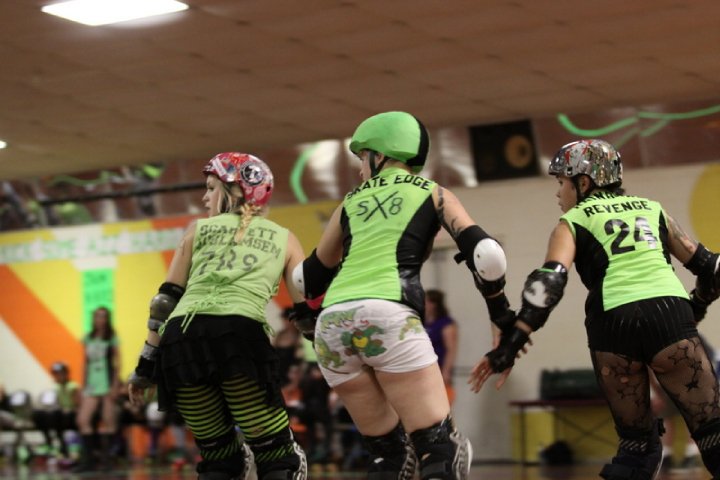

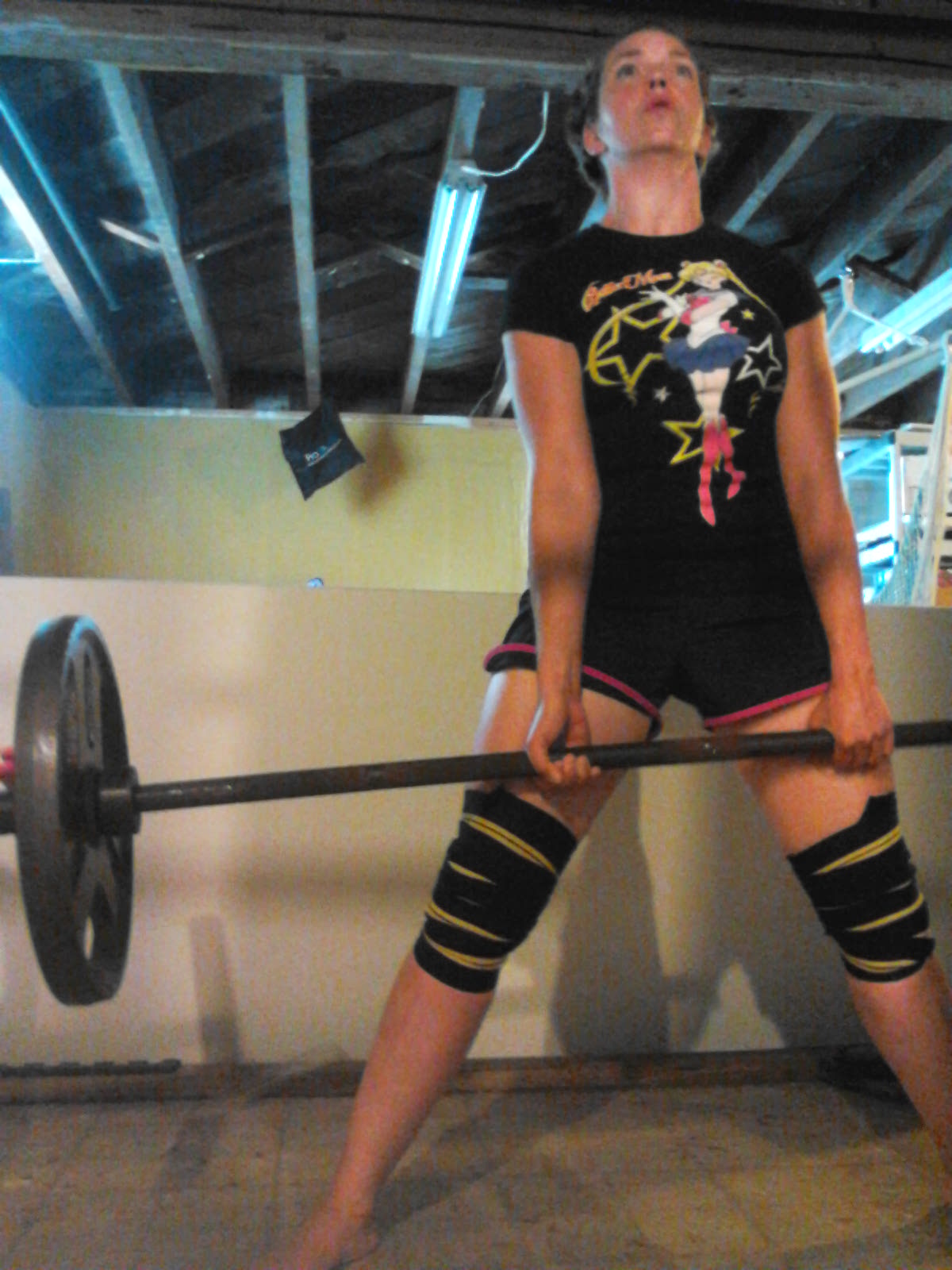


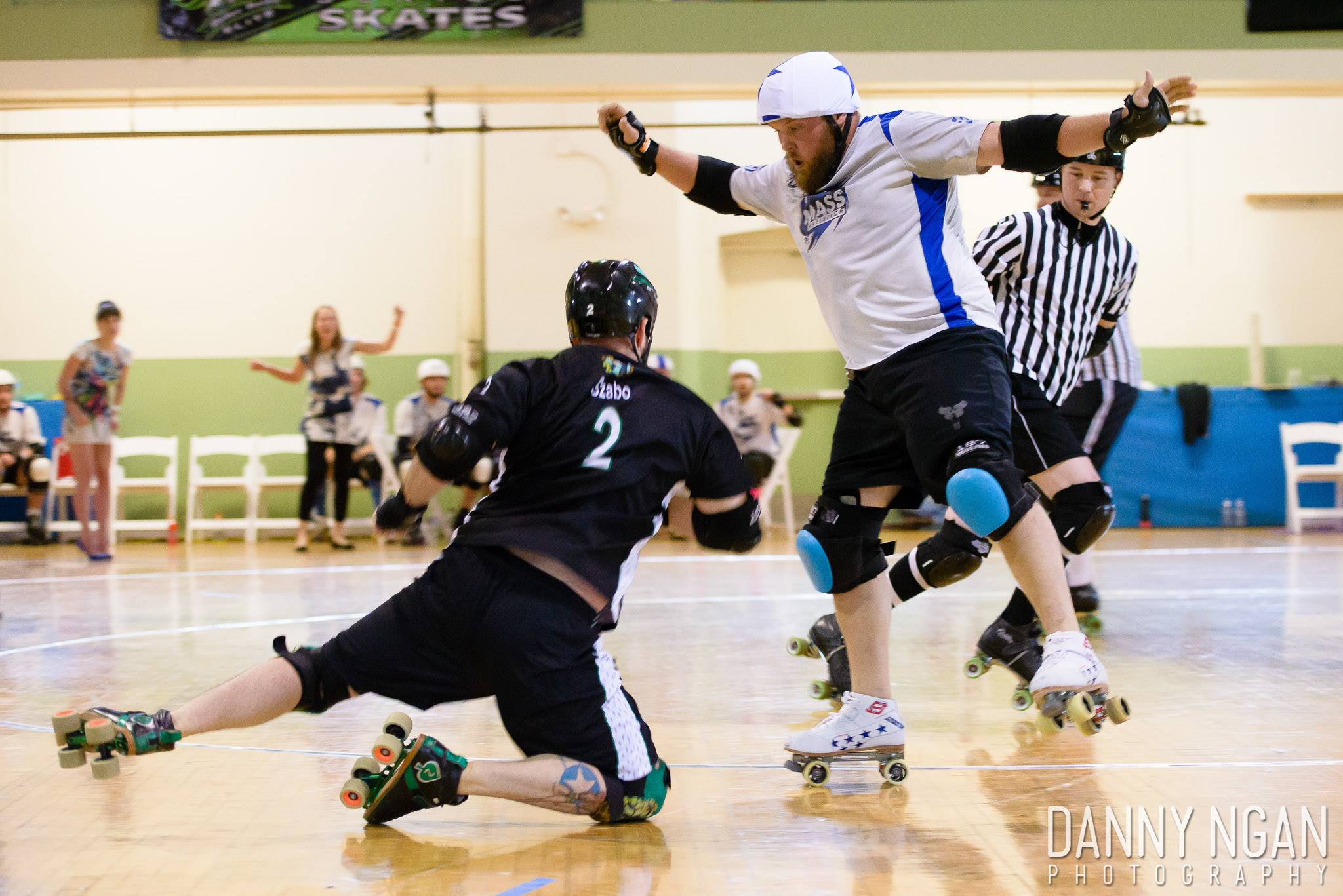




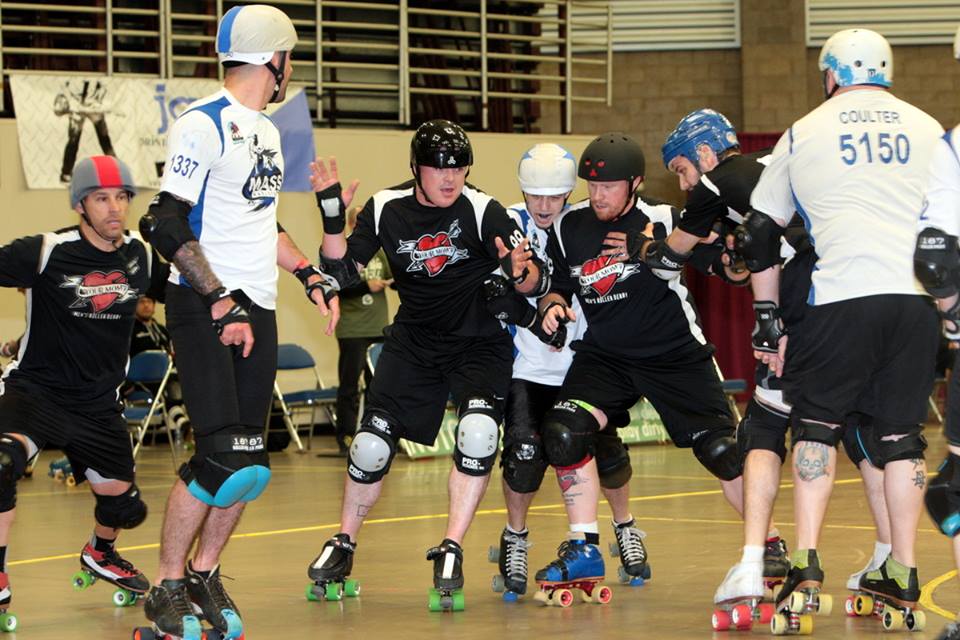
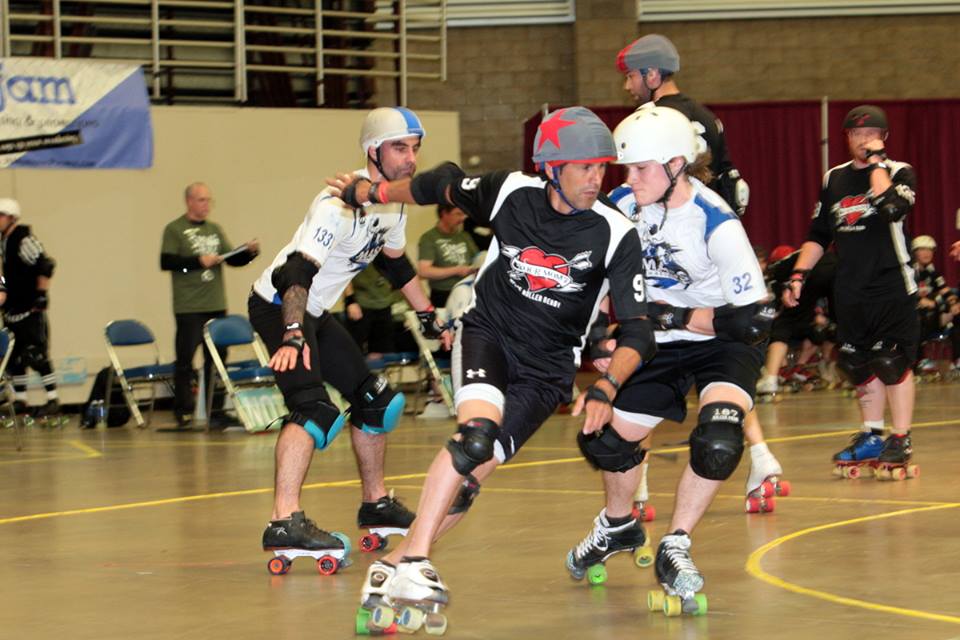
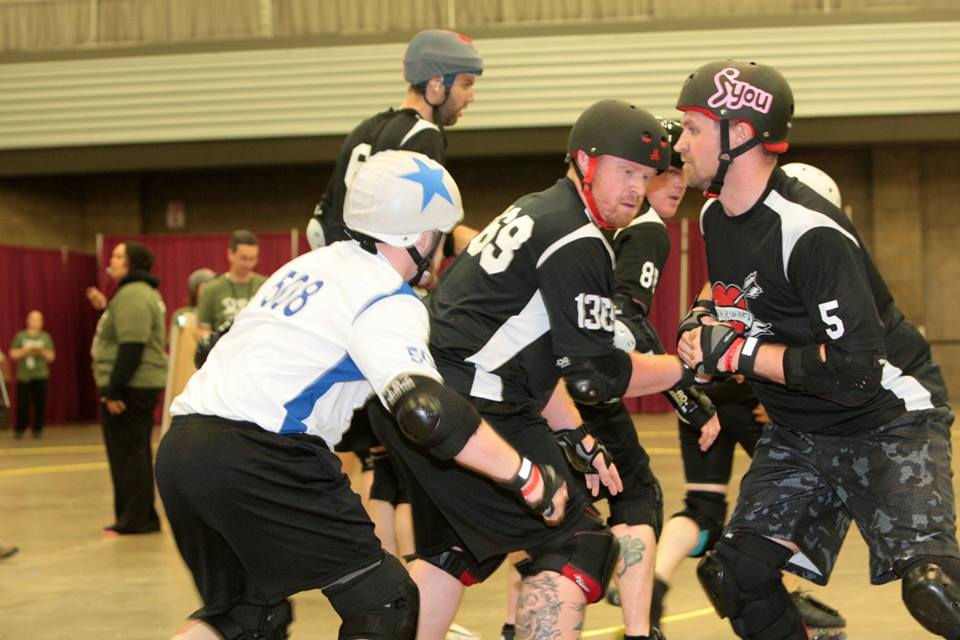


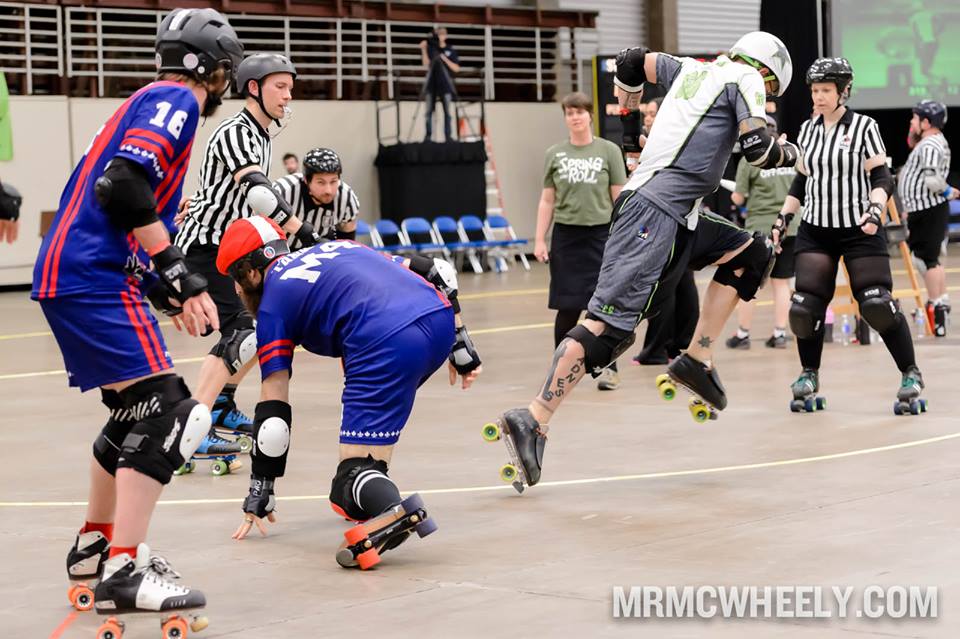



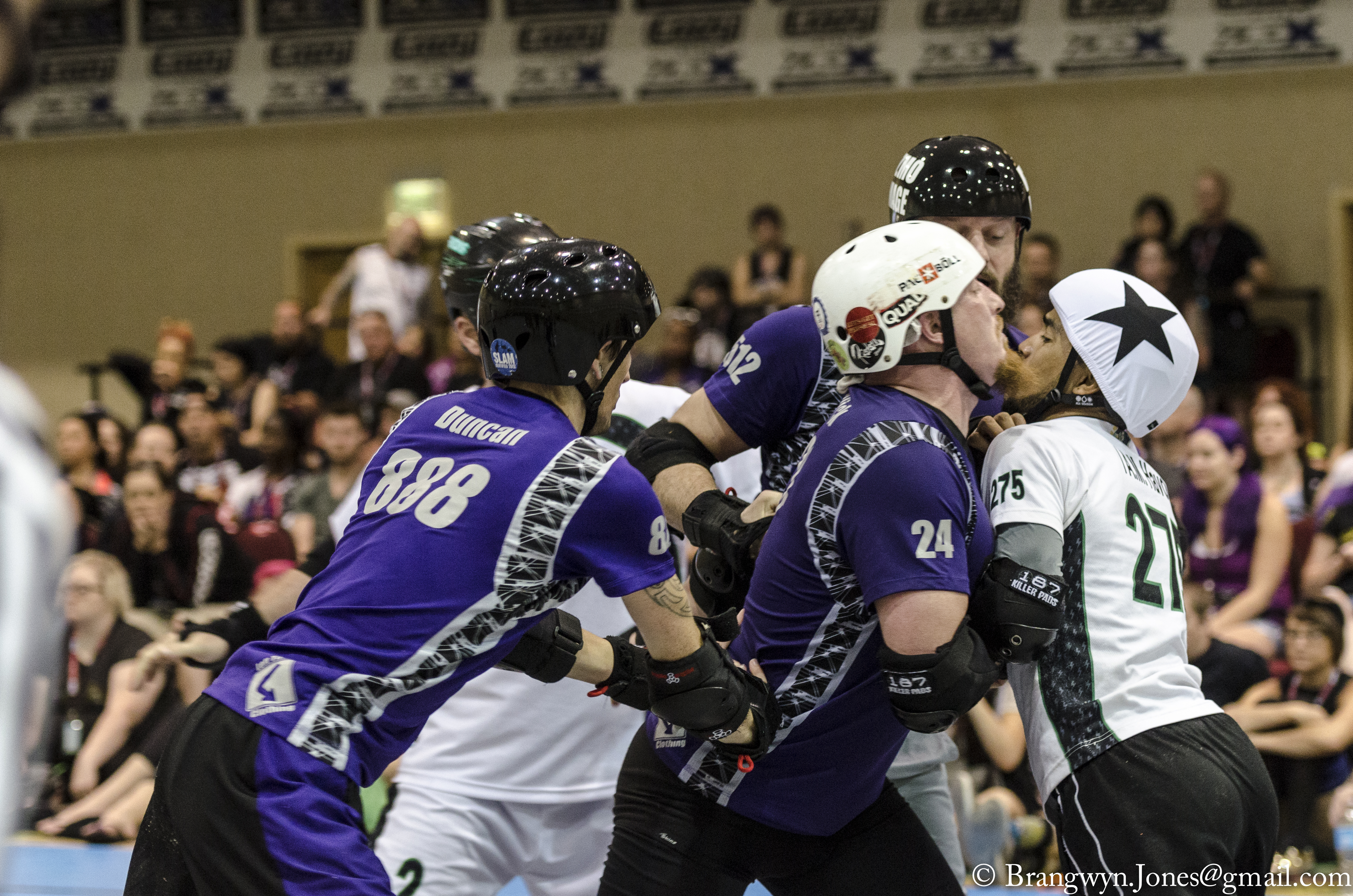



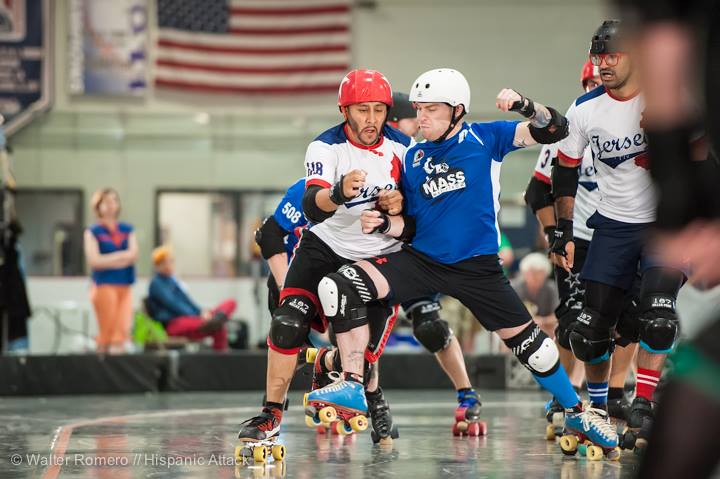


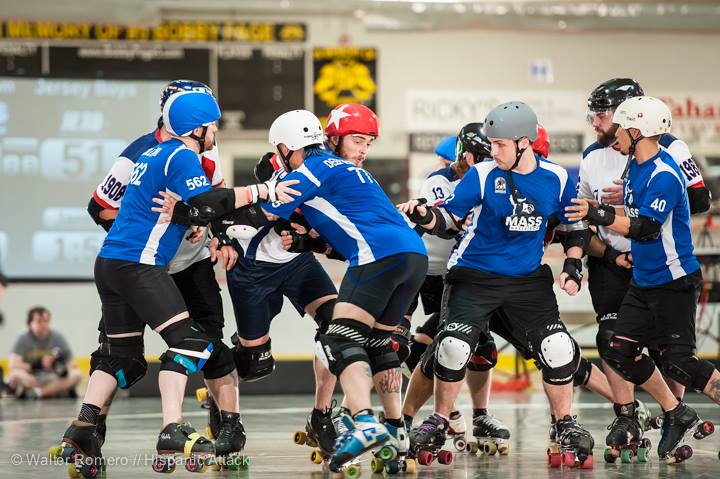

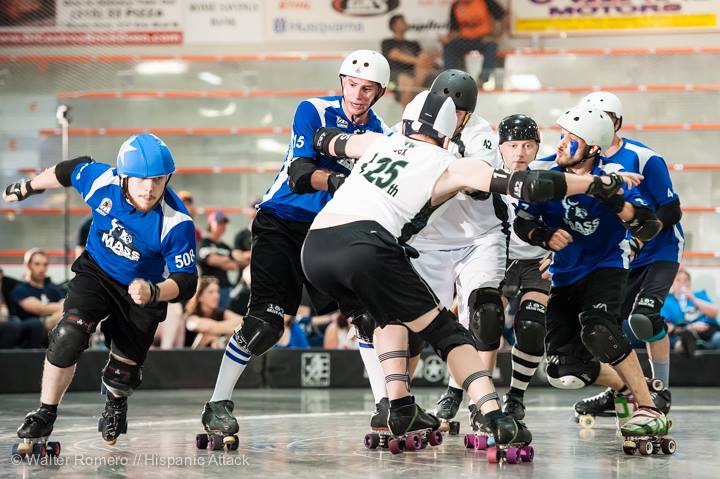
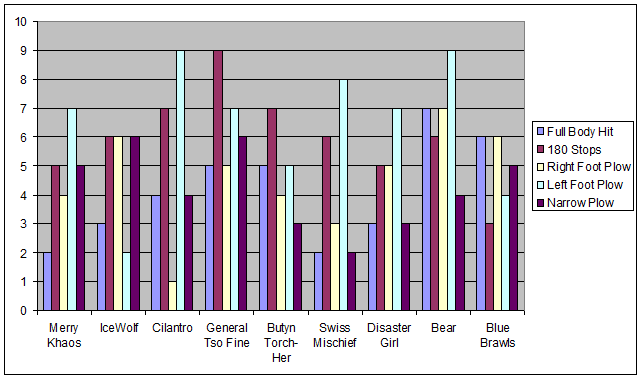




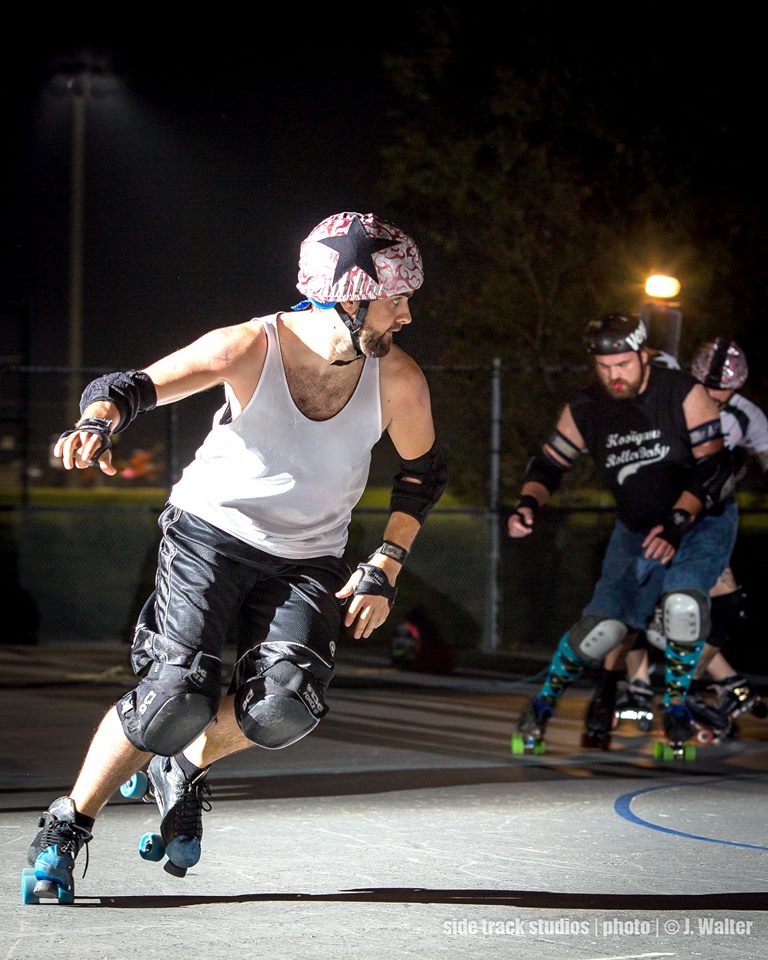


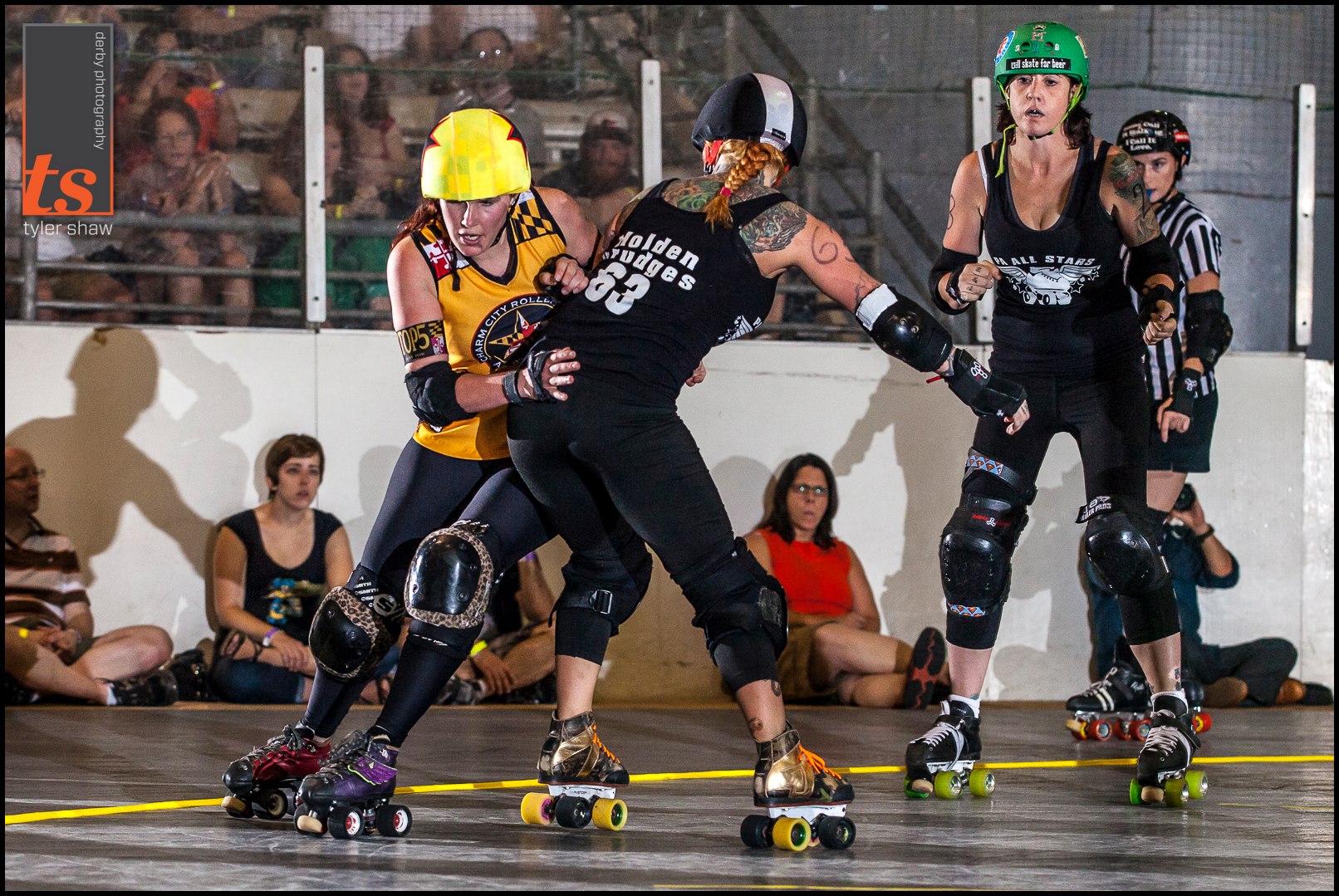


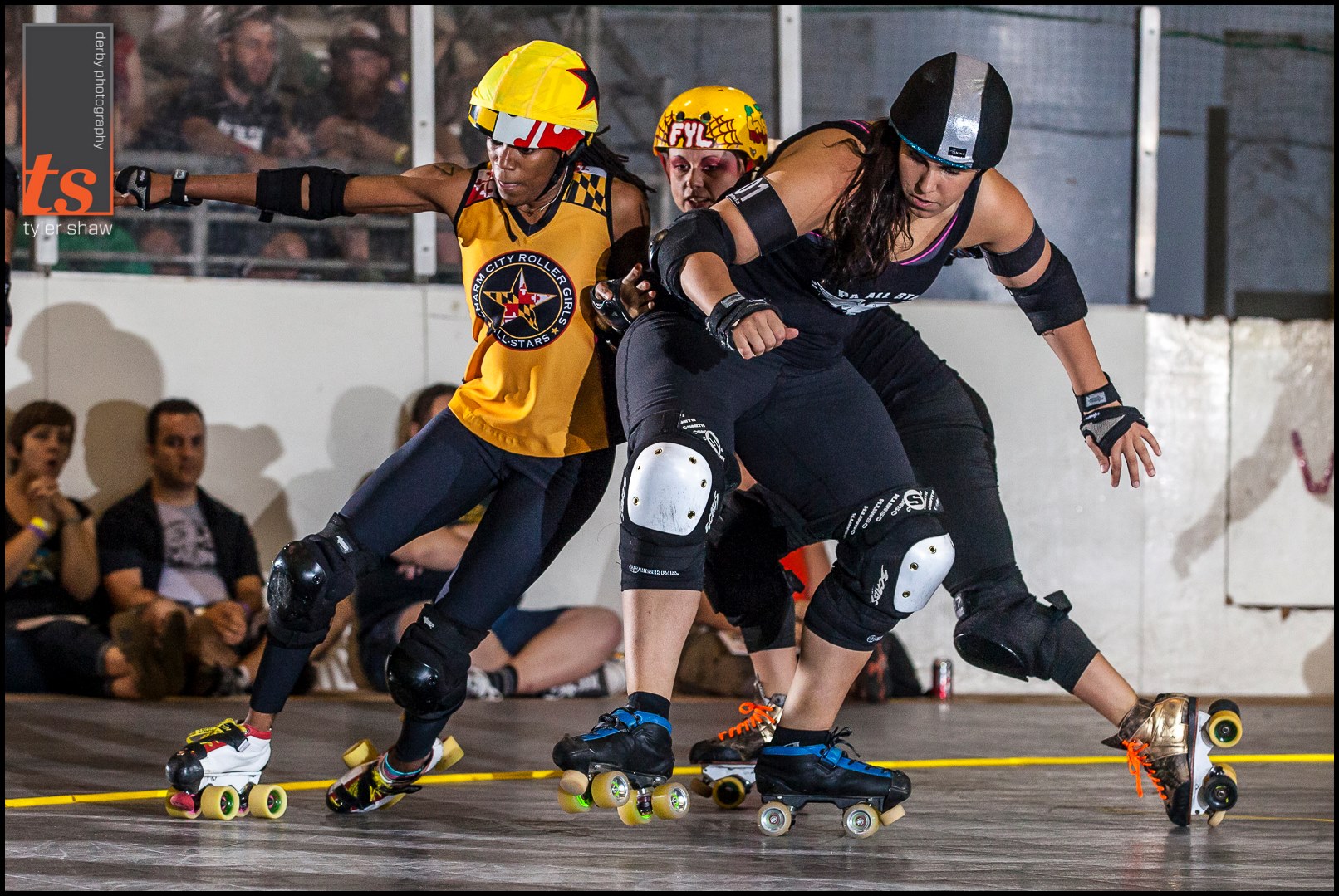


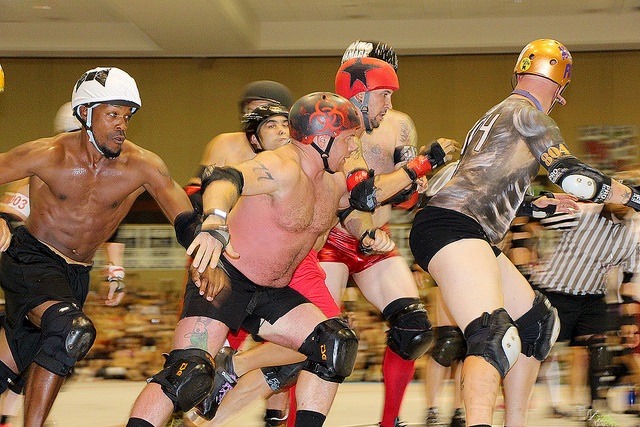



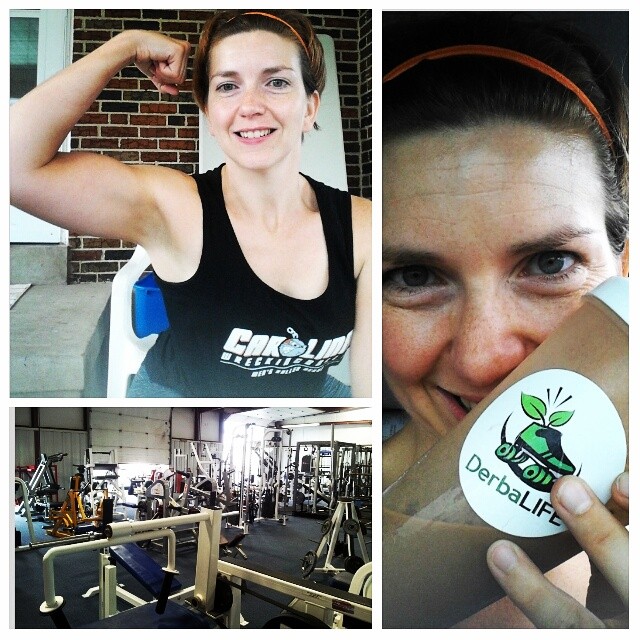
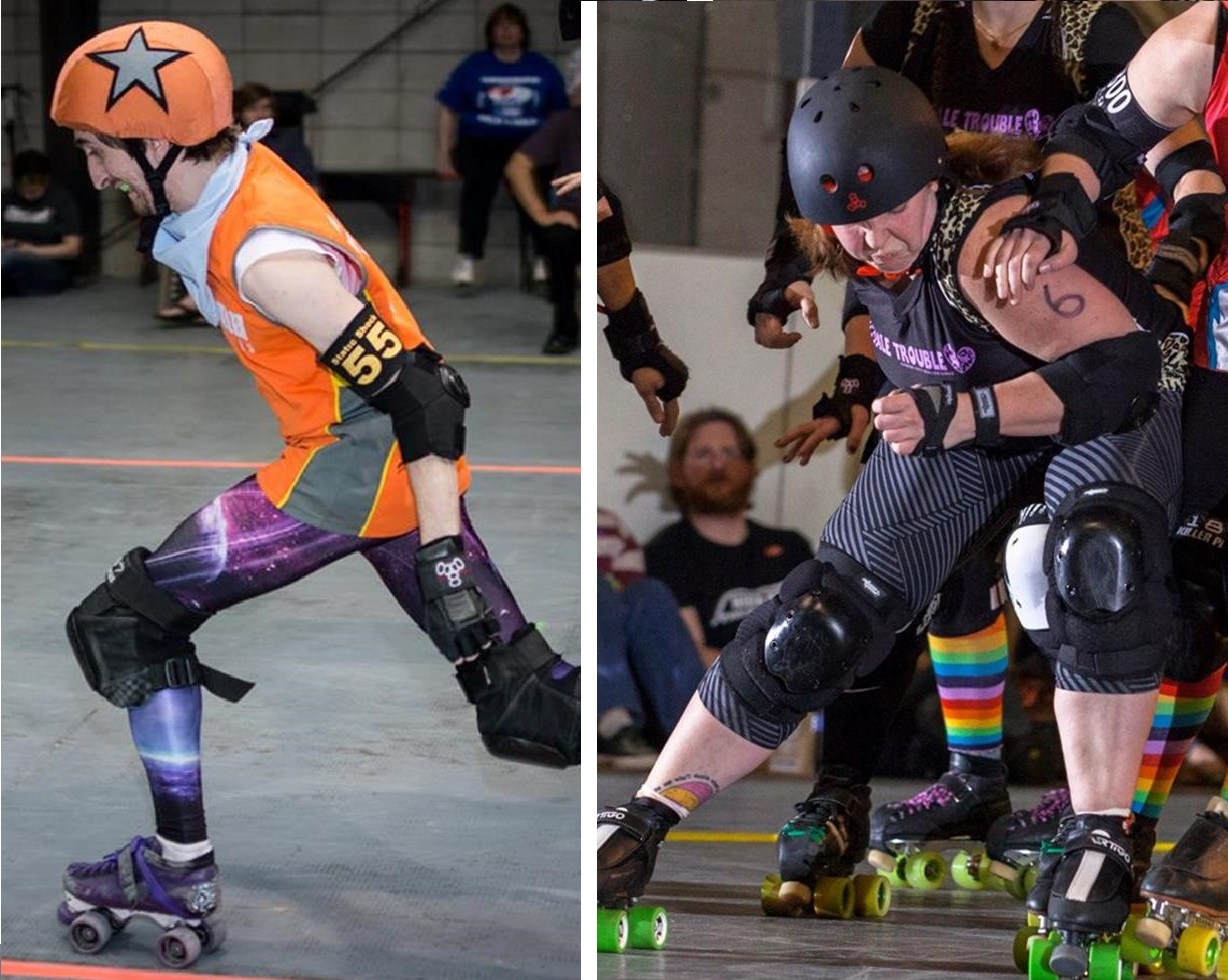

 Khaos Theory Derby