The life and times of Merry Khaos and her alter-ego, Kristie Grey. A romp through the inner workings of a mind in roller derby athletics, training, and business management.
When talking to derby folk about nutrition I hear the same things over and over:
“I don’t know what to eat.”
“I don’t know when to eat”
“I try to eat healthy” OR “I eat terribly and I know it”
“I drink plenty of water” OR “I don’t drink water and I know it’s bad”
I’ve been doing this health coaching thing for a little while now and I can almost predict what people are going to say before they say it. It is part of why I’m so passionate about Derbalife – I want to help my friends answer questions.
Because honestly, it can be really confusing when you’re trying to figure all this out on your own! There are a billion fad diets and trends, and everyone has a different idea of how much you should eat and what you should eat. And then the SCHEDULING? WOOF. That can be rough.
So, while my method isn’t perfect by any means, and there is still some trial and error that goes along with creating plans for yourself, I wanted to share with you what I have created for myself.
Some notes:
1) This is my 90 day plan. As I approach the end of 90 days, I will re-evaluate, tweak, and create a new 90 day plan (that won’t look too far off of this one, probably).
2) Bout weeks will change up my schedule. I will do a deload leg day on Thursday, and will rest at least a day and a half before a bout; more than that for a more competitive game, or for a weekend competition.
3) I have eased into this schedule. I did not just decide one day to work out this much. This has been a two and a half year process. Do not just try and hop into a two a day program. Work with a sports trainer if you’re unsure of how to plan out your cross training.
4) I have nothing to do other than work, train, and play/ref/watch derby. Do not look at my schedule and think “Wow. I could never do that.” **kick stones** “I guess I just won’t do anything”. No. That is not the point here. The point is to show you how you can break down every day of your week into an intentional plan.
So the first thing I did was color coding. I broke my day into half hour bite sized increments. Then I went through and blocked out the scheduled pieces: work time, drive time, practice time is all set. I can’t change them, so they go in first. From there, I could build my cross-training schedule. After that, my extra stuff could go in.
Bruise Crew at The Blood Shed in Austin, TX, getting ready to play The Firing Squad. Practice times are not negotiable, so I make sure they’re a part of my plan before my plan has fully formed. Photo by TXRG
Once I could see what my days look like, I could build my meal plan. I know that when I work at Taco Bus I can only eat meals during certain times. I also know that I get employee meals. The goal is to eat every 2-3 hours, starting with eating within 30 minutes of waking up. I walked through my day, and found times that I thought I’d be able to eat. I typed in what I thought would be good snacks and meals. I put in as many snacks and meals as I thought would hit my desired calorie count… which… originally… I thought was 2000 calories. As you can see, below, it is NOT 2000 calories.
So after I planned out Monday, then I went onto a calculator program on If It Fits Your Macros. When you walk through the calculator, I always encourage people to use the athlete formula (since it factors in your exercise amount, not just your body fat). I, personally, am on a plan to help me gain conservatively. Everyone’s goals are different, and that’s ok! I would recommend, for derby athletes that you choose either the “Recommended” for WEIGHT LOSS, the MAINTAIN, or “Cautious” for WEIGHT GAIN.
PS Macros are : Fat/Protein/Carbs/Fiber. How I got my numbers? I’m 32 years old, 5’4”, and 145#, looking to GAIN CONSERVATIVELY and working out “everyday”. I also did the formula where I eat 1g of protein per 1# of body weight, .4g of fat per 1# of body weight, and I had it calculate for 7 meals a day.
Right, so it gave me numbers listed just below this paragraph. Next I went into FatSecret.com and plugged in the day I had planned out to see what it gave me. I found out that not only was I about 600 calories short, but I was 25g of fat short! Good fats are super critical for muscle creation and is also awesome for your joints and your brain. Once I saw that, I could go back through my Monday and adjust my meals! I had them broken down in my tracking program, so I could see that a snack only had 11g of protein and I could add some jerky to it to improve that. Or that a meal was only 150 calories, so I needed to add some avocado. 😀
I want everyone to know that while I am super excited about the above schedule of cross-training … I also get a little vomity looking at it. I am not a cardio kind of girl. If you know me, or have been keeping up with this blog, than you know that I would rather deadlift every day than run. EVAR. However, too high of a focus on weight training for too long can weigh someone like me down (especially since I cameo jam now and again). So I’m moving my focus to some explosiveness. On my lift days, I’m using a modified 5×5 program, that I have preached about in the past! More about lifting and 5×5 here.
You may look at this schedule and say, “But Khaos! You said that running for long distances doesn’t do much for derby!” And it is true. It doesn’t. However, my long endurance has been slipping since I am on a team that doesn’t do endurance practices. Since I am not doing a speed practice, I am utilizing my conditioning training to help keep my long distance endurance strong, which is linked to recovery over the course of a bout. (So it may not help me from jam to jam, but over the course of a whole game, I want my large muscles to still be able to respond.)
How to build your meals?
Look at your macros, use your tracking devices to understand the compositions of your food. Whenever I eat, I make sure there is at least 10g of protein in what I’m eating. Otherwise I pick something else, or add protein to the thing I’m already eating. I also drink a gallon of water a day. I also take vitamins 3x a day. Doing those things helps to keep the metabolism running and helps your body absorb all the things you’re giving it!
Feel free to use my meals as a starting point! If you want specific help please feel free to message me at DerbyAmerica@gmail.com. I have a good bit of Herbalife in my personal plan, but I can help you figure things out for you with or without the Herbalifle. ^_^
It’s a lot. It’s confusing. It’s overwhelming. Break it down piece by piece. Map it out. Then, all you have to do it is follow it and be awesome! The nice side effect of mapping out your nutrition and fitness this way? You’ve just made a road map for your daily schedule. Watch your productivity go through the roof!! And don’t be afraid to schedule in “FUN TIME” or “TRAVEL TIME” or “READING”. Do it up! It’s your plan.
So… my blog has been super quiet for a while. Sorry about that. It hasn’t been for a lack of wanting to write, or for a lack of material. I have about three blogs either outlined, or in the works including “balancing the zebra and the lion”, “creating the plan” (how to schedule your training and why), one about how to overcome the difficulties of transferring, and one about what it means to really be a part of a team.
It’s Why has my blog been quiet? I’ve been back to the life of the “real world”. I’ve lived in three places since I’ve been here in Florida and FINALLY have settled into a little town called Gulfport, and landed me a job at a place called Taco Bus. And quite honestly, when I get home from running around slinging tacos for 6 hours, I have a hard time mustering creativity.
Also, I have been skating 4-6x a week. Monday, Wednesday, Saturday, Sunday I train with Tampa Roller Derby. Currently I’m a blocker on the Bruise Crew and the Black Widows, and I hope that one day my team mates will see enough potential in me to make me a Tampa Tantrum, and I’ll get to wear a shiny WFTDA patch on my jersey again.
Bruise Crew 2015; Photo by Phantom Photographics
Tuesdays you can find me with the Tampa Bay Men’s Roller Derby. I’m officially recognized by the MRDA as a ref (woot!), and technically am TBMRD’s head ref. This rainbows into the other things I do on the weekend. Most Saturdays you’ll find me either making calls and wearing stripes, or you’ll find me playing on Team Zebra.
You can see me in the background there, all disguised in stripes; Photo by Phantom Photographics
When I’m not skating for Tampa, I’m usually at a fundraiser for the Bruise Crew, or a league appearance, or I’m straight up at the gym. I train 3-6x a week; 3 days of weight training, 3 days of conditioning (assuming my work schedule and traffic allows).
What else have I been up to? Well there have a few times that I started to write blogs, and then remembered that I have deadlines to attend to. I’m now writing a column for JAMMERLINE MAGAZINE out of Canada called “Below the 45th, which is focused on US derby. I also have been asked by BLOOD AND THUNDER MAGAZINE to do articles and blogs concerning off skates training. I’m also piecing my book together. I had to rewrite a BUNCH of it since my perspective on training has shifted a lot in the last year and a half.
Mashing it up, and jamming through; Photo by Phantom Photographics
The last piece is Derbalife. I’ve gotten settled in enough that I have started my business of health coaching back up and I’m getting back to my roots of helping people with their NUTRITION. A bunch of us coaches had gone astray and gotten distracted the last few months, but now we’re locking arms and changing the world!
There is another reason I haven’t written much. And that’s because I had gotten a bit discouraged. Over the years, it has gotten more difficult to find photographs to use in my blog. I am not a photographer. I will not pretend to be one with my iPhone. I have too much respect for the craft. But I am also super wordy. ^^^ As you may have noticed. To have blogs without photos to break up the scheme, it’s really hard to read.
I, by no means, want any photographer to feel undervalued or that their work isn’t worth purchasing. That being said, I have been hand washing my clothing for the last 4 weeks instead of going to the laundromat just to have extra money for food, gas, and bills. This blog makes zero dollars. I write because I love to write, and because sometimes people like to read it.
The whole thing had gotten really depressed and defeated honestly. I didn’t want to write because I knew I wouldn’t feel confident publishing without photos. But … now that defeat has gone away. I’m super stoked that Florida has Phantom Photographics down here documenting all of the awesome that is happening.
Photo by Phantom Photographics
Florida derby is expanding SUPER quick, and the competition is getting very high amongst the teams. Phantom is one of the photographers that travels around the state and takes PHENOMENAL photos! MRDA, JRDA, WFTDA; he does it all. He does a lot of portrait work too, which I’ve always been a fan of.
At State Wars Roller Derby; Photo by Phantom Photographics
For those of you from the Northeast, he’s like having a Sean Hale, Prints Charming, Sir Clicks-a-Lot, Rick Odell, or Shutterfly. And he’s super nice. So… Go visit his page because he’s awesome. I’m so happy that he’s letting me use his photos in my blogs, and I feel confident in writing again. 😀 You should buy a shirt from him too. (PS if you’re a photog and you want me to feature any of your photos, don’t be shy in letting me know!!)
If there’s a topic you want to see me cover in an upcoming blog – drop me a line at DerbyAmerica@gmail.com ! Have you gotten your ticket to RC? I’m submitting to teach classes again. I hope to see you there at the WESTGATE!! If you don’t already, follow me on Instagram at KHAOS24FIT
Like my EAT BIG PLAY BIG notes, this is not going to be a verbatim dissertation of what we went over, but more the bullet points of things we talked about and maybe some WHYs involved. We talked about nutrition too, but because I have my notes posted from EBPB up and running, why don’t you just check them out and get the full picture of the athletic nutrition.
WHAT I MEAN BY LIFTING WEIGHTS
Big lifts – Build all over strength and power, utilizes the full bar
Barbells – Build stabilization muscles and helps support big lifts, small movements, and quick twitch.
Free Weights – Barbells and bars; your body must do the work to keep things in place
Plate/Smith Machine – Training wheels; no real accurate measure of weight. Some plate machines are useful (like the leg extension) but usually you can pass by these.
Cable Machines – The baby of free weights and plate-loaded; there is some stabilization work done here.
Free weights and cables should be used as your supplemental workouts. Like your vitamin and protein supplements, they are the extra stuff you do to support the mainline of work. They should not be your primary form of ‘weight lifting’. Mostly because you’re not really lifting weights when you do them.
WHY SHOULD YOU WEIGHT LIFT?
The easy answer is: Because you play a contact sport.
Gnat King Kill getting it done. Strength effects speed and control. It allows him to deal with fast skaters and bigger blockers.
Show me one contact sport that does not require their athletes to weight lift. If your coach tells you to do dry land drills, do you question? No. You question weight lifting because it’s different and new and super difficult. The resistance to lifting in roller derby is not because it’s not helpful or proven to advance skaters – it’s because it takes more effort to do it. And, honestly, it can be intimidating.
From the physics standpoint think of this reason why you should weight lift:
If you can only squat 130 pounds, that means you can only push that much weight (approximately) into your wheels. If you have someone who is 170 pounds hitting you, but you can only respond with 130 pounds – who is going to win?
This is a very basic, crude example, but hopefully you get the point.
Why bench press? I learned during Beat Me Halfway that if you have Magnum PIMP doing truck-and-trailer with you, your arms and core better be able to hold up to the resistance he’s giving you. If he then directs you into a full-speed Screecharound, your arms and body have to be able to deal with as much power as he’s putting into you to transfer to your skates, to transfer to Screecharound to take him all the way to the line.
Arm strength has just as much a place in derby as leg strength these days, as illustrated by the Mass Maelstrom blockers. Photo by Tyler Shaw – Prints Charming Derby Photography
PHYSICS!
(and also, I was so sore the next day)
If you can push a sled with 150 pounds on it, you can push through a link giving you 100 pounds of resistance.
WHAT IS CONDITIONING?
We talked a lot about lift days verse conditioning days.
Your lift days are just that. You’re picking up heavy weight. Your conditioning days involve cardio work, particularly HIIT. This is your tire flips, your hill runs, your wind sprints, your heavy plyometrics. If you do Crossfit, those WoDs should be your conditioning days … so the extra days. WoDs every day will not build your strength the way lift days will.
Myself and McJagged picked up heavy things and moved them around, jumped on walls, and moved around kettlebells for conditioning work
WHAT DOES THIS FEEL LIKE?
Like with derby, we have to adjust to a new feeling when we start weightlifting. If you’ve done plate machines in the past, then you are not used to what it feels like to have 180# on your back, or to pick up 200#.
It feels heavy. It feels miserable sometimes. It feels like you might hurt yourself. Just like it feels when you’re doing a new advanced skill on roller skates. Like those one foot “chomps” or one foot plows.. Picking your foot up and putting it down in front of you, with your toes turned in and your knees touching? That’s terrifying! I was sure I was going to break my leg. I didn’t. And you won’t break your shit just because it feels heavy.
It’s supposed to feel heavy. That’s the point.
DO I NEED SPECIAL GEAR?
Not necessarily.
I wear knee wraps because I can feel things shift around in my right knee when I squat and it’s weird and I don’t like it. With lighter weight, you don’t need belts, wraps, wrist grips. As you start lifting, talk to people around you about the gear they have. You’ll learn when you’ll need to get a belt, or if you want to get gloves.
Wear flat shoes or no shoes. Those weird toe shoes? They actually work really well for lifting. So do Chuck Taylors. So does nothing. Just like you wouldn’t buy Bonts for your first pair of skates, you shouldn’t go buy the special fit lifting shoes before you start lifting.
WHAT ARE THE LIFTS I SHOULD DO?
No questions asked you need to do:
Squat
Deadlift
Bench Press
Lifts that I think you should incorporate:
T-bar Row
Front Squat
Hack Squat
Incline Bench
Sumo Deadlifts (or Sumo/Russian)
Upright Row
Overhead Press
WHAT SUPPLEMENTAL LIFTS SHOULD I DO?
This one is tough. It depends on your programming. Ones that I make sure I incorporate:
Leg Extension
Glut-Ham Raise
Pull-Up
Hanging Leg Raise
Bent Over Row
Lat Pull Down
Seated Row
WAIT – HOW DO I KNOW WHAT TO DO?
Guess what? More reading for you!! What I recommend to EVERYONE is to pick up Mark Rippietoe’s “STARTING STRENGTH”. There is an app you can download called 5x5Stronglifts that will help you through the whole process.
Here’s the idea that I can pass on to you that I started with… 5×5. So you’re doing 3 lifts each day, 5 times, 5 reps. This does not include your 5 rep warm-up. When my plan was set for me, we did one lift for the upper body, one for the back, one for the legs.
I then did 1 or 2 supplemental lists each day (unless I was crazy spent). Getting someone to help you set up a training plan around your skating schedule is awesome. I had a couple people helping me along the way. And don’t be afraid to tweak your schedule as you progress. After your first four weeks, you should be in a routine, but before that it’s ok to move things around and figure out what works best for you!
Learn form on your own through the BUFF DUDES series. They’re really a great, short series of tutorials.
HOW DO I KNOW HOW MUCH TO LIFT?
Again, having a friend that knows lifting is helpful here. If you don’t, go to your gym and find the biggest dude or lady who is both strong in the upper and lower body (or ask someone at the desk of who to ask), and humbly request help.
Think of it this way: If someone came up to you at an open skate and said, “Hey you look like you know what you’re doing. I’m trying to get into roller derby, but I don’t know how to plow stop, can you watch me real quick to help me?” You’re not going to tell them to fuck off. Lifters feel the same way about their sport. I promise they’ll be nice to you.
Step one is to find your personal record (PR), also known as your one rep max (1RM).
Do not plan on doing your 5×5 during max days. You also shouldn’t try to max out multiple workouts for the same body part. For example, don’t try to max out back squat and front squat on the same day.
To max out, do your warm up weight (people can help you figure out what that would be… for me, my deadlift warm up has ALWAYS been 135#, and my squat started at 100#, bench was 45# … these are good starting points). Do 5 reps. Your buddy can help you go up in weight. Do 3 reps. Then up in weight and do 1 rep until you can’t move it. Boom. 1RM.
Plugging these maxes into your 5×5 Stronglift app will create a nice little “oh this is what I lift today” guide for you. You can contact me if you want something more specific.
You call it extreme, I call it “what it feels like 185# on my back”
SO I JUST LIFT FOREVER NOW?
Things can change up, but yes, now you just lift. In a 5×5 program, I do like incorporating a deload week either on week 5 or 6. A deload week is when you do your lifts, but at 50% of your max. It gives your body a chance to recoup.
When I first started this program, I was going up in weight for some of my lifts each week, not up for others. The stronglift app helps you with that.
Setting goals will help keep you focused and your training tight so that way you don’t get bored.
OTHER NOTES
You will plateau. You will have bad days at the bar. It happens. Just like derby. Sometimes you have enough sleep, you’re hydrated, you’ve eaten enough, and you just can’t squat the bar the way you did the week before. It’s ok. It happens. Seriously.
This can be new and can be scary. Just like derby. Don’t be put off from lifting by yourself because “You don’t want to hurt yourself”. There is just as much risk for injury in this sport as others. If you play derby, you know that you can have someone there with you, you can be in the process of being coached, and you can do one thing and still hurt yourself. Don’t fear injury for the sake of fearing injury.
You are probably not going parallel on your squats. If you have never squatted before, start with BOX SQUATS. Your new gym bro can find a good box for you. It should be low enough that when you sit on it, your legs create an angle lower than 90 degrees.
Your back is going to hurt. That’s because this will be the first time you’re fully using your back for a lift. All the time I hear “Oh man, my low back hurts! I must not be deadlifting right.” Or you’re deadlifting exactly right and you’re using muscles you never have before. Your back is going to hurt.
If your back is weak, your squats will suffer. “What?? But squats are a leg lift!” Yes, but the bar is on your back. So if you can’t support the bar, you can’t squat it. It’s possible that your squats may be lighter than what your legs can handle at first, because your back is not strong enough.
RECORD YOURSELF SO YOU CAN SELF-CRITIQUE AND GET NOTES FROM FRIENDS. It seems super narcissistic, but you can correct between sets sometimes! You can send the video to your friends from around the country and say “Hey is this parallel?” or “what am I doing wrong?”
When you’re lifting, EYES UP HIGH! Pick a spot towards the ceiling, look at it. Do not look side to side. Keep your weight on your heels, you should be able to wiggle your toes.
I think that’s about it!
Drop me a line if you want some extra help or have other questions about setting up your program. Your offseason program is going to be different than your in-season program, so I can help you with that stuff too. When in doubt, read books! 531, Beyond 531, and Starting Strength are the ones that have been recommended to me. Drop me a message at DerbyAmerica@gmail.com with questions or if you have anything you want me to address.
You cannot ignore Puget Sound Outcast Derby. Mostly because their uniforms demand your attention, but also because that jersey is probably going by you at Mock 5.
The Outcasts are a team of World Class level roller sport athletes that have come together for the love of derby. Ball and cane, speed skating, hockey, artistic, aggressive inline, downhill racing – these are all the sports (and I may have missed some) that the men of Puget Sound have competed in. When you watch them play, you can’t help but notice their sheer skating talent and balance; they do not fall. They are hard to push out of bounds. They are hard to out skate.
The longest-establish West Coast men’s derby team, Puget Sound is no stranger to the Championship tournament. They have qualified for Champs each year (and even finished #2 in 2011 against New York Shock Exchange), and plan on making a rise above their #4 seeding by the end of this weekend. As host of the tournament, Puget Sound seems to be trembling with excitement to show the world that they have been focusing on their weaknesses and developing game plans for each opponent they face.
In the past, Puget has seemed to rely on their straight-up talent to win their bouts. They are so much fun to watch, but when I have seen them play (Mohawk Valley Cup in 2013 and then streaming at Champs), I have noticed a ‘superstar’ style of play. They have relied less on walls and tightly-bound defense, and more on big, driving hits, pulling cut tracks, quick bursts of speed, and out-skating the opposition in the past. To continue to dominate, Puget knows they must shift into a team-based style of play.
Scott Slamilton’s artistic background make him nearly impossible to capture. Blockers like Bonus Jonas and Dilly Dally are small and unassuming to look at, but their agility on wheels only enhances their ability to pop into larger opponents to stop or redirect an opponent’s momentum. (small blockers – watch these two this weekend. Take notes. Learn things.) With such a variety of sizes on the bench, Puget can really tailor their lines to take on individual jammers to play to strengths. Need pure power and size? Put out Big Bill and Radiallac. Need stronger walls and communication? Put out Quadzilla, Low Rider, and Thunderstruck. If you need blockers who can chase and re-capture a wiley jammer, you put out Cory Pain and Chuck Hendrick.
In the first round of play this weekend, Puget Sound gets to face their little brother, Bridgetown Menace. Bridgetown has been steadily closing the point gap between PSOD and themselves each time they play. Puget needs to focus on communication and containment against Menace if they want to continue their winning streak. Both teams are very fast and very sharp, neither waste energy in their hits or skating. No more can Puget rely on being a team of simply more talented skaters. Menace is coming in with a point to prove, and Puget Sound has an opportunity to show that they have learned from their past match-ups. Puget has a chance to finally solidify being a collective team of insanely talented skaters that know how to read each other and trust each other. Puget has a chance to show the world that they are here not just to play. They have a chance, and a desire to walk away as the host of the Championship tournament where they will leave with more gold around their neck than just what is on their uniform.
Check out Puget Sound’s Facebook for updates and awesomeness. Thank you, Eric Lyons for use of ALL the photos in the article. Tune into WFTDA.tv at 3p PST to watch Puget Sound work their fancy feet magic against Bridgetown Menace.
How the hell do you run practices when your league has practicing membership from Level CobraSnake to Level NewbornFoal? THIS is the biggest question asked across the world by coaching committees in roller derby right now. How can we keep our vet skaters challenged and satisfied with the training process [so they don’t transfer out] while bringing new skaters up [quickly] to a level to be able to play with those vets?
I had such a huge response to the blog I posted two days ago, about League Rebuilding that I wanted to make sure that my blog about training the leagues that are rebuilding went up quick!
There are fundamental corners to The House that Derby Built: Skills, Teamwork, Strategy, and Health. Without one of the corners, the house will not fall, but it will lean a little funny. Without two of the corners, you don’t have much of a house.
TESTING THE FOUNDATION
First you need to understand where your league is at with each of these fundamental pillars. The first step is to take an honest look at where each skater is individually and as a league. For Skills and Health you can actually do measurable tests to help you with your mapping process.
Set up a practice to set benchmarks and test skills, and I would recommend asking coaches from nearby leagues to come in and help with the ranking process, since the will be more impartial in the process. Create a list of skills (crossovers, one foot glides, lateral motion, hip checks while moving, jumping, counter blocking, 180 toe stops, blocking to the line, etc) and have them ratable 1-10. Move your way through drills, as you would when doing a certification, but make sure you have more advanced skills on the list than a strict certification process.
For Health, you simply create a list of ‘events’ like a football combine. You can test squat strength, bench strength, 100 yard dash, 400 yard dash easily. You can create short ‘obstacle courses’ and time each player through it while rating their cuts, bursts of speed, jumping, and footwork. You can do one foot balance, long jumps, pull-ups, or anything else you think would be applicable to strength and endurance needed for derby.
Once you have your 1-10 data points you can put them into a spreadsheet and simply create a point chart! Boom. You now know where people are. This is not to make anyone feel bad. This is simply a way to benchmark individuals so that the training staff can develop upcoming practices and make recommendations about cross-training. This information is also a great starting point for goal setting! Part of setting goals is that they have to be MEASURABLE. With benchmarks in hand, captains can meet with skaters to create a real list of SMART goals for the skater to focus on in upcoming months.
To benchmark Teamwork and Strategy is harder. Teamwork, though very easy to see the presence (or lack of) teamwork, it is not easy to quantify. You may want to ask those coaches to come and observe your team in a scrimmage against another league to rate overall Teamwork and Strategy. When you map, you will not be mapping for your team, but you will be mapping for groups of skaters, or the team as a whole.
Things to rate from 1-10 in Teamwork could be: Proximity of skaters, holding lanes, communication, mobility of walls, awareness, recycling, and protecting edges.
Things to rate in strategy could be: Offense, O to D/D to O switch speed, Bridging, Jam line start, power jam defense, preventing recycling. Watch some bouts and make notes of how to describe strategy and teamwork and create your list to test (use the words and ideas that I listed as your example).
CREATING THE PLAN
After you map the data, you can analyze it with your training staff. You’ll be able to see weaknesses very easily. Data doesn’t lie. Create the charts however your brain can deal with the data. After playing around a bit, I decided that I like the bar graph, since I can see distinct lines across. I just made up a mock chart for an example (I picked derby names at random, I didn’t actually rate people on things).
From looking at the chart, you can see that some people have strengths, and some have extreme weaknesses. You do not want to use those as your focus. You want to teach to the median weaknesses. Note: This does not mean ignore the strengths, it just means you now know where to focus more of your training energy. Looking at this chart, I immediately notice that NO ONE has even a 7 on narrow plows. Next thing I see is that while we have a few people strong at left foot plows, the rest are not, and no one is strong at right foot plows.
If you have a team that is primarily new skaters, and you are noticing that in the corners of your house, the median score is 1-5 in most areas, than grade on the curve. So you can’t look at the data and go, “Oh man, there are only a couple 7s. WE MUST FOCUS ON EVERYTHING.” Right, ok, so, bring the top grade to 7 and look at the skills from there. If 7 is the top and you’re noticing some skills have more 4/5s and others have more 2/3s, focus on the 2/3s.
You do this with all four of your pillars. Identify your team’s overall weaknesses.
THE EXCUSES
“But we have too many new skaters to do this!” No. No such thing. If your skaters can’t complete skills they get a 1 on the scale. That’s it. Everyone can run, lift, jump on sneakers.
“But we don’t have any place to do the off skates benchmarks!” Really? You know that? I just suggested it and you’re already coming up with an excuse to not do it? Have you called the gyms in your area and asked about it? Tell them what you want to do. Offer them advertisement in exchange for use of their gym to do benchmarks. They can be the “Official Combine Location of the Blankety Blank Roller Vixens”. Local, privately owned gyms or franchises are the best place to start. You may want to approach CrossFit gyms about it, because they’ll usually have sprinting space too, and some of those coaches have experience in combines.
“But we already spend so much time at derby, we don’t have the time for this! We know how our skaters are, can’t we just use what we know?” Cancel practice for a week and do this. If you want to improve and you’re serious about focusing your training program, you need to know what you’re working with and you need to have an OBJECTIVE view of where you are starting. Without data, provided with the help of people who don’t know you from Adam, all you are doing is continuing old habits. Your current training is based on what you think you know about your skaters. Chances are your advanced skaters are not advanced. Chances are your fresh meat have skills you didn’t realize.
“But we’re not Gotham or Bay Area. We don’t need to train like a D1 WFTDA team.” Well I will respond with a Vince Lombardi quote:
“If it doesn’t matter who wins or loses, then why do they keep score?” You don’t have to be a D1 team to want to be successful or to train to be successful.
What it comes down to is that this is new, and new is scary. What it also comes down to is exposure. Exposure is scary. Skaters (especially self-proclaimed ‘vets’ and those who like to pop into practice when convenient) do not like being told that they need to improve at something, or that the ‘lowly fresh meat’ is actually better than them at a skill. This is not about belittlement. This is about recognition and understanding. Without it, you cannot move forward.
DON’T FEAR TO START AT THE START
If you have to grade on the curve, and you have noticed that you have that moment of “We have to work on everything”, then step one is take it back to the beginning. Begin training the TRUE fundamentals for individuals and teamwork: The mechanics of roller skating & speed skating New derby position (tailbone tucked, feet shoulder width)
Toe stop & duck runs
Holding a lane
Skating without using your arms or looking at the floor
Skating in a pack
Pace lines & Speed control
Lateral motion/Laterals using edges & leading with your knees Carves (short and long)
Narrow & One foot Plows
Stopping with edges
Making a wall
Moving as a wall
Anatomy of hitting Sticky blocking
Transitions both directions
Communication & awareness while in motion
This is the start. These are the building blocks. You cannot do a box drill if skaters don’t know how to control their speed and skate close to other people. You cannot do a weaving pace line if your team doesn’t know how to do a basic pace line. This is your first check list. And honestly? I probably missed things. (I have walked away from this list and come back to it several times.)
Old derby position (l) – Butt out, weight middle of the feet/heels; New derby position (r) – back straight, tailbone tucked, feet hip to shoulder width apart You won’t be as low in new derby position, but you have more mobility from this position, and a stronger stance for blocking and walls
“But my vets will be bored!” No, they won’t be. In any drill that involves team play, the vets should be focused on helping their team mates cover lanes, maintain position, and work on speed change. The vets need to be the coaches through the drills with the new skaters. For any individual skill, the vets need to be focused on cleaning up their own abilities. Encourage the vets to work on precision, quickness, reaction, depth of skill, and visualizing they’re in a game situation.
Your vets can plow? They should work on plowing narrower, sharper, stopping quicker, keeping their hips more square, their back stronger, and their head up and looking around while doing it. Your vets ‘know how to roller skate’? Encourage them to make their stride deeper, lengthen their pushes, and focus on breathe work and mental tricks as they go around the track that they can access during game play to calm themselves.
***THERE IS NO PERFECTION IN ROLLER DERBY***
Every skater needs to review and practice these fundamentals. These building blocks are not things to check off a list and never visit again. I recommend revisiting these fundamentals often, even after every skater on your crew can rank at an 8+ with them.
NOTE: Every skater is responsible for their own progress and should be empowered by their team and coaching to take responsibility for practicing fundamentals on their own time as well as whatever happens in practice. Just like with the health section at the end of the blog, it is not the coach’s responsibility to mother each skater to make sure they are keeping sharp on their skills on their own time.
DO NOT COACH DOWN
Just because you are working on fundamentals, it does not mean that you need to treat your skaters like 5 year olds, or offer them drills that do not challenge them. Create drills that push your new skaters. Do not assume that because they are fresh, that means they are incapable. Keep your pace lines challenging. Do not skip a drill that works on something that needs to be addressed because someone thinks the fresh meat won’t be able to do it.
When Mystery Violence Theatre came to HARD she couldn’t stand on her skates. Through coaching confidence & her own hard work, she now skates for Gotham’s Wall Street Traitors & Bronx Gridlock. Photo by David Dyte
You do not get better unless there is a challenge. Making drills JUST above the median level or intensity will push your largest faction of skaters. Dotting in more advanced drills or more basic drills, will keep everyone confident and working hard.
For example:
Let’s say you are working on edgework! You can start with carving long and slow and then short and sharp. Time these for about three minutes, with all skaters moving around the track.
Next, put dummy blockers around the track, facing proper derby direction, near the inside and outside lines. Have them stand NEAR the line, but with some space. Have your skaters carve between the blockers and the line, showing their back to the blocker as they go through (they’ll have to twist their body). After everyone has done it for a few laps, have the dummies take an extra step away from the line, and have skaters get by them by bursting past with a 3 step duck run (which utilizes edges).
For newer skaters, put bodies about as far away as the green cone. For the more advanced skaters, go with the red.
Then put obstacles in the track – one in the middle of each straightaway, one at either end (trashcans or chairs work great). Have skaters rolling and approaching the object, then bursting around the object with the 3 step duck run. They can challenge themselves to get as close to the object (without touching it) as they can before they burst around it.
After this, bring the practice back down by practicing lateral motion, leading with the knees, from line to line across the track. You have started with something very basic, upped the intensity a few times, and then brought it back down to a lower intensity, more precision-based drill.
So the moral of the story is – don’t think that your new skaters can’t do it just because it’s harder. You can always offer ways to adjust a drill harder and softer to accommodate for all skaters.
MIXING LEVELS IN PACKS
“Do we have levels mix together in drills?” Yes and no. I will define who skaters should get with as we progress through a coaching plan. This is something that the coaches need to decide. I will say “vets with tots” or “Get with someone of your skill level” or “find someone on your home team” to define who I want them to work with.
You may want to rotate skater partners too, so that way the newer skaters get the advantage of in-drill coaching. Don’t be afraid to spend a longer amount of time on drills and skills. You do not have to rush through practicing; it’s through repetition, repetition that our bodies learn. It takes 5000 SUCCESSFUL repetitions to establish muscle memory. Let them practice in mixed levels, then switch them to equal levels to allow themselves to push and challenge each other.
LESS IS MORE
Less talking, less complication, less spending of energy: in roller derby, less is more.
Do not spend 30 minutes talking about a drill. Do not spend 30 minutes arguing about a better way to do the drill. Do not allow other skaters to try to bully the coach into doing the drill a different way. Explain the drill, demonstrate, try it, observe it, correct misconceptions, do it again, observe it, tell everyone what you’re noticing, do it again, bring everyone to the center, talk about what you observed, take quick questions, move on.
Do not think that you have to bring drills to practice that have 15 steps. Simplification is critical. One piece at a time, and build your blocks. Practice your one foot plows/chomps. Then practice stopping in a two wall. Then practice stopping in a three wall. The practice stopping a jammer in the three wall. Then practice stopping a jammer in the three wall, and having the wall step in front of the person blocking. Build.
Do not think you have to be good at every strategy. Vince Lombardi is one of the most decorated NFL coaches of all time not because his Green Bay Packers could do ALL the plays. It was because they did a handful of plays SO WELL that no one could defeat them. By keeping things more concise, you will give your skater tots less to learn (less overwhelming), meaning they’ll be able to advance quicker and get to the level of working with the vets and having everyone be successful.
Teamwork, communication, being on the same page, and focus. Less is more.
3 FAVORITE PRACTICE THINGS FOR ALL LEVELS
Boxes: Everyone is in a tight box, on the whistle the box completes an action. You can either pick actions before the drill starts, or coach can shout the action before the whistle. Actions can be: rotate right, rotate left, inside line, outside line, hop, front to back, back to front, make a wall, make a line, make a box, speed up, slow down, 180 stop, etc etc etc. Start basic. Work up from there.
Double Pace Lines: Especially if your league needs some long endurance work, double pace lines can be beneficial to teach speed control, footwork, skating proximity, and awareness. You can have individuals weave, teams weave and lead, teams race, individuals block, teams weave and hit between the pace line, and more.
Games: Soccer (use an empty water jug instead of a ball), dodgeball, tag, and more! Get your team distracted from what they are doing by making them do something that isn’t roller derby. It’s amazing how the footwork, stops, awareness, avoidance, cuts, spins, toe stops, and communication improve after just one session. Plus – it’s really really fun!
So that “health” corner of the house? Here’s the tough thing: You cannot make people do anything outside of practice time. If a skater wants to live on McDonalds and potato chips and watch 5 hours of television on their non-practice nights, that is their prerogative. Doing the benchmark combine may be the shock some people need to start developing some outside healthy habits, but you cannot count on that (You would think being winded after a lap and dreading the 27 in 5 would be enough motivation, but not everyone motivates the same).
YOU CANNOT WANT IT FOR THEM.
You can give all the Braveheart speeches you want, but each person makes their own decision of what to do with their body. If you are a decided rec team, what you can do is make recommendations as a training committee of how people can train for roller derby outside of practice. If this blog hasn’t tired you out completely, check out my SHIFTING PERSPECTIVE blog about training for our sport.
Some leagues I have come in contact with have an ‘extra practice’ that they must complete each week on their own – it’s a set of workouts that they can do at home or in a gym. More serious leagues (or leagues that want to become more serious) are requiring their all-stars to have gym memberships (these leagues usually also have some kind of agreement with their local gym for discounted rates). In the future, some may require a level of baseline fitness in order to qualify for all-star rosters.
Every league is different. Do not be afraid to adopt these health requirements for your league, simply because it is unprecedented in your area. Do not be afraid to not adopt such policies because you do not believe it would be right for your league. Either way, it’s a discussion that the league as a whole may want to have.
My first league was not a D1 level of play, but it was understood that we did NOT drink alcohol the week of a bout.
Nutrition is as critical a part of fitness as the weight lifting, yoga, land drills, sprints, etc. As a Derbalife coach, I spend a lot of time simply teaching skaters what is and is not good fuel for the body. Creating a voluntary fitness challenge with rewards within your league could be a great way to get your skaters to do something good for them (and their skating) without the league instating rules and policies. It can be something people ELECT to do.
I guarantee the people who lift weights and do extra conditioning work outside of practice will, in the long run, excel past those who do not.
PROTEIN! HYDRATION! VITAMINS! EATING BEFORE PRACTICE! EATING PROTEIN AFTER PRACTICE! CUTTING DOWN ON SUGAR! These are things that can play a huge role in a skater’s success on the track.
CONCLUSION
Wow you’re still here? Well done!! I hope I have addressed your questions, concerns, and issues at least a little bit. This is a difficult problem for a league to have.
If your league is looking for bodies all the time, then you will continually have to rotate in fresh skaters into your tots. It’s imperative that you develop a new skater check list for each player to practice and complete and be tested on before they make their way onto the track with the vets. This way you can be sure that each player that is introduced to your team have spent time building up each corner of their house before they mix it up with more advanced skaters.
Remember that you are not the only league going through this training process. Pick goals, plan out your trainings a few weeks at a time, keep communication open, and evaluate and adjust after each chunk of training plans.
Skate hard, skate fast, be excellent to each other and do it for THE LOVE OF DERBY!!
Like me, Merry Khaos, on Facebook! Like DNA Coaching on Facebook! Want me to come out to your league to help with this stuff? Need nutrition and fitness help for you or your league? Drop me a line at DerbyAmerica@gmail.com and let’s chat about Derbalife.
I have worked with a lot of leagues at this point in my career.
I have been a member of and guest coached small leagues, rebuilding leagues, D1 leagues, crumbling leagues, thriving leagues, and leagues in identity crisis. I’ve been with leagues that have had 9 transfers out in the off season, and ones with 9 transfers in during the off season. One reoccurring theme I have come across before guest coaching is this: “We have so many different levels, we don’t know how to coach our team.” A subset of this is: “We have vets who don’t show up, and when they do they don’t want to work as hard as our fresh meat.”
I am going to do my best to be clear and articulate and write this blog in an organized fashion (I really need to do outlines like real writers). I am going to mainly talk about the subset. This is the question I’ve gotten from several leagues recently: We have a league that is small already (under 25 who actively pay dues) and our schedule is built around a core of 14 skaters who started the season with us. However, they haven’t made attendance in months, when they do they don’t do the drills, and they belittle the newer skaters who are working to improve. How do we structure our training, and how do we deal with game day rosters when 8 of our 14 have not made attendance and our fresh meat are not yet prepared to skate?
My answer about training:
If you have a core of fresh meat that are showing up and are dedicated to working hard and building skills and teamwork, why would you tailor your training to girls who aren’t showing up? Create your training schedule (yes, I am a HUGE proponent of building training schedules in 4 week chunks) based around the team you have, not the team you HAD. Maybe this time six months ago you had 9 advanced beginners, 5 beginners, and 2 newborn foals, but now you have 2 advanced beginners, 8 beginners, and 5 newborn foals that show up on the regular. Why would you build your training schedule to include backwards blocking and diamond formations? You need to build the basics first. There are basics of roller skating/footwork, basics of teamwork, basics of roller derby, and basics of cross-training. Each needs time and nourishment.
H.A.R.D. (neon green) faced off against Dutchland at ECDX in 2010. Several HARD vets had transferred to DDR, leaving HARD with an array of skill levels. Skating that day were Rainbow’s Revenge (pivot) & Anida Blade (purple helmet) who had 3-4yrs of derby to Ivanna Impaler & Spazmanian Devil who had 3-4 months. The vets always showed up, though. They put in the work, respected the coaching staff, and helped the newbs get their skates under their feet. It’s part of why we had a winning season in 2011. Photo by Jim Rhoades 2010
When ‘sporadic vets’ decide to show up, they need to fall in line and do the drills of the day and have respect for their coaches, team mates, and the process. If they’re not coming to practice regularly, they probably need the fundamentals as much as the Skater Tots do (especially the fundamentals of teamwork). Packs of skaters are jenga puzzles – if you have one piece that is not in sync, the pack is wobbly. If you have more than one skater not in sync, the puzzle is going to fall. The only way to develop teamwork and trust is through time, experience, and work. Wall work is not a magic thing that just happens for 60 minutes of game play. The teams that can maintain strong, appropriately fluid walls, are the ones who have spent hours drilling it. Texas is Texas for a reason.
Really? Why not? (JOKING!!) Honestly though, do you all feel that way or are you just being defensive in the name of what your league has accomplished thus far?
Most of the leagues that bring the scenario of a handful of rogue vets to me will present me with “but we don’t want to be competitive, so doesn’t that make a difference?” And then when I dig a little deeper, what I find is that a handful of people don’t want to be competitive. SOME people don’t want the challenge, but there are more people that do want the challenge and the improvement, but maybe they’re used to being quieted at meetings or at practice. Maybe they are the ones being belittled during drills.
I rarely meet any skater that shows up 2-3x a week, pays $30+ per month and DOESN’T want to be competitive. The skaters that skate for funsies or as their gym membership are usually the ones that, in the long run, don’t make attendance, don’t come to league events, don’t participate in fundraisers, and therefore should not be making a roster.
Yes, even if that skater is ‘more skilled’ than the others on the team.
Remember how I said that packs are jenga pieces? I would rather have a team of 9 pieces that know how to skate with one another because they’ve shown up to practice, than a team of 14 pieces that have one or two ‘superstar-exception-to-the-rule’ in every pack. They make each line unstable. They do not know the strategies that have been worked on in practice. They fall out of their lines. They become rogue, big hit blockers (or “Points for the other team” we can also call them), play offense inappropriately, don’t have experience with specific scenarios, don’t know how to communicate or receive communication from the others in their pack, and, in general, cause dissent in the league.
Dissent? Que?
Yes. If you have a girl who is ‘super talented’ or ‘vet’ who gets on a roster AND significant play time despite chronically breaking league policy and attendance, how will that bolster team morale? What it shows is that the coaching and training committee rewards talent and time claiming derby girl status. It shows that the coaching does not value sweat, work, and time on the track as a team. Resentment is a cancer.
“But we only have 9 players that show up to practice and that qualify to skate! Should we borrow?” No. You play those 9. “But we’ll lose!” Ok. So what? It’s just f***ing roller derby. “But what about our fans?” Will your fans value seeing a consistent group of core skaters whom they can cheer for and get behind (and one day have “I remember when…” moments) or would your fans rather have an ever rotating roster of borrowed skaters in sharpie-written t-shirts?
Your team will attract the kind of players that your practice and rosters nurture. If you nurture individual skaters who can come and go as they please, mouth off to coaches, skip drills that they don’t like (though they’ll tell you it’s because ‘it’s too easy), and disrespect their teammates, you are going to continue to attract those skaters that are in it for the derby name, disrespectful, lazy, and unreliable.
If you nurture a positive, athletic environment with a schedule and focus; if you nip negativity in the bud and encourage skaters to improve and push themselves, you are going to attract skaters that are willing to work during the paid practice time and invest themselves in the league. If you respect the process of roller derby, you will draw people to you that also respect the process of real, strong, athletic, revolutionary.
Mother State decided what they were going to do, and go for it. They are notorious in the northeast for skating short. Only 5 skaters went to Alaska to play Rage City. Real, Strong, Athletic, Revolutionary. They attract the skaters they want. Photo by Down’n’Out Photography
Ok, conjecture aside. Your league has mostly skater tots (again), some mouthy advanced beginners (who don’t want to admit that they are still beginners), some awesome intermediate-advanced beginners, and a couple orbiters that don’t really fit anywhere. ‘Vets’ are inconsistent at practice. We have issues. What next?
Before we get to track time, let’s look at league policy and communication. Confrontation is hard. I have never met so many leagues with so many people in the BoD who do not like to talk about the elephants trampling the team. Call a league meeting. Tell everyone that it is going to be a roundtable discussion on the future of the team, policies currently in place, and policies moving forward. This is not a time for league voting. There will be people who get riled (and you should have a moderator designated who is good at cooling people off and putting out fires to slow the conversation down when people get heated). Have every skater bring a list of no more than five things they would like to address, and have each skater bring a list of at least three things that they feel are going well with the league.
NOTE: NO ALCOHOL AT THIS MEETING.
Before things start, it may be a good idea to do a team building exercise. I very much like this one: Write each person’s name on individual note cards. Hand out colored writing implements to everyone there. Each person gets a note card (if there are people not there, some people will start with multiple). One person has a stop watch. You have 30 seconds to write down a positive word or phrase about that person. At 30s your timer says “Pass” and everyone passes the cards to the LEFT. When the cards have made a circuit, put those cards in a box. You will pass them out AFTER the meeting is done. (PS this is a great locker room exercise too.)
After your meeting is done, hand out these cards. You can even go around the room and have everyone pick out one word or phrase that they are going to choose to embody during upcoming bouts or practices.
I didn’t have note cards, but you get the idea. Names on one side, positive words on the other! (My writing is terrible, yes that says “Fast!” on Bill Coulter’s card.
Move forward from your meeting with the positive idea that despite change being scary, you are going to be steps closer to a more smoothly running league. All the things that people brought to the table? Well the BoD should have brought their own list of topics. Talk about what the BoD has brought to the table, and after the meeting create a master list of things that people want addressed. This is where committees/BoD will focus their efforts in the upcoming weeks. This is not an easy or clean process, but this is step one. You are playing 52 card pick up, and this is stage where you’re taking the pile of messy cards and working to shuffle them back into a one deck that can work as it’s supposed to.
COMMUNICATION AND RESPECT is critical for this process. Mediation is necessary. No name calling. Set ground rules for the meeting. If people who show up to the meeting (which you may see faces you haven’t seen for a while) are breaking ground rules set at the beginning of the meeting, the mediator is allowed to throw the Insubordination sign and ask them to leave (or at least to sit outside an cool down for a moment).
No one in roller derby wants to be angry at their team, no one comes into this for ‘drama’. A league meeting doesn’t have to be ‘drama’, but each team is a business. So think of it as a business meeting. A State of the Union meeting. A “let’s talk about what is good and what is bad and how to move forward from here”. I say this is not a place for league votes because things can get heated, and if you have people showing up that haven’t been there in weeks, they may come in with blinders on. You want people to have a chance to digest.
I am also a fan of people having to be in good standing with the league (dues paid, committee hours accounted for, attendance in, etc) in order to be allowed to participate in any league vote. I know. I’m a Maverick.
Make sure you have some sort of Team Gathering scheduled in a couple weeks after the league meeting that is not derby, and just hangout time! We want to remind the skaters that it is more than a league – it’s a family. And family members may get mad at each other now and again, but it doesn’t mean they stop loving each other. This one, alcohol is allowed (though it’s bad for gains, I’ll allow it)
Training different levels at once: This is going to be a separate blog. Once I’ve gotten to this, I realized that I have written so much already, your eyes probably want a break. Thank you for reading through, and I hope you have gotten some good ideas on how to move forward within your league. Any anger, resentment, fracturing OFF the track will be directly reflected ON the track. When I watch a team play, I can almost immediately tell when they have poor league communication, attendance issues, or unchecked egos.
Imagine rushing up to the backs of four very strong, stable skaters at near full speed. Imagine the blur of the yellow tape on the floor, the glare of flashbulbs off of the plexi glass, the noise and the cheers, and the pounding of your heart in your head. And then somehow, you’re backwards and ducking. Suddenly you’re pushing through a hole in the wall you had not seen, but you sensed. With twist and turns and ducks and power you hold your ground and then see daylight. You push. You push like you pushed the prowler, you twist like you did in practice and you move your feet like you have been training for four years.
And then you’re in the air of the arena again, crossing over with fluidity against the draining sap of the sport court that sags when you stop pushing. You’re in the wide open with people looking at you and cheering and unsure who this skater is that they’re just really seeing for the first time. And you think about what just happened, and you don’t view it from a first person perspective, because you don’t feel like you really did it, you just let it happen. Your body did it for you. You let yourself go to the situation and trusted your instincts and let power and intent wash over you and drive you through.
And you were successful. But you don’t quite know how.
That was most of the Championship bout with the Mobtown Mods for me. I remember doing things, kind of. I couldn’t tell you how. I just let my body go on autopilot. The vets had always said that eventually it would happen. You would find your zen and just start doing things. It started in practice that week and continued into the game.
When it’s time to toe up, will you be mentally prepared? If you had asked me to jam against IM Pain a year ago, the mental strain would have been too much. Photo by Down n Out Photography
What is the MENTAL GAME?
In every sport there is the talk of “The Mental Game”, but I feel that the term gets thrown around to mean many different things. Your mental game could be how you handle pressure, how you react to new situations, how you trust your feet, how you read a pack, how you release fear and go on autopilot, how you steel yourself after a team mate has gone down with injury. I am going to talk about a few things you can do to increase your mental stability during game play and practice time and what I have done to help better myself internally for roller derby.
Make Practice Time Harder Than Game Time
You play like you practice. We have all heard it, and hopefully digested it and spewed at someone else. If you play like you practice, and you allow yourself to get away with drills at 50% than you are going to play at 50%. If every sprint you are pushing your hardest, and every step of footwork is done with hard, clean precision than you will slowly prepare yourself for the intensity a game demands.
If you find yourself able to go through the motions of the drills easily, you are not pushing yourself. Gotham is not a three-peat champion because every practice they do fancy new drills that you haven’t heard of. They are champions because they do the same drills over and over and over. Not until they are perfect, but until they can’t get it wrong.
The moment that you are bored in a pace line, that you catch yourself thinking “This again?” that is the moment the mental game kicks in. You need to build the mental strength to do that drill, and do it with focused strength and intention. Bring yourself internally in that moment and think about doing the drill in a way you never have: look behind you more often, take note of the wheels the people around you are wearing, learn to sense the people around you and how close or far they are, learn the width of the track while you are bursting harder and stopping faster.
Every moment you can sharpen your mind while in drills will translate to better gameplay at game time.
Krissy Krash always makes her workouts way harder than game play could be!
Set goals
How will your mind know where it’s going, if you don’t decide where you’re going?
Goal setting should not be arbitrary or hastily done. Take 30 minutes of quiet time. No TV or internet, and turn off Spotify; just you, a notebook, and a pen sitting together. Center yourself and think about what you want to accomplish in a year. Write it down. If it’s one over-arching goal or many goals, write them down. Now look at them and see if you can turn them into SMART goals (Specific, Measurable, Attainable, Relative, Time-Specific).
Statement: Be on travel team.
SMART Goal: By June 30, 2015, I will be a starting player on the All Stars.
Once you have your year goal, you can work backwards. Your relative goals don’t have to be a replication of the long term goal. If your goal is to be an all star, what smaller goals can you set for yourself that will make you all star material?
Possible Goals:
Between now and December 31, I will attend 1 boot camp per month.
Between now and December 31, I will decrease my 30 lap time by 15 seconds.
Between now and December 31, I will increase my squat PR by 75 pounds.
These goals are not “I will be looked at by the all stars”. You cannot control when the all stars will actually begin considering you, however if you make self-improvement goals that make you a desirable skater for the all stars, you’ll be working towards your goal of being one. Let’s break it down further. So you have mid-range goals, so let’s make some shorter term goals.
Possible short term:
In 6 weeks, I will decrease my body fat by 3%
In 6 weeks, I will be able to do a 120 pound front squat.
In 6 weeks, I will be able to hockey stop.
Boom. Just keep making your goals smaller and more precise, and keep working backwards. If you find that you are creating goals that do not relate to the longer term goals, ask yourself why you want to achieve those things. If I just randomly say I want to be able to do 5 pull ups, ask yourself why? How does it relate? Maybe add in another long term goal so that you can see the long term advantage of being able to do those pull ups.
When your training is hard, when you are feeling discouraged, come back to these goals. Read them daily. Put them in a spot where you can be reminded of them. Use post-it notes. Get dry erase markers and write on your mirrors. Remind yourself and you will be motivated forward. Your brain is easily set astray – keep it on track.
By my buddy, @MacheteBeast
Make declarations, set intentions, listen to motivation
I am a firm believer that the energy we put out is the energy we put in. Motivation and mental clarity takes work and maintenance, just like our fitness and nutrition. Our mental game does not only come when we put on our sneakers or skates, our mental game is present in every facet in our life. We believe what we tell ourselves. If you spend your ‘real life’ enveloping yourself in negativity, no amount of positive reinforcement during training will help you overcome a difficult drill or a plateau.
When you wake up, listen to an audiobook of personal development, or go onto YouTube and find a motivational video to watch and listen to. (Ted Talks has a lot of good stuff too.) Listen to it, without distraction. Absorb it. Take those first minutes of the day for yourself and for your mind.
Then, write your intention and declaration for the day. Make them strong and clear so that you and the Universe know what it is you are going to achieve that day.
Examples of intentions:
I intend to meet 1 person today who I can help.
I intend to complete my full training circuit without taking extra water breaks.
I intend to run for 45 minutes.
Examples of declarations:
I am worth a healthy life.
My past does not define me.
I am greater than my bank account
Words of negativity are not my truth. I do not have to bend to meet them.
I deserve happiness and strength.
Audiobooks full of Personal Development and Declarations: Secrets of the Millionaire Mind by T Harv Eker
The Big Leap by Gay Hendricks
Energy Bus by Jon Gordon
Tribal Leadership by Dave Logan
Start. Punch Fear in the Face, Escape Average, Do Work that Matters by Jon Acuff
Fish! The Book by Stephen Lundin
“Fear is excitement, without the breath.”
Breathe!
We hear it all the time, but why do we hear it? There is the obviously the direct physical advantage to having more oxygen in our body as we’re trying to complete a task. There are multiple mental aspects as well that are often not thought about.
For example, did you know that your brain uses about 20% of your oxygen intake when you are at rest?[1] So if that much is used while you’re sitting doing nothing, can you imagine how important it is to keep your brain running while it’s sending out electrical signals to every muscle and nerve in your body while keeping your mind sharp for physical reaction and strategic thinking? If you are not breathing, you are depriving your muscles of strength AND you are depriving your muscles of strong neurological signals that they need to work powerfully.
Let’s also think about heart rate and breathing and the brain. “Fear is excitement, without the breath” (Robert Heller); when we are scared, we try and starve the fear by holding our breath. Think about when a hit was coming for you, and you weren’t confident enough to dodge it. Think about your first time wearing the jammer panty. Think about if you have ever been in a car accident or ridden a roller coaster.
When we hold our breath all we do is increase the fear. When we are afraid, part of our brain shuts down and stores memories independently[2] – which might be fine if you’re in a car accident, but if you’re in the middle of a jam, you need to be in control. When we breathe, and stop starving our brain of oxygen, the fear turns to excitement. It is a complex chemical process within the brain where we understand that we are not in danger, despite a feeling that we should be. I can’t say it nearly as eloquently as Shirah Vollmer.
Breathing also has a direct effect on our heart rate. (An increased heart rate, which can be effected by the lack of breath, can also cause fear within the body, ps) When we breathe steady, our heart rate comes down. Our heart can keep up with the athletic needs of our body and we can perform more optimally. Breathing has been a source of centering and focus for thousands of years, so why turn our back on the practice now? When it gets hard, when you get tired, breathe.
When I jam, for example, I will count my strides after I break from the pack. I will also have made conscious efforts in every training session to breathe in and out distinctly (whether I’m skating, running, or pushing a sled). It helps me to focus on the task at hand while my body is getting the oxygen it needs.
Moral of all this: KEEP BREATHING!!
By breathing through the hits, I am able to burst through an open spot. Photo by Tyler Shaw – Prints Charming Derby Photography
Practice and scrimmage and practice and scrimmage
We play a sport that is unlike anything in this world. We must play offense and defense at the same time. We take away the stability of our feet and play on wheels instead. Everything about all of the techniques we use are unnatural to our body and must be trained.
Which means that you cannot ever stop practicing.
The mental clarity that you see in the top athletes does not come from luck or talent, but repetition of the game. Earlier I mentioned that drills will get boring. They should get to a point where you can do them without getting them wrong. When you get to that point, make them faster, stronger, harder, sharper.
Push your limits at scrimmage. Play different positions and with different packs whenever possible. I also believe that getting out of your comfort zone in scrimmage can strengthen your mental game. I have spent many years playing in mash up games and in challenge bouts. When I was a lower level, it made me more aware of my surroundings and listen better to the leaders on the floor so I could complete the strategies. I had to think on my feet. My mental awareness and reaction improved because I did not know where these people were going to skate to or do next. I may have been able to hop into a scrimmage with Madhouse Mexi and know where she was going to block, but in a pack with Battery Operated, I had no idea.
So you learn. Now that I’m at a higher level, the mix up scrimmages help me make quicker decisions and communicate more effectively. I am able to play with higher level skaters in a way I never have before, because I understand what they are going to do, despite never having played with them before. At Northeast Derby Con, I had a wonderful jam with Richard Gaudet of Mass Maelstrom. I knew his style of skating because I’ve seen him, but we were able to communicate non-verbally in order to hold the jammer behind me while he guided me from the front. Using my legs and small steps to maintain position, and Gaudet’s guidance and stability, we were able to effectively hold the opposition while we communicated to our other two to play offense for our jammer. (PS when she finally did get around us, we were able to recycle to the front and come back together almost instantly. It was pretty awesome.)
Without having been in scrimmage after scrimmage over the years, I would not have been able to react in such a clean, direct way. The mentioning of Gaudet brings up a good point. Move out of your comfort zone! If you’ve never played co-ed before, why haven’t you? What tools could you learn from playing with different body types? Have you ever played on a bank track? MADE or USARS rule set? Go do something new.
By taking yourself out of your comfort zone in scrimmage, you are putting pressure on yourself that you don’t feel with your home league. Repetition of pressure in a scrimmage situation will help your brain function under conditions of increased endorphin levels and less oxygen (which will be very helpful training if you ever find yourself with the star in the last jam of the game with only 20 points separating you and the opposing team in the Championship bout).
Just saying.
I love the outdoor Hootenanny that happen in Delaware during nice weather! Get a chance to work with a variety of levels and body types. (Look at me and Carnage Asada blocking!) Photo by Jason Walter
Watch footage, talk shop
To be the best at the game you must understand the game on a deep, psychological level. To understand the game, you must watch the game and discuss the game. Not just what motions skaters use, but you must talk out the strategies and the theory of roller derby. Watching footage is not just useful to understand and train for your opponents, but it gives your mind a visual solution to problems when they come up on the track.
Roller derby is a series of “ah ha” moments, no one can argue that. I have overcome many “What the hell?” moments by simply accessing memory banks of game footage I had watched previously. I knew the solution that Rose City had used, so I was able to attempt the same maneuver, or predict the next motion of the jammer because I had already seen someone else do it.
Watching the bouts and then taking the time to digest and visualize yourself completing the motions successfully and definitively will give your brain a baseline of what to do and when to do it. We do the things we tell our brains we can do or have done. If you take the time to do visualization exercises of making the apex jump, completing a Pegassist, stopping on a dime; your brain will believe that you have already done them, and when the situation comes up in game play, the fear will disappear. Your brain will access the file that says that you have done this before, and will present that option to your muscles.
Creating those ‘card files’ in your brain of different solutions for strategic problems is critical in the development of your mental game. Instead of panicking because you don’t know what to do in the situation, your brain will calmly instruct you on your options. It is easy to see what skaters have not watched game footage when their jammer is knocked out of bounds and drawn backwards. Skater who have seen this done before will move forwards, in the hope to suck in the jammers coming backwards, to put them on a negative pass. Jammers will pace themselves and watch the hips of the person who knocked them out of bounds, so that they can enter legally, but as far away from the approaching wolves as possible.
Skaters who have not watched footage will either come right back onto the track, to promptly get a cut track penalty, or they will stare at their bench with that “What now?” look on their face.
Don’t lie. We’ve all seen that pack of blockers that has no idea what to do in this situation because they’ve never seen it done before. Well. You’ve seen it if you watch footage or go to live derby.
Southern Discomfort v Gatekeepers at Spring Roll 2014. Did you watch it? Why not?? Great examples of partner and diamond blocking, footwork, and offensive work. Photo by Mr. McWheely
Go to all the camps, book all the coaches
We all fall into patterns, including our coaches. Our brain needs a little bit of variety to stay sharp. When we are in a familiar situation for learning over and over again, our neurons have a tendency to get a bit burnt out, so to keep it fresh[3] – never turn down the opportunity to learn from someone new. Coaching variety not only offers new drills, but also new explanations of old skills. A new explanation could finally help make something ‘click’ internally so that you can complete a physical skill. When teaching plow stops, specifically, I always tell new skaters who are having trouble with the skill to ask EVERYONE how to do it. You never know who you are going to learn from.
If your league is (sadly) not open to the idea of various coaches, or having a guest coach come in now and again, you must seek out new learning opportunities on your own. Boot camps are becoming very popular across the globe. They are a great chance to get a lot of information from a new source, and have access to new insights and teaching styles. The newness of it will keep your brain focused on the drill, even if you’ve done the drill before or you are advanced at the skill it is teaching.
Going to training events like Northeast Derby Con, RollerCon, and Beat Me Halfway are great opportunities to learn from a smattering of coaches in a short amount of time. It is a great way to learn, and for many they serve as a reboot. They refresh the brain with new and interesting techniques to apply to the drills and skills and coaching that is going on at their league that they may previously have been mentally fatigued by.
Also, it again trains the body and mind to function and perform together in new and difficult circumstances. You’re being watched by those who you may admire. You’re on a floor you are not used to. You are working with people you are unfamiliar with. The situation demands a mental focus and clarity that will benefit you in the comforts of your home rink.
Hammer City brought DNA Coaching up for a two day boot camp! Myself, Antidote, & Shenita Stretcher had a blast, and the teams that participated said they learned a lot – even about the things they thought they already knew
The mental game is a complexity that we must not forget in our journey through training. Even in this blog, I barely touched on how to create new focus in cross training, motivation to complete the tasks you set up for yourself, or how to tackle the depression and disappointment that comes along with injury, naysayers, or plateaus. Continue your journey and continue your personal development. Continue to breathe and continue to challenge yourself to make everything come together in little pieces. Never stop learning. Never stop practicing. Namaste.
I have changed a lot about my habits in the last 15 years. There is a lot that has resurfaced from the years of being a young, naïve tomboy in middle school (competition and weight lifting in particular). And there is a lot I have had to release over the years. Here are seven things about me that have significantly altered my physical energy, my spiritual strength and my overall positive outlook on life. As I was writing this, I realized I could have made a list of 20 things! I’m sure you’ll hear more in the future.
Befores and afters. ^_^ (and still going)
1) I eat protein for breakfast
“But Kristie! Oatmeal is so good for me!”
O rly? What I have found is that when I start my day with a high protein breakfast, one balanced with complex carbs and some fat, I have considerable energy throughout the day. When I eat oatmeal, cereal or breakfast potatoes I find that I am sluggish, hungry quicker and have a hard time firing on all cylinders at work. It is because even your “steel cut oats” are still oats. They spike your blood sugar and they do not keep you full.
What does this breakfast look like? Ideally it is an Herbalife breakfast shake – recently it’s been 2 scoops of Formula 1 Sport, ½ cup of pasteurized egg whites and maybe some PB2 for fun. If I know I’m running around a lot during the day, I’ll save the shake for later and I’ll start out with 2 eggs, a 1/3 cup of pasteurized egg whites, sautéed spinach, onion, broccoli and tomato.
2) I get dressed as soon as I wake up
Yes, for as much as I try and live in the comfiest clothes possible, I have found that if I wake up and toddle around in my PJs for too long, I become lethargic and my to do list stays as long as it was the night before. By staying in the mode of sleep wear, I have given my body permission to remain in sleep mode. No more permission granted!
Get up, get dressed, have breakfast, wash your face, do stuff.
If I don’t get up and get moving, this happens. Then I really feel stuck.
3) I reserve bananas pre-workout only (if at all)
More and more people are catching on that bananas are not the super fruit we once thought. High in sugar and low in protein, these little bombs of energy are fantastic for before a workout, but are a culprit in keeping you hungry and padded when eaten before a long day at the office. And while good for potassium and fiber, there are 6 electrolytes total that effect cramping. If you are chowing down on bananas Charlie horses go away, you very much need to take a look at the rest of your diet. My dehydration migraines have stopped now that I incorporate all the electrolytes into my diet, along with drinking at least half my body weight in ounces of water each day. The 24 Hydrate by Herbalife has been a lifesaver.
4) I eat until bed time.
Yup. Your body doesn’t actually care what time it is. By saying “I’m not going to eat after 7p” and then staying up until 11p, all you have done is slowed your metabolism and hurt your recovery – especially the athletes in the crowd. If you do a workout that finishes at 11p, then you need to eat afterwards. It’s one of the strongest changes I’ve made. That being said, keep away from the simple carbs within four hours of bed time since your body won’t be able to burn them off before bed.
These athletes at Big Bear know that we need to eat until sleep!
5) I rarely step on a scale, and I only do measurements every 60 days.
It’s ok to not know where your body is moment to moment. I know that I am much happier feeling healthy and strong and not being concerned if I weigh 138 or 144. Do my pants fit? Do I feel strong during practice? Am I faster than other people? Did my squat max go up? These are the questions I hit myself with. It is good to track your metrics so that you know what your progress looks like and you can re-evaluate every 90 days, but our body fluctuates too much day to day to use a daily weigh in as a gauge. I have seen friends drive themselves crazy over this. It causes stress, which then feeds right into keeping the weight on. It’s a cycle. Don’t feed into it.
There was a time where this high-waist pencil skirt was too tight on me.
6) I realized that I eat mostly the same things every day, so I may as well make them healthy.
Before my journey began, I used phrases like “Variety is the spice of life”, “Diets are boring” and “I live to eat, not eat to live.” And then one day I realized that all I was doing was making excuses for myself and my habits. And then the next day I realized that I was repeating my meals every week anyway. I always had something egg-based for breakfast, I always had a sandwich or salad for lunch, I always had a protein with some carbs and veggies for dinner. (Back then I also always had 2 cherry sodas a day, a few soft pretzels and candy bars as snacks.)
If you can recognize that you’re really not as chefy as you like to think you are, you can tighten down easier on a schedule of healthy eating that is nourishing, promotes your goals and saves you money (now that I know what I want at the grocery store, there is no need to randomly pick up ingredients “Just in case”).
Also, shakes for meals are not nearly as scary as I thought when I first heard about them. Mostly because my shakes don’t come out of a metal can, I’m full afterwards and they taste RIDICULOUS. Also, when you’re eating 5 – 9 times a day (like athletes should), it’s a whole lot easier to scoops, shake, drink than it is to make 8 individual meals.
One of my favorite shakes right now!
7) I include workouts that are mental exercises.
Yoga and running are most specifically what I have worked on, though rock climbing and speed skating are another set of mental challenges.
I hated running. Hated it. Railed against it and refused to believe that it could help me (secretly, I knew it would, I just hated the way it felt because I was so out of shape). I will never forget running my first mile alongside of Eric Winters on the track of Mechanicsburg High School; technically I was his pole-vault coach, but he gave me the single greatest lesson of my life as the ex-boyfriend turned best friend:
Your body will do amazing things, if you just ask it to.
Conquering workouts that we hate means that we must overcome our self-doubt, our mind’s will to sabotage and we must release all of the excuses we have made in the past. Yoga, running, climbing, speed skating, cross-country skiing… there is quiet control and a zen-like state that must be achieved for success. You must connect to your breathe, to your soul, to the Universe’s will around you.
Bouldering is so much fun, and a true mental challenge – you know.. when you’re not posing for a cameraWarrior 2 on the edge of a cliff on the way to Big Bear.
Pro Tips: Set an intention at the beginning of the session. “Focus”, “Awareness”, “Precision”, “Fearlessness” are all excellent intentions. When it begins to get hard (and it will), repeat this to yourself. Also, I like to visualize something that I connect with that calms me. The giant manta ray that I would watch float towards me in the vastness of Atlantis’s aquarium in the Bahamas comes to mind when I am running and my breath gets ragged. I picture the calm beating wings to gather myself and then keep going.
The tranquility of the manta ray
To start on your journey with me as your coach, drop me an e-mail at KGreyActiveNutrition@gmail.com and follow me on Instagram and Twitter @Khaos24Fit
Every time I start to get comfortable with the idea of going on a temporary hiatus, I watch roller derby and then convince myself that I can stretch my time for a little longer before my pause. Thank you for making my decision more difficult, Nashville & Madison. This bout at Ashville’s Division 1 playoff has been an awesome way to wake up on Saturday!
Now your next question might be, “Wait, what? Temporary hiatus?”
Life happens, sometimes folks. And so do injuries. I’ve been dealing with knee pain since last October (and to be fair, my doc thinks that the injury I received against Philly is not the same as I incurred when I sprinted into a gopher hole during softball practice). The further I get into physical therapy, and the more we don’t see long term improvement, the less hopeful I am that it can be solved with just nutrition, exercise and patience.
To give you an idea of what I’ve been dealing with – extend your right leg completely. First of all, I have only recently been able to do that. When I do, and when I extend it fully as I walk, there is pain. What kind? Well the spot is just south of my kneecap, on the inside of the leg, and each time I step, it feels like someone is digging a blunt screwdriver into it. When I walk fully (striking on the heel, rounding to the big toe with full leg extension) it feels like a nail and then the blunt screwdriver.
If I stand with all my weight in my heel, it feels like the joint gets “heavy” and everything inside and around my knee cap aches with a dull pain. Every now and again, I’ll be walking and I will experience a pop on the outside of my right knee – I acquaint it to the plucking of a guitar string. This is the flare up some of you have heard me talk about. After a flare up, I cannot straighten or bend my leg for about 5 minutes, and can put zero weight on it.
My flare ups have been improving. The intense pain used to last hours, or days. Now it’s less than a few minutes and I’m fine again. It used to be that I couldn’t straighten my leg for weeks. Now it’s an hour. That being said, there is no rhyme or reason to them. I have had a flare up while demonstrating 180 toe stops, while standing up on my wheels, while bringing myself down off of a bank track, while jogging and kicking the edge of a sidewalk, while sprinting and falling into a gopher hole, while jogging to first base, while walking to the bathroom, while laying down watching a movie.
I have been playing with the idea for a little while now of taking next year off of competitive play to focus on my Derbalife business and to heal up a bit. It’s so hard to make that full commitment to non-competition. If I need to have surgery, than I will be off skates for a while regardless. It is hard to voluntarily say, “I’m taking myself off skates pre-surgery”. I’m really struggling with it.
The plan is to transfer to Charm City. I want to try out for the All Stars (because, c’mon! it’s the Charm City All Stars!! I’ve looked up to that team since I began skating). But for the sake of my body, mind and business I may just aim for B-team and home teams for the majority of 2014. I am hopeful that I can focus on Harm City Homicide for 2014. I am hopeful that I can find the money for an MRI and, past that, surgery.
Harrisburg Area Roller Derby Nuclear Knockouts v Charm City Female Trouble – October 2010.
Even if I hang my skates up, it will not be a permanent retirement. I still haven’t skated at a Divisional playoff. I have a goal of skating at Champs one day as well. It will be realized. It will happen.
Head up. Keep moving. I will do what I can in the meantime and constantly be analyzing and evaluating. There are two more Blitz bouts this season and I just don’t know whether I should push through them. I can’t help but wonder if my team would be better if I just stepped away now so that they can work together without me getting in the way.
I mean – Have I even been an asset this season? Photo by Hispanic Attack from ECDX 2013
How do you make a decision of what to do when you have no idea what is wrong? How do you make a choice when you have no idea when you’ll be able to fix it? Anyone want to start a GoFundMe to help me with my MRI or surgery costs? Anyone want to book me for some boot camps to help me pay for my MRI and surgery costs?
I know in the end I will be stronger. I know a year from now, everything will look different. However, I am so hyper focused on the next two months that it feels impossible to see 12 into the future. I will be pumping some personal development into my skull and continually evaluating my position in life, work and roller derby.
Encouraging words are always appreciated. And thank you for keeping up with my misadventures in recovery. At least my nutrition has kept me peppy through all of it.. #Herbalife #FTW
Well, I’m on day #14. Officially 2 weeks of travel, training, coaching, vending and derby. There have been ups and downs, it’s absolutely true. It looks like my time in New England is going to come to an end quicker than anticipated, so Friday or Saturday I will be heading back to the New Jersey/Philadelphia area. (So if your team practices Friday and you’re looking for a guest coach let me know!)
This last 7 days have been pretty intense. What has really helped is having a home base since Saturday. MikeOpathic and Wife-Opathic have been amazing hosts for me. They have the comfiest couch I’ve ever slept on and have been gracious enough to let me put my Herbalife on their counter and a few of my beers in their fridge. Their cat, Socks, looks like my Wesley and has the temper of Abbey, but it’s ok.
I’ve gotten to do 2 outdoor skates (one with the Opathics and a 30 mile adventure with another Viking, Jack Hammer’d), I’ve coached three leagues (Mass Attack, Worcester and Bay State) and tonight I’m going to a co-ed scrimmage hosted by Mass Maelstrom.
A recap of 30 miles in Rhode Island!
The struggle this week has been to balance my eating with not being at home, my work with an unusual schedule and my knee after it popped during a demo at Mass Attack.
I will say this however: when my injury first started occurring and my knee would ‘pop’. I would be down and out for 2 weeks. Now, it pops and I’m back up in 10 minutes. Seriously. I ungeared at Mass Attack and by the time I was done taking my stuff off, I could put full weight on it. The next day I could straighten it completely. The day after that I had full range of motion again. Is it tender? Yea. But no more than it was before it popped.
Mass Attack Roller Derby are doing good stuff
Hell yes, good nutrition. While my first week on the road was not stellar for my protein count and vitamin intake, I have been really strict with myself this week. Vitamins and Herbalifeline, a shake a day minimum, at least 100g of protein and plenty of water. Boom. Injuries cannot stand in my way!!!
On the Derbalife front, I am trying to get the men of derby to pay attention, but getting them on my side is difficult. I believe it may simply be because they think I cannot possibly know what they need – since I’m a lady. So, I’m taking a new approach at Men’s Derby …
Hey men on wheels! Let me replace products you use already with the Herbalife equivalent for one month. See if you’re into what we have to offer. Whether it’s a pre-workout, post-workout, your Monster, your Gatorade, your Clif Bars or your vitamins: I have something for you. What have you got to lose?
Getting amped up for Rollercon too. A lot of details are still up in the air, but I am optimistic as always! Also, I will be heading to the Mohawk Valley Cup in a few weeks as a vendor for a men’s derby tournament.
Finally…. It’s happening folks. Team Rogue will ride again!! We are going to be playing the Penn Jersey Hooligans on September 29th on the bank track. It’s a double header that night, and guess what else is amazing? I get to play both bouts. I will be making my debut on the PA All-Star team that night as we take on the Penn Jersey She Devils. It’s going to be wicked. If you are anywhere near Philly, you have got to come to this!
Go Rogue or GO HOME
Finally … if you are a Derbalife athlete with a health result or a before/after picture, we at Derbalife want you to be a part of our revamped website! Have you stopped using your inhaler? Cut down your lap time? Lost weight? Gained weight? Become the top jammer? Become the strongest blocker? Send Derbalife@gmail.com your story, derby name, league and who your coach is. Also include a photo of you (or a before/after if you have it!). We need testimonials from Derbalife Coaches as well!
If you are a Derbalife athlete going to a Divisional tournament, mention that in your message – we have swag for our tournament skaters. E-mail Derbalife@gmail.com with your name, league, which divisional and who your Derbalife coach is to reserve your swag.
Phew. That was a much longer update than intended. I hope you all are enjoying my updates. I may do another entry later on tonight or tomorrow. For now… Happy skating!!
At CrossFit Collective doin’ work
If you are interested in getting hooked up with Derbalife, or if your league is looking for a Derbalife Boot Camp opportunity, drop me a line at DerbyAmerica@yahoo.com!

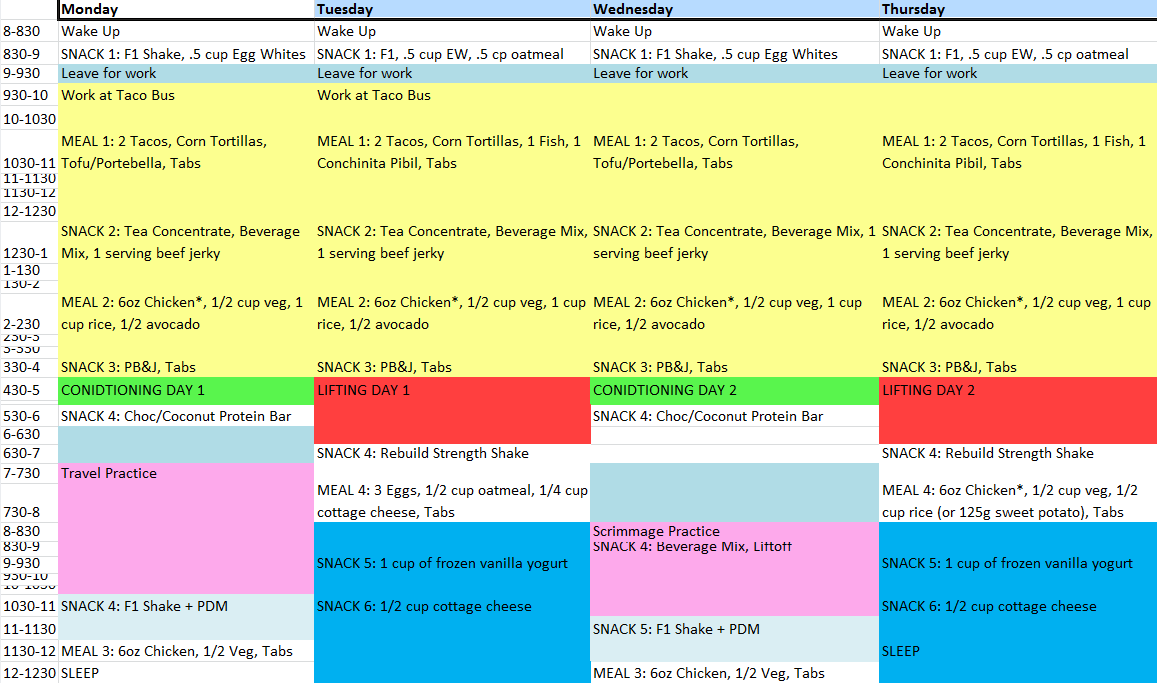


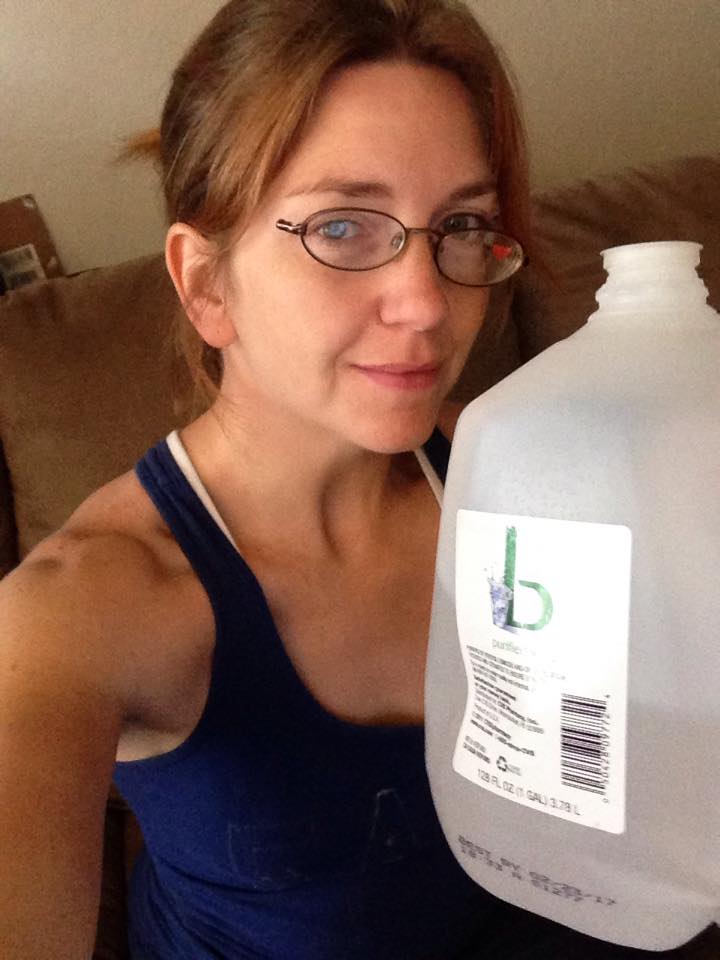


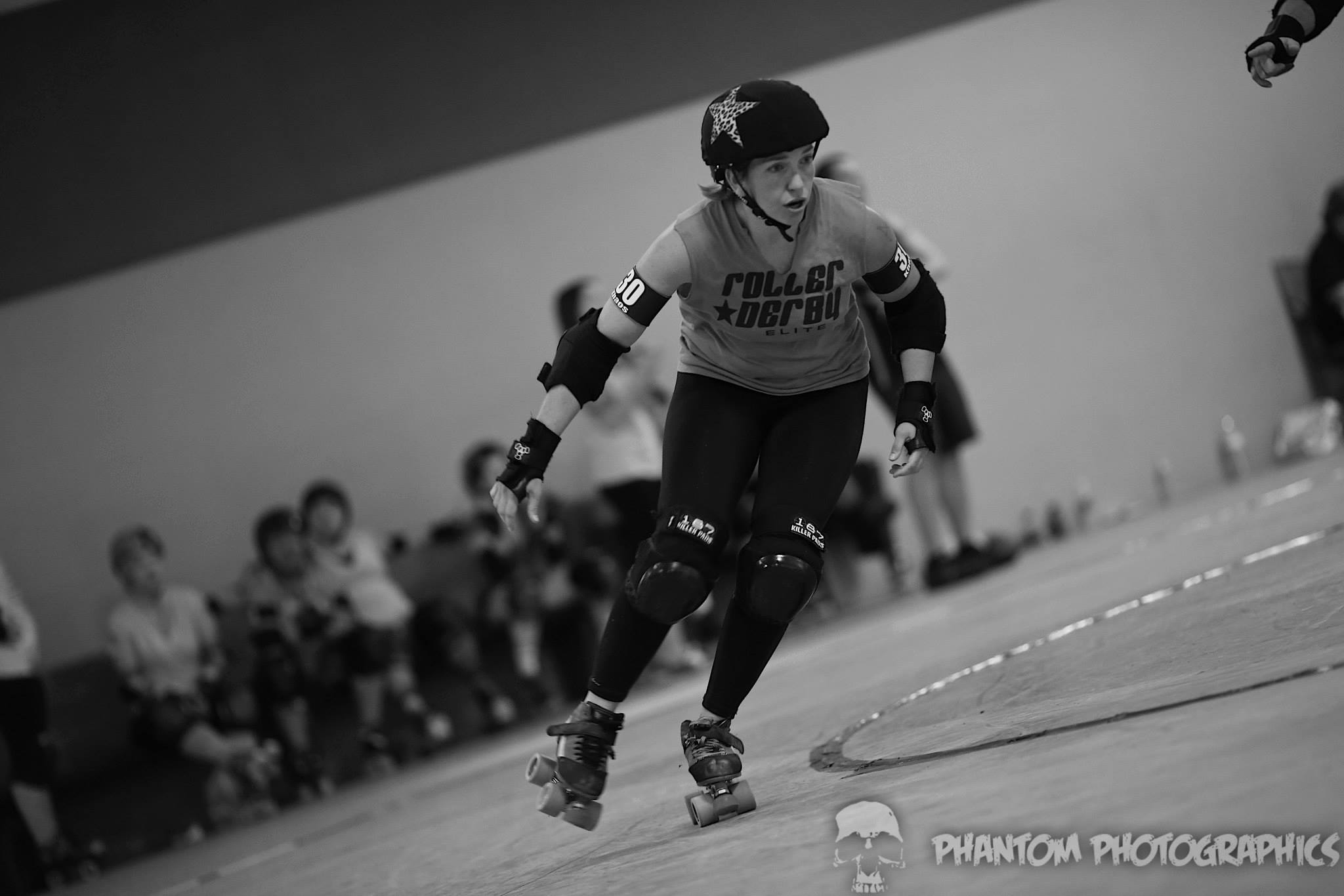


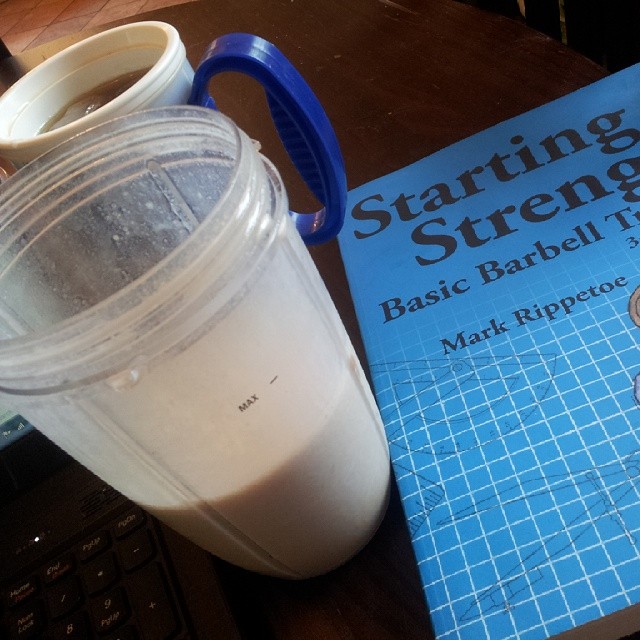
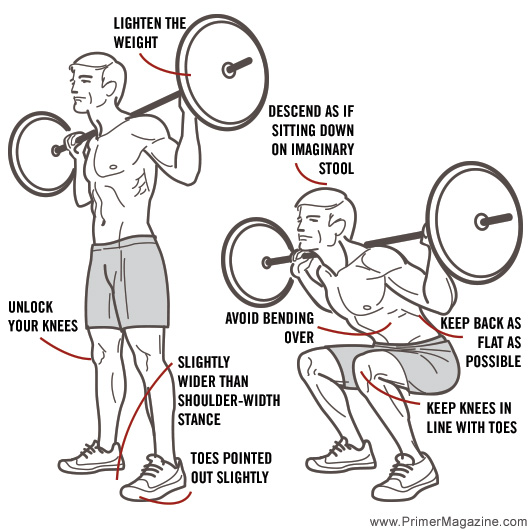
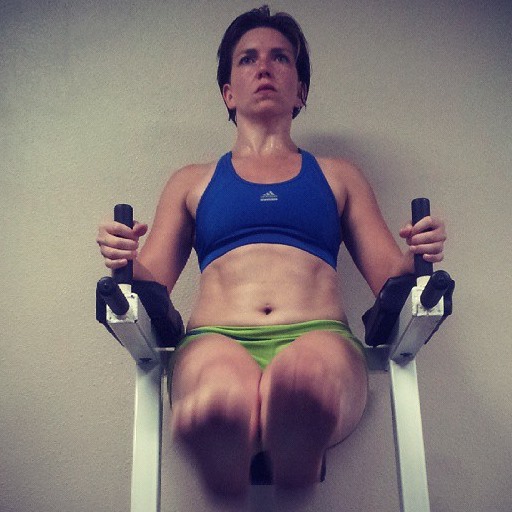

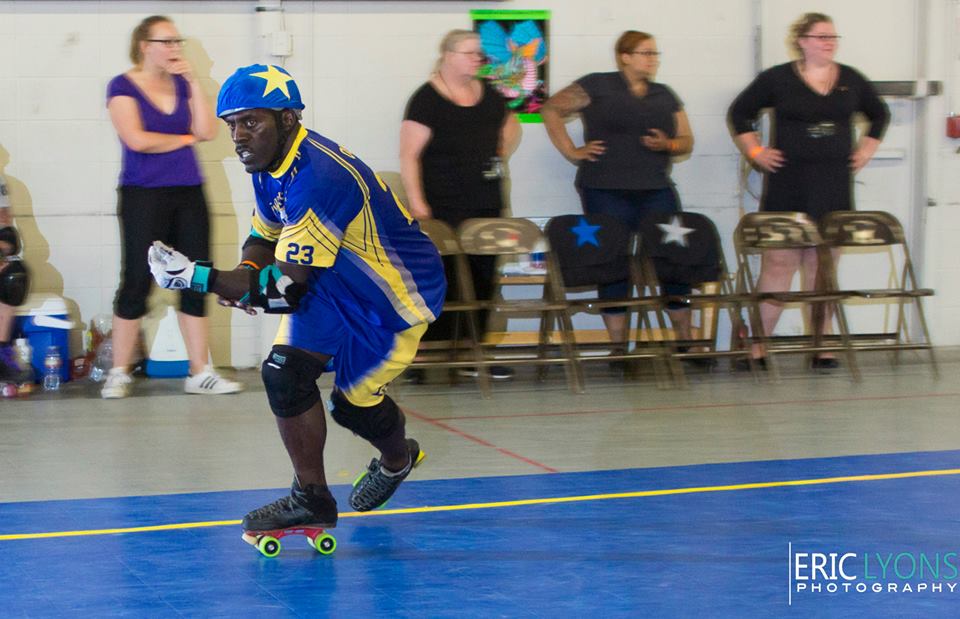

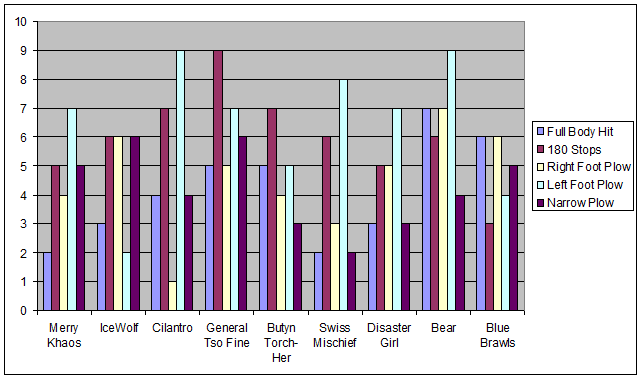




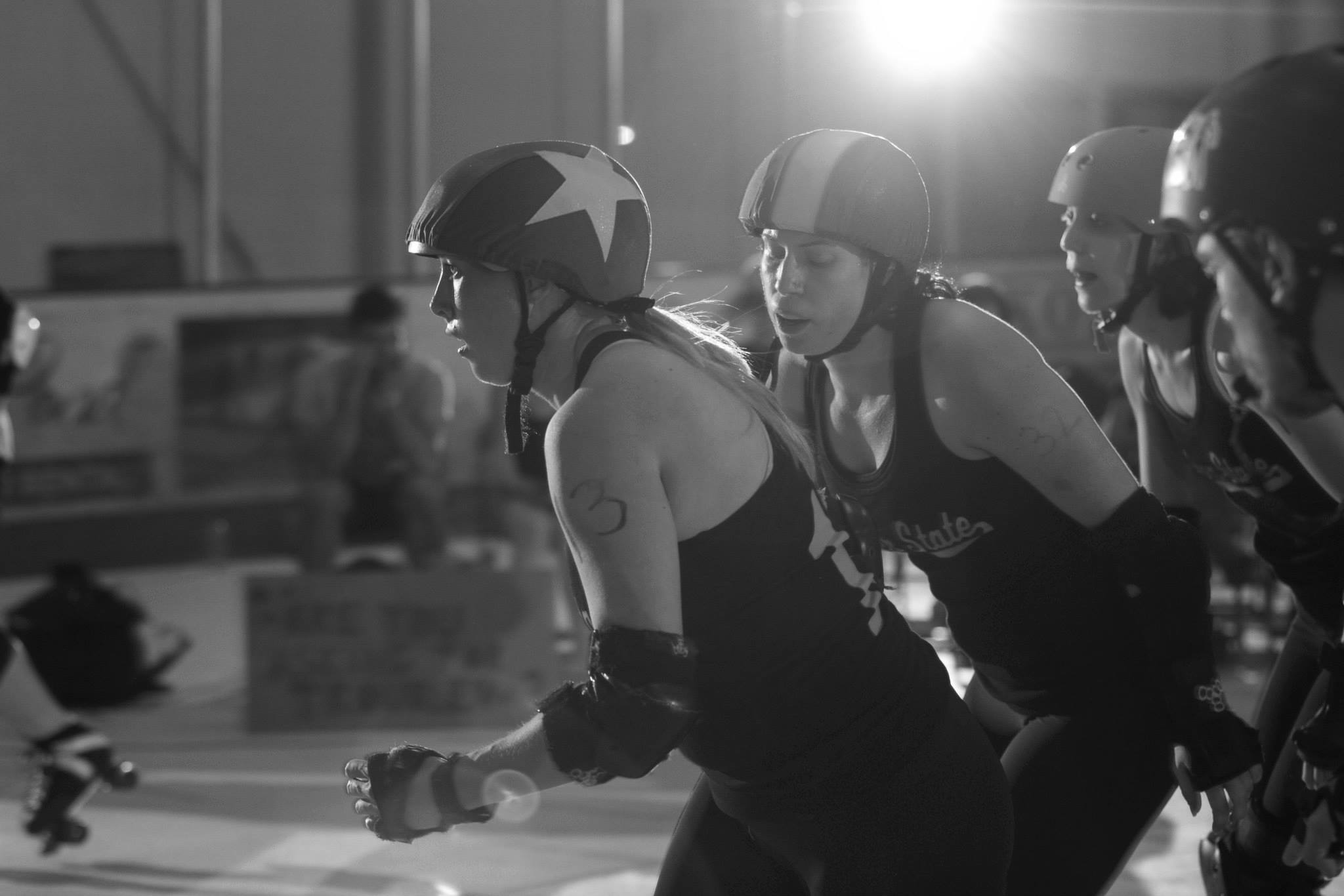

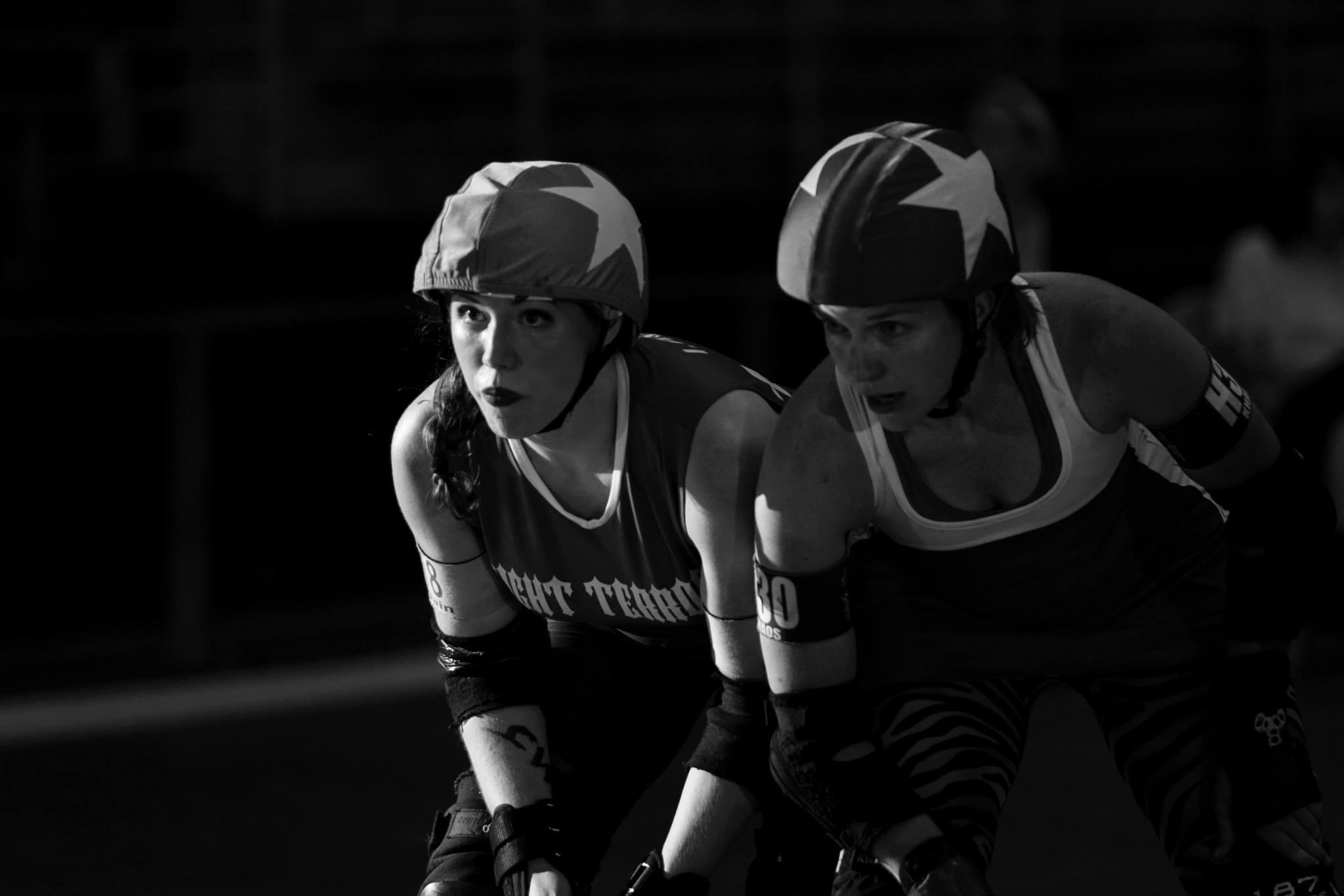



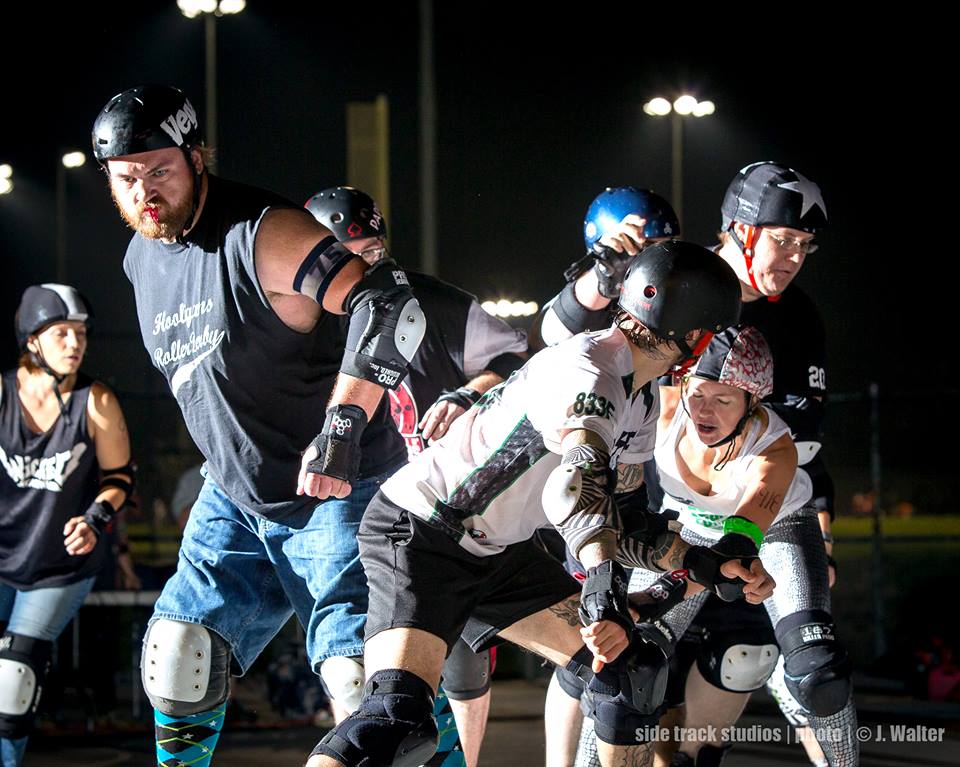

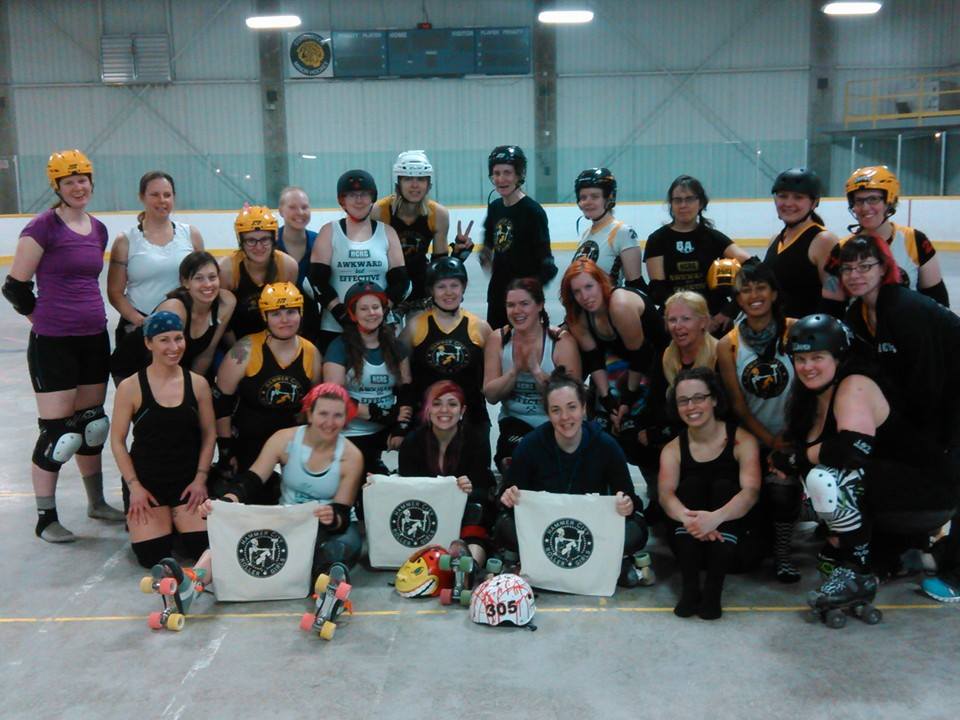


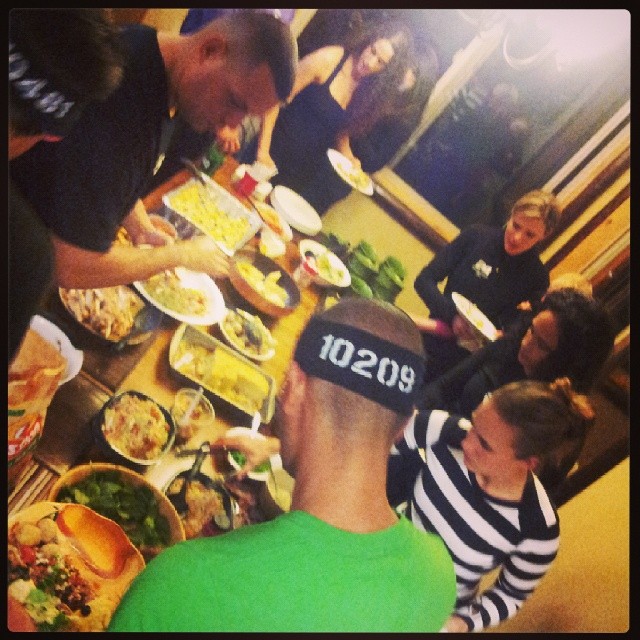


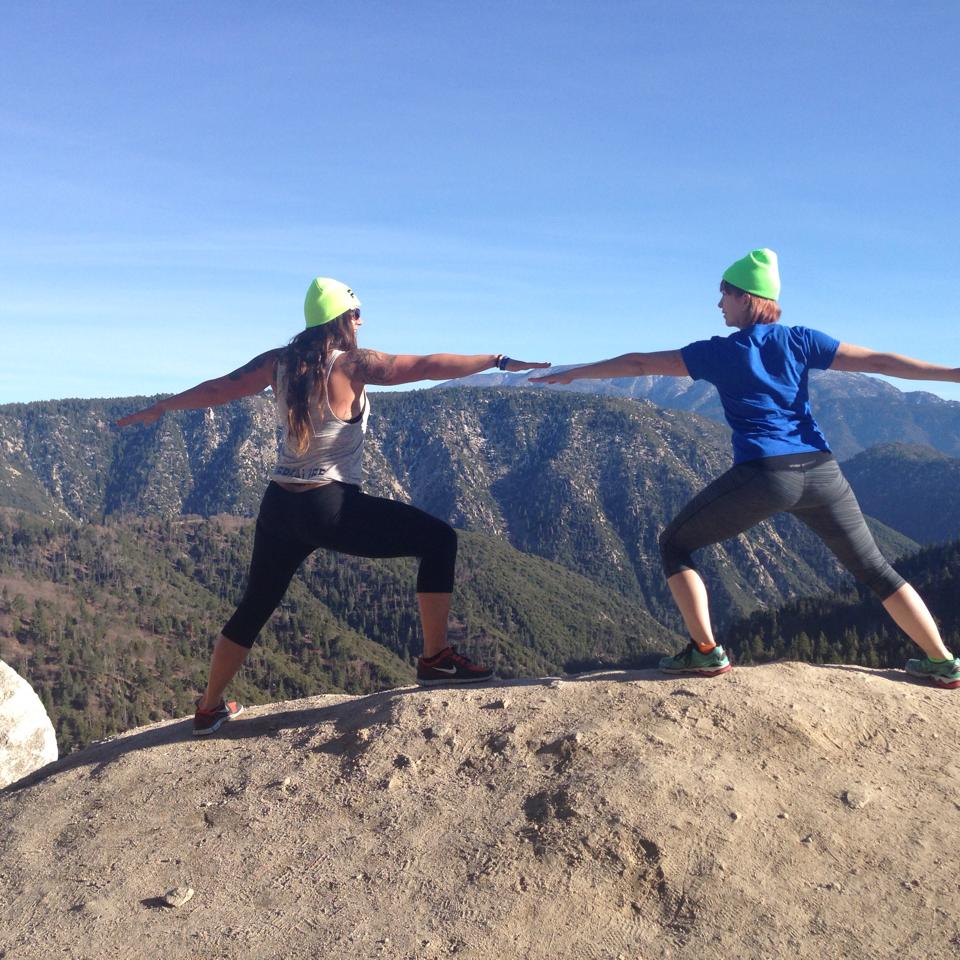


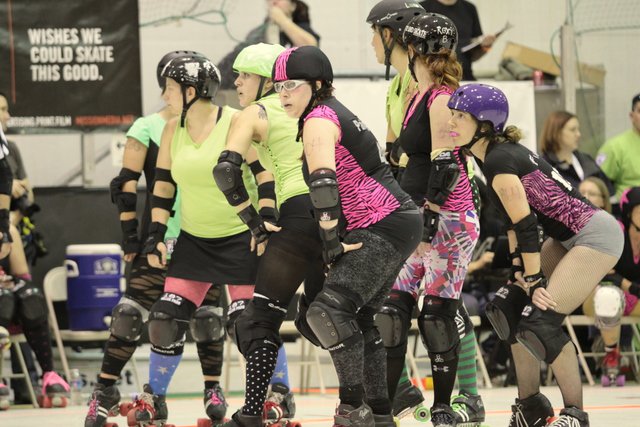




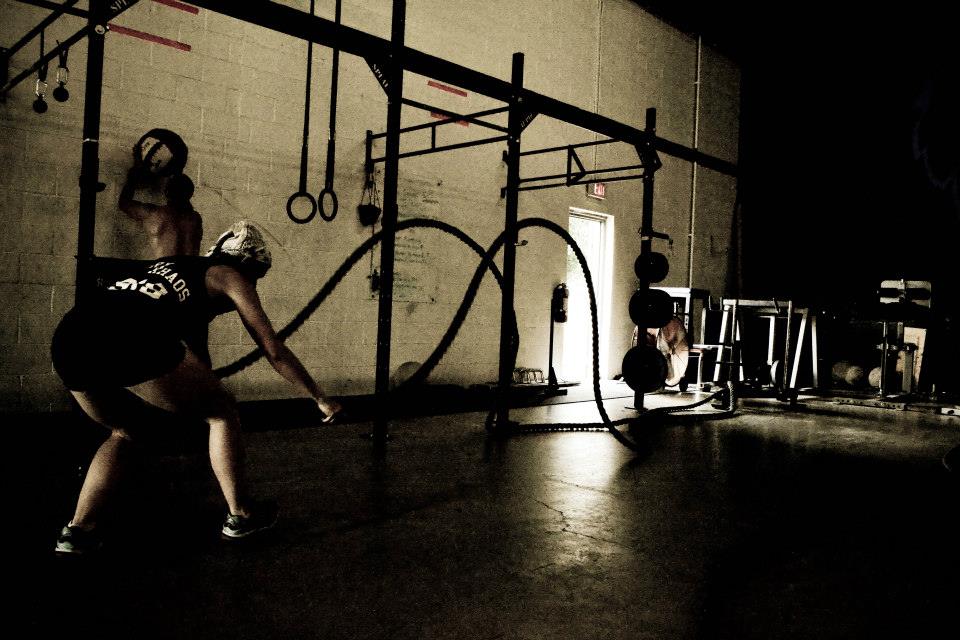
 Khaos Theory Derby