The life and times of Merry Khaos and her alter-ego, Kristie Grey. A romp through the inner workings of a mind in roller derby athletics, training, and business management.
There’s been a “12 Reasons you should watch roller derby” buzzfeed article floating around. Guess what, folks? Some of it they got right! Some of it they got eeeehhhhh…..
So I’m rebooting this blog! It was one my first popular article on Examiner.I’ve re-written some of the explanations, but I’ve kept the headlines the same. 2010 derby or 2015 derby, these are still the 10 reasons you should watch roller derby. (PS Most derby leagues still don’t have seating, so you may want to pick up a Coleman Stadium Seat for your comfort at the game.)
The WOW factor How many of your friends watch roller derby? If the answer is “many”, then maybe there is something to this. Maybe they have an in on something. If your answer is “none”, you can introduce your circle to the fast-growing sport on the planet. How cool does that make you look? Roller derby is a completely unique, high-impact sport that is totally inclusive of age, gender, nationality, etc. It is an international phenomenon that grows every year. In 2018, the third Roller Derby World Cup took place in Manchester, England, hosting 38 countries, including the Czech Republic, Korea, and West Indies. Barcelona is the stage for the third Men’s Roller Derby World Cup in April 2018, where 24 teams, including Japan, Chile, and Denmark will compete. The speed, power, and finesse on 8 wheels is enough to keep you entertained, even if your local team isn’t allowed to sell beer!
Texas took on Missouri in the men’s championship of State Wars in December 2014, with hard hits and fast feet. Photo by Phantom Photographics.
The social works of derby teams Roller derby teams are often non-profit organizations themselves; regardless you will find your local teams out at charity events and raising money for good causes at their home bouts. Tens of thousands of dollars have been raised worldwide for charities. Whether promoting suicide prevention, helping wounded animals, collecting for homeless shelters, promoting love as love, or helping a city rebuild after tragedy, derby has covered the spectrum of charitable causes. The Girls on Track Foundation was founded to keep young girls involved in the sport of roller derby, thus building their confidence, courage, and leadership skills. Locally, our own Tampa Roller Derby is involved with Big Cat Rescue and Girls on the Run,
Athletic prowess These are athletes. Teams practice between two and six times a week, and the participants work out beyond their practice limits. Yoga, crossfit, powerlifting, Spartan Races, aerial silks… the cross-training of roller derby knows no limits.
Impressed by your favorite hockey player doing fancy footwork and scoring points? Wait until you see Lil Slinky of Stockholm duck and dance through the pack effortlessly. Get hyped up by your favorite safety playing all over the field defense? You will love seeing Alli Kat Scratch of the Tampa Tantrums crush the hopes and dreams of her opponents. The feats of agility and pure strength are display at any game (whether it’s the 500-person strong Rose City Rollers or 20 strong Twin City Terrors).
PHDiesel makes a lap for Team Florida at State Wars. Photo by Phantom Photographics.
“Any Given Sunday” Just like in any other mainstream sport, roller derby has the “any given Sunday” mantra. The Oly Rollers came out of nowhere in their first season as a WFTDA* team, and took the Hydra as the underdog. It is possible for any team to sweat and bleed their way to beating a giant of roller derby. Tournament play has seen a lot of international teams come in and shock the world with their undeniable strength. Teams from the United Kingdom, Germany, and Australia have been doing damage in WFTDA and MRDA** rankings the past few years.
Less expensive than a movie date
An American movie date can easily breach $75 (IMAX anyone?), and if you’re counting dinner, you can bet on a night breaking $100. Yes, there are some games that offer beer or full entrees (thank you Charm City). Yes, buying merch from Tampa’s Wrecking Mall might up your final cost for the night. However, most teams still play in roller rinks with small concessions and bake sales. A derby date can easily stay under $30! Derby encourages interaction and conversation, whether you are with one person or a group, and it’s way better than sitting awkwardly in a dark theatre with your Tinder date. Bring them to derby!
Who needs a movie when you can be next to the action? Photo by Phantom Photographics
Community! The roller derby community is a very inclusive place; if it’s a tailgate kind of game (you can check with the league on their event page ahead of time), get a group together and hang out in the parking lot. My first team was notorious for cookouts and beer trading in the parking lot of the Olympic Skating Center before games. Groups often mix and mingle. Don’t know what’s going on during the game? Ask the people beside you (or look for someone with a “Ask me about derby” sign). Regardless of the side you are rooting for, everyone is super friendly and inclusive. You will make friends in the fans, the refs, and the league members themselves. Labels and judgement have no place in our house, so come one, come all!
Direct interaction with athletes
How many sports teams offer one-on-one time with their athletes? Every game and after party is a meet and greet, and leagues host events throughout the year where you can meet your favorite skaters. You can catch up with league scores from those directly involved, and can really feel like a part of the organization even as a fan. Websites like Flat Track Stats even gives you chance to follow how your favorite travel teams are doing, even if the team hasn’t received official sanctioning ranking. With the popularity of tournaments growing in roller derby, keep your eyes peeled to your team’s social media, it’s likely their travel games will be live streamed at some point. Then you can even watch them from home.
Junior derby is gaining momentum! Your son or daughter can play, or you can watch the future of derby at local events. Photo by Phantom Photographics.
Unique characters Mainstream sports are chuck full of big characters, and roller derby does not disappoint. Be warned: It is not make-up and fishnets. It is the heart, soul, blood and tears that they pour into their work that make these athletes into giants and idols. Big characters in derby are the big hits, the big jams, and acrobats on skates. Whether your team matches in black compression pants, or dons old school mis-matched DerbySkinz and stickers on helmets, you will see the personalities on and off skates. It’s not just the skaters that make the game exciting: The announcers of roller derby are some of the most colorful characters you can imagine. Plus they are super knowledgeable about the game, so make friends with them.
You might find a new love Skaters, refs, NSOs***, announcers, medics, and coaches have to come from somewhere. Often, they come from the audience. Fans, friends of the fans, and the munchkins of fans are the future of roller derby. Even if you never end up skating, your support is vital to your league. Being a fan and posting about the games, inviting your friends to the events, watching WFTDA.tv, watching the YouTube archives of bouts… it spreads the goodwill of derby to people outside of the community who may never have heard of derby before. Or, maybe they went to a game three years ago and “have been meaning to return”. Maybe you can be the one to remind them to spend a Saturday night at the rink.
Derby is always looking for more officials to help at games. Skates not required! Photo by Phantom Photographics.
It’s just plain FUN The excitement is infectious. Regardless of your familiarity with the sport, the skill and strength of roller derby pulls you in. It is impossible to resist cheering as your jammer breaks through the pack. Try not to flinch when your team knocks an apex jump out of the air. The more you learn about your league, the more fun you will have each game. BUT the only way to learn more is to actually go!
Calling it off! Photo by Phantom Photographics.
If you have been pushing off attending a roller derby bout, it’s time to get off of Facebook and head to the rink. Friends, excitement, and real social networks await you. Youtube offers some great fan tutorials, or wait until you get there and inquirein person. Spend some time at your local games. You’ll be cheering more than at a Marvel movie, you’ll get closer to the action than nosebleed seats at Lincoln Financial, and you will build relationships unlike anything else you have experienced before.
*Women’s Flat Track Derby Association
**Men’s Roller Derby Association
***Non-Skating Official
Support Khaos Theory by making a donation to the blog today:
Thunder City Derby Sirens Photo by Phantom Photographics
What makes us want to be on a roller derby team?
I’ve been thinking about this topic for months. Tried writing a blog a few weeks ago and I couldn’t actually translate my feels into a coherent written structure. I’m not talking, “Why do we love the sport?” or “Why do we join a league?” But rather, what drives us all to make a travel team? Or be drafted to a home team?
Before my home league’s travel team votes on the charter, each skater gets to talk about what they had to offer, and why they wanted to be a part of the team. It was interesting to hear the answers from those dropping their name in the hat for the all-stars versus the b team. There was quite the difference in theme of statement from one team to the other. I realized that those going for the the all-stars had a much different theme of answer than those wanting to be on our b-team. It got me thinking more and more about WHY we want to play on teams so badly.
If you ask a derby skater why they want to be on a team, the most common answer you’ll probably get is: “I want to play in bouts!” (Or do I call them games in the blog now?) **winky face**
They want to travel. They want to play other opponents. They want to prove themselves. Playing in bouts is a bit about the attention of everyone watching you, but should also be about the practical applications of skills and drills. Bouts are the place we test ourselves against an opponent to see if we have improved. I have been on many teams at this point, and I can say that being in a bout means different things based on the culture your team builds.
Tampa Roller Derby on our way to Texas for a weekend of the derbs.
Some teams value bouts strictly as ranking potential.
Some teams just want to enjoy the fun of the sport; including all that boutfitting, production shenanigans, and after parties offer up as they play against your family from a different city.
Some teams want to try out what they have been drilling in practice, to see how their strength and mobility have improved.
Some teams play bouts just to raise money in their home venue and have their friends and family come and watch them do the thing that they love.
Some teams work really well together on bout day, and everything is low stress and fun.
Some teams may work together, but tension runs so high that benches become explosive.
Maybe a team just has that one player that yells at refs or complains about calls, and because they’re a “superstar”, the behavior isn’t squashed. That behavior spreads to the rest of the team, and the bench becomes a 3 headed monster.
Maybe the bench coach is that one superstar yelling.
Or maybe everyone loves each other and the sport so much that everyone is just focused on the fun of the game.
I should mention that teams don’t always take the time to create a culture. Some are self-aware enough to create a mission statement of culture to promote and strive for. Most derby teams, I have seen, do not even understand that a culture has manifested through coaching habits, attendance enforcement, and superstar treatments. Sometimes an awesome derby culture of fun and support is born organically through individuals gathering for a common purpose. Too often, I have seen leagues succumb to the expectation that certain players get praise and playtime, and those players can do and say no wrong. Everyone else are plebeians and must fall in line and teach themselves.
If you just had an ‘ah-ha’ moment, recognizing that your team has not given itself a Culture Goal (or worse, you’re in one of those cancerous league situations!), maybe it’s time to sit with your steering committee and decide on some core values for the league and individual teams.
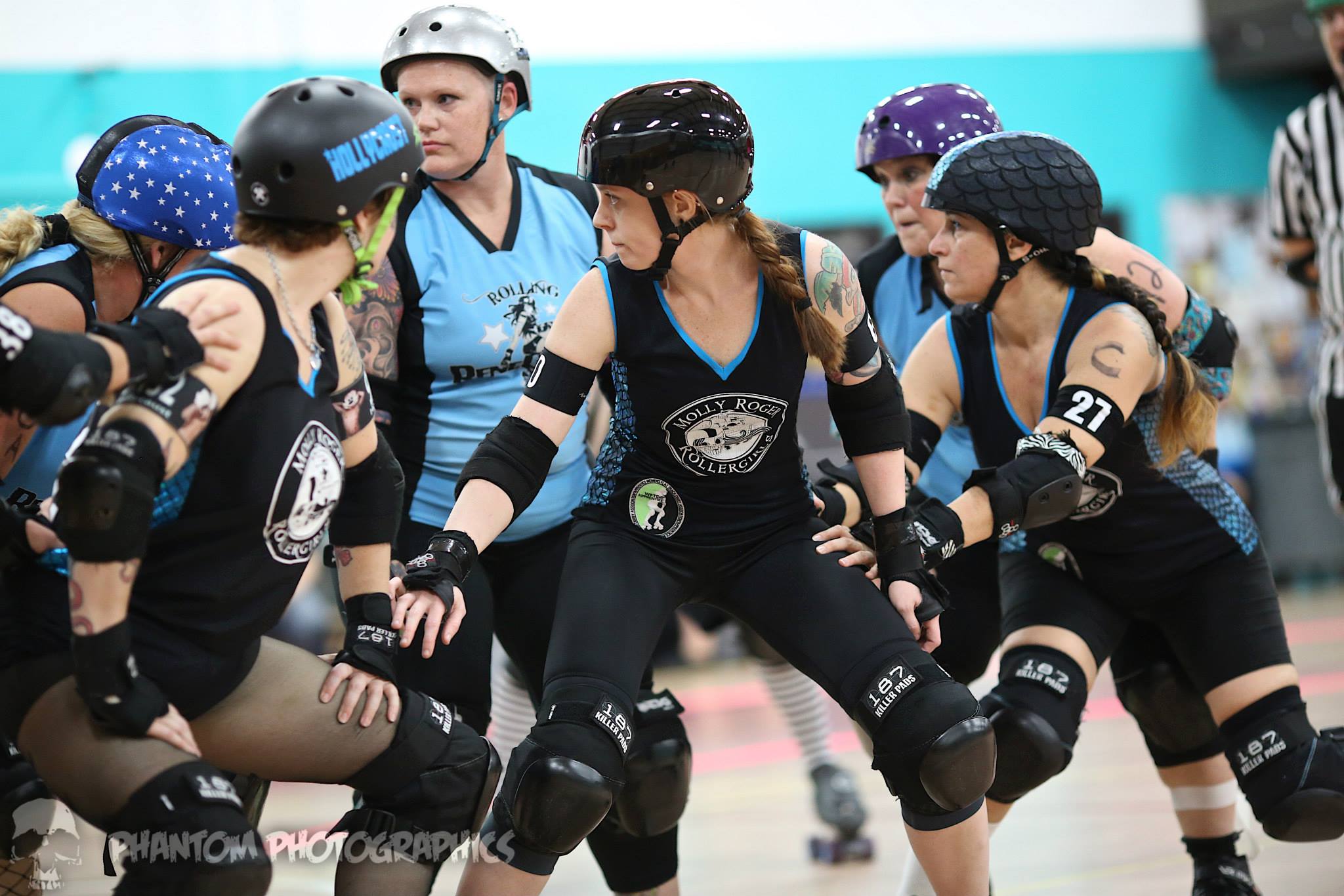
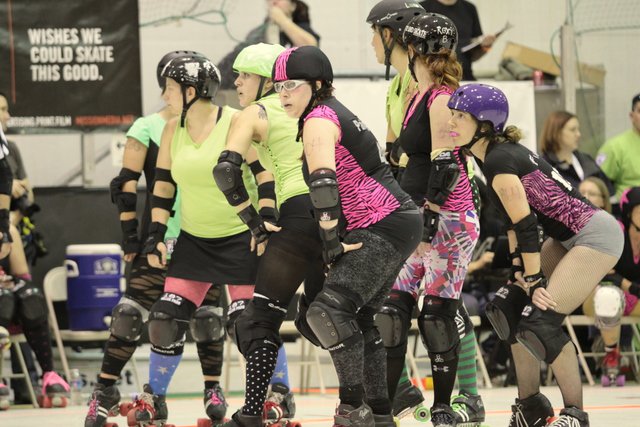
Molly Rogers line up against the Rolling Renegades of Sarasota. Photo by Phantom Photographics
Many cultures have this idea rooted into their core values without realizing it: “You will play bouts when you are on the travel team, and we do this to play in bouts.” So the skater immediately begins lobbying for a spot on the travel team, despite dedication. Despite training. Despite safety. Despite their willingness to play on a team. Endgame, we are taught, is: PLAY IN BOUTS.
I have a radical suggestion for you, Roller Derby:
You should not want to be on a team to play bouts. You should want to be on a team to practice roller derby.
Wait, what?
You should want to be on a team to PRACTICE roller derby.
What do I mean?
I mean we need to adjust our mindset.
Bouts are fun, yes. Bouts are what count towards our ranking, absolutely. Bouts are the culmination of our practice time and work together, yes. But it’s just 60 minutes on the clock.
I am not saying we should undervalue bouts, or want to play in them less. Rather, I think we all need to shift focus to being excited for practice time. Most of Roller Derby practices at least twice a week. You are spending far more time with your team in drill, skill, and endurance situations than you are in bout situations.
I do my best to not even worry when my next bout is, because my intensity does not change from practice to practice. I do not show up with different intentions or drive when I know a roster is being decided that night. Every practice is 110%. I pay for this time on the track, so I am going to love it and use it. If I am put on a roster, great! If I’m not, it’s OK because I have practice again Sunday night. I know I won’t be short on derby for the weekend.
Too often skaters put so high a priority on bout day that all they think about is making the roster. They show up just in time, and with just enough intensity to play in the bout. If we could shift the prevailing thought in roller derby to be less “BOUT DAY!!!” and more “PRACTICE DAY!!” think of how many people would value their drill time more? How much would attendance change?
Bout day is a priority because Roller Derby puts an emphasis on it.
To me it is just as fun and invigorating to stop Tazmaniac in a wall drill in practice, as it is to stop her in a bout day situation. Putting our focus on the awesome of practice means more excitement, which means more bodies, which means more opportunities for strategy and teamwork. Which will, unsurprisingly, lead to MORE SUCCESS ON BOUT DAY.
Slayor Moon Rojo Grande, Pup, and Splatypus ready for the Molly Rogers jammer. Photo by Phantom Photographics
When practice time is the center of attention, you can focus on goals as an individual and as a team mate. You can put your energy into what is being practiced instead of worrying about making the next roster.
When your focus is practice, not bout day, you think about your daily cross training differently, and with the mind of making practice better. You know you’re going to be doing five minute jams at practice on Monday, so what can you do on your off day, Saturday, to improve your conditioning for it? Thinking about that every week builds into months and then years of cross training, almost by accident!
When you focus on practice, you get to struggle and laugh with all of your team mates in all the different situations. You get to love the sport and the nuance of the sport.
When our focus is bout day, we get caught up in the spotlight of it. We get caught up in the pressure of performance, but when we focus on practice day, we are all Superstars, and egos are left at the door because no one is watching. When our focus is practice, we work hard for two hours at a time. If we can work hard for two hours, we can definitely work hard for our piece of 60 minutes.
Practice is the proving ground for bout day.
Practice is where we get to push ourselves and learn.
Practice is where we get to high five our family and celebrate victories.
Practice is where we get to tell our friends that bad days happen, and that one bad practice will not equate to a lifetime of failure in the sport.
Practice is where we get to put our head down and do work.
If your heart doesn’t beat with excitement when prepping for training (sometimes up to 5 in a week), why are you in the sport?
Glory should come from within. Achievement should be felt when doing something awesome with your team mates. This is no longer an individual sport. No longer should we put the spotlight on those who have talent, who don’t come to practice or fundraisers or do committee work.The spotlight should be on the weekly warriors who sweat with each other and create the bonds that only practice time can.
Practice IS our sport. I feel like the leagues that recognize and promote that in their culture, have the most success over the long term.
Stop counting down to bout day. Start counting down to Monday.
For coaching and nutrition help for all athletes, or to ask questions, propose blog ideas, or just give feedback, leave me a comment, or drop me a line at DerbyAmerica@gmail.com. I’m always booking league coaching for all levels.
Don’t forget to visit Phantom Photographics’ Facebook to purchase photos and ask him about his cool shirts.
Like my EAT BIG PLAY BIG notes, this is not going to be a verbatim dissertation of what we went over, but more the bullet points of things we talked about and maybe some WHYs involved. We talked about nutrition too, but because I have my notes posted from EBPB up and running, why don’t you just check them out and get the full picture of the athletic nutrition.
WHAT I MEAN BY LIFTING WEIGHTS
Big lifts – Build all over strength and power, utilizes the full bar
Barbells – Build stabilization muscles and helps support big lifts, small movements, and quick twitch.
Free Weights – Barbells and bars; your body must do the work to keep things in place
Plate/Smith Machine – Training wheels; no real accurate measure of weight. Some plate machines are useful (like the leg extension) but usually you can pass by these.
Cable Machines – The baby of free weights and plate-loaded; there is some stabilization work done here.
Free weights and cables should be used as your supplemental workouts. Like your vitamin and protein supplements, they are the extra stuff you do to support the mainline of work. They should not be your primary form of ‘weight lifting’. Mostly because you’re not really lifting weights when you do them.
WHY SHOULD YOU WEIGHT LIFT?
The easy answer is: Because you play a contact sport.
Gnat King Kill getting it done. Strength effects speed and control. It allows him to deal with fast skaters and bigger blockers.
Show me one contact sport that does not require their athletes to weight lift. If your coach tells you to do dry land drills, do you question? No. You question weight lifting because it’s different and new and super difficult. The resistance to lifting in roller derby is not because it’s not helpful or proven to advance skaters – it’s because it takes more effort to do it. And, honestly, it can be intimidating.
From the physics standpoint think of this reason why you should weight lift:
If you can only squat 130 pounds, that means you can only push that much weight (approximately) into your wheels. If you have someone who is 170 pounds hitting you, but you can only respond with 130 pounds – who is going to win?
This is a very basic, crude example, but hopefully you get the point.
Why bench press? I learned during Beat Me Halfway that if you have Magnum PIMP doing truck-and-trailer with you, your arms and core better be able to hold up to the resistance he’s giving you. If he then directs you into a full-speed Screecharound, your arms and body have to be able to deal with as much power as he’s putting into you to transfer to your skates, to transfer to Screecharound to take him all the way to the line.
Arm strength has just as much a place in derby as leg strength these days, as illustrated by the Mass Maelstrom blockers. Photo by Tyler Shaw – Prints Charming Derby Photography
PHYSICS!
(and also, I was so sore the next day)
If you can push a sled with 150 pounds on it, you can push through a link giving you 100 pounds of resistance.
WHAT IS CONDITIONING?
We talked a lot about lift days verse conditioning days.
Your lift days are just that. You’re picking up heavy weight. Your conditioning days involve cardio work, particularly HIIT. This is your tire flips, your hill runs, your wind sprints, your heavy plyometrics. If you do Crossfit, those WoDs should be your conditioning days … so the extra days. WoDs every day will not build your strength the way lift days will.
Myself and McJagged picked up heavy things and moved them around, jumped on walls, and moved around kettlebells for conditioning work
WHAT DOES THIS FEEL LIKE?
Like with derby, we have to adjust to a new feeling when we start weightlifting. If you’ve done plate machines in the past, then you are not used to what it feels like to have 180# on your back, or to pick up 200#.
It feels heavy. It feels miserable sometimes. It feels like you might hurt yourself. Just like it feels when you’re doing a new advanced skill on roller skates. Like those one foot “chomps” or one foot plows.. Picking your foot up and putting it down in front of you, with your toes turned in and your knees touching? That’s terrifying! I was sure I was going to break my leg. I didn’t. And you won’t break your shit just because it feels heavy.
It’s supposed to feel heavy. That’s the point.
DO I NEED SPECIAL GEAR?
Not necessarily.
I wear knee wraps because I can feel things shift around in my right knee when I squat and it’s weird and I don’t like it. With lighter weight, you don’t need belts, wraps, wrist grips. As you start lifting, talk to people around you about the gear they have. You’ll learn when you’ll need to get a belt, or if you want to get gloves.
Wear flat shoes or no shoes. Those weird toe shoes? They actually work really well for lifting. So do Chuck Taylors. So does nothing. Just like you wouldn’t buy Bonts for your first pair of skates, you shouldn’t go buy the special fit lifting shoes before you start lifting.
WHAT ARE THE LIFTS I SHOULD DO?
No questions asked you need to do:
Squat
Deadlift
Bench Press
Lifts that I think you should incorporate:
T-bar Row
Front Squat
Hack Squat
Incline Bench
Sumo Deadlifts (or Sumo/Russian)
Upright Row
Overhead Press
WHAT SUPPLEMENTAL LIFTS SHOULD I DO?
This one is tough. It depends on your programming. Ones that I make sure I incorporate:
Leg Extension
Glut-Ham Raise
Pull-Up
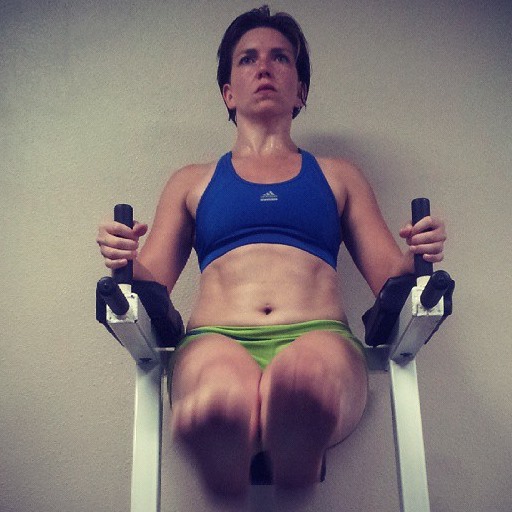
Hanging Leg Raise
Bent Over Row
Lat Pull Down
Seated Row
WAIT – HOW DO I KNOW WHAT TO DO?
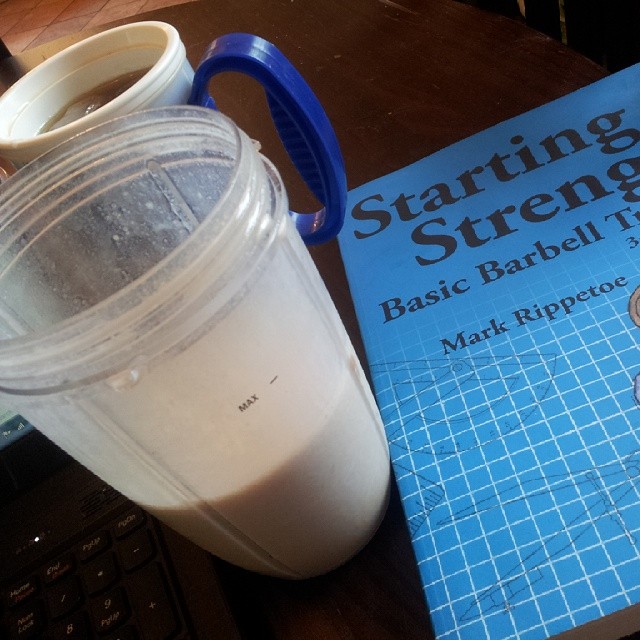
Guess what? More reading for you!! What I recommend to EVERYONE is to pick up Mark Rippietoe’s “STARTING STRENGTH”. There is an app you can download called 5x5Stronglifts that will help you through the whole process.
Here’s the idea that I can pass on to you that I started with… 5×5. So you’re doing 3 lifts each day, 5 times, 5 reps. This does not include your 5 rep warm-up. When my plan was set for me, we did one lift for the upper body, one for the back, one for the legs.
I then did 1 or 2 supplemental lists each day (unless I was crazy spent). Getting someone to help you set up a training plan around your skating schedule is awesome. I had a couple people helping me along the way. And don’t be afraid to tweak your schedule as you progress. After your first four weeks, you should be in a routine, but before that it’s ok to move things around and figure out what works best for you!
Learn form on your own through the BUFF DUDES series. They’re really a great, short series of tutorials.
HOW DO I KNOW HOW MUCH TO LIFT?
Again, having a friend that knows lifting is helpful here. If you don’t, go to your gym and find the biggest dude or lady who is both strong in the upper and lower body (or ask someone at the desk of who to ask), and humbly request help.
Think of it this way: If someone came up to you at an open skate and said, “Hey you look like you know what you’re doing. I’m trying to get into roller derby, but I don’t know how to plow stop, can you watch me real quick to help me?” You’re not going to tell them to fuck off. Lifters feel the same way about their sport. I promise they’ll be nice to you.
Step one is to find your personal record (PR), also known as your one rep max (1RM).
Do not plan on doing your 5×5 during max days. You also shouldn’t try to max out multiple workouts for the same body part. For example, don’t try to max out back squat and front squat on the same day.
To max out, do your warm up weight (people can help you figure out what that would be… for me, my deadlift warm up has ALWAYS been 135#, and my squat started at 100#, bench was 45# … these are good starting points). Do 5 reps. Your buddy can help you go up in weight. Do 3 reps. Then up in weight and do 1 rep until you can’t move it. Boom. 1RM.
Plugging these maxes into your 5×5 Stronglift app will create a nice little “oh this is what I lift today” guide for you. You can contact me if you want something more specific.
You call it extreme, I call it “what it feels like 185# on my back”
SO I JUST LIFT FOREVER NOW?
Things can change up, but yes, now you just lift. In a 5×5 program, I do like incorporating a deload week either on week 5 or 6. A deload week is when you do your lifts, but at 50% of your max. It gives your body a chance to recoup.
When I first started this program, I was going up in weight for some of my lifts each week, not up for others. The stronglift app helps you with that.
Setting goals will help keep you focused and your training tight so that way you don’t get bored.
OTHER NOTES
You will plateau. You will have bad days at the bar. It happens. Just like derby. Sometimes you have enough sleep, you’re hydrated, you’ve eaten enough, and you just can’t squat the bar the way you did the week before. It’s ok. It happens. Seriously.
This can be new and can be scary. Just like derby. Don’t be put off from lifting by yourself because “You don’t want to hurt yourself”. There is just as much risk for injury in this sport as others. If you play derby, you know that you can have someone there with you, you can be in the process of being coached, and you can do one thing and still hurt yourself. Don’t fear injury for the sake of fearing injury.
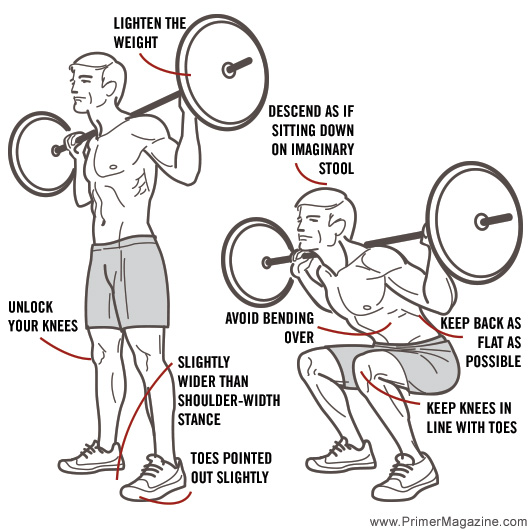
You are probably not going parallel on your squats. If you have never squatted before, start with BOX SQUATS. Your new gym bro can find a good box for you. It should be low enough that when you sit on it, your legs create an angle lower than 90 degrees.
Your back is going to hurt. That’s because this will be the first time you’re fully using your back for a lift. All the time I hear “Oh man, my low back hurts! I must not be deadlifting right.” Or you’re deadlifting exactly right and you’re using muscles you never have before. Your back is going to hurt.
If your back is weak, your squats will suffer. “What?? But squats are a leg lift!” Yes, but the bar is on your back. So if you can’t support the bar, you can’t squat it. It’s possible that your squats may be lighter than what your legs can handle at first, because your back is not strong enough.
RECORD YOURSELF SO YOU CAN SELF-CRITIQUE AND GET NOTES FROM FRIENDS. It seems super narcissistic, but you can correct between sets sometimes! You can send the video to your friends from around the country and say “Hey is this parallel?” or “what am I doing wrong?”
When you’re lifting, EYES UP HIGH! Pick a spot towards the ceiling, look at it. Do not look side to side. Keep your weight on your heels, you should be able to wiggle your toes.
I think that’s about it!
Drop me a line if you want some extra help or have other questions about setting up your program. Your offseason program is going to be different than your in-season program, so I can help you with that stuff too. When in doubt, read books! 531, Beyond 531, and Starting Strength are the ones that have been recommended to me. Drop me a message at DerbyAmerica@gmail.com with questions or if you have anything you want me to address.
Imagine rushing up to the backs of four very strong, stable skaters at near full speed. Imagine the blur of the yellow tape on the floor, the glare of flashbulbs off of the plexi glass, the noise and the cheers, and the pounding of your heart in your head. And then somehow, you’re backwards and ducking. Suddenly you’re pushing through a hole in the wall you had not seen, but you sensed. With twist and turns and ducks and power you hold your ground and then see daylight. You push. You push like you pushed the prowler, you twist like you did in practice and you move your feet like you have been training for four years.
And then you’re in the air of the arena again, crossing over with fluidity against the draining sap of the sport court that sags when you stop pushing. You’re in the wide open with people looking at you and cheering and unsure who this skater is that they’re just really seeing for the first time. And you think about what just happened, and you don’t view it from a first person perspective, because you don’t feel like you really did it, you just let it happen. Your body did it for you. You let yourself go to the situation and trusted your instincts and let power and intent wash over you and drive you through.
And you were successful. But you don’t quite know how.
That was most of the Championship bout with the Mobtown Mods for me. I remember doing things, kind of. I couldn’t tell you how. I just let my body go on autopilot. The vets had always said that eventually it would happen. You would find your zen and just start doing things. It started in practice that week and continued into the game.
When it’s time to toe up, will you be mentally prepared? If you had asked me to jam against IM Pain a year ago, the mental strain would have been too much. Photo by Down n Out Photography
What is the MENTAL GAME?
In every sport there is the talk of “The Mental Game”, but I feel that the term gets thrown around to mean many different things. Your mental game could be how you handle pressure, how you react to new situations, how you trust your feet, how you read a pack, how you release fear and go on autopilot, how you steel yourself after a team mate has gone down with injury. I am going to talk about a few things you can do to increase your mental stability during game play and practice time and what I have done to help better myself internally for roller derby.
Make Practice Time Harder Than Game Time
You play like you practice. We have all heard it, and hopefully digested it and spewed at someone else. If you play like you practice, and you allow yourself to get away with drills at 50% than you are going to play at 50%. If every sprint you are pushing your hardest, and every step of footwork is done with hard, clean precision than you will slowly prepare yourself for the intensity a game demands.
If you find yourself able to go through the motions of the drills easily, you are not pushing yourself. Gotham is not a three-peat champion because every practice they do fancy new drills that you haven’t heard of. They are champions because they do the same drills over and over and over. Not until they are perfect, but until they can’t get it wrong.
The moment that you are bored in a pace line, that you catch yourself thinking “This again?” that is the moment the mental game kicks in. You need to build the mental strength to do that drill, and do it with focused strength and intention. Bring yourself internally in that moment and think about doing the drill in a way you never have: look behind you more often, take note of the wheels the people around you are wearing, learn to sense the people around you and how close or far they are, learn the width of the track while you are bursting harder and stopping faster.
Every moment you can sharpen your mind while in drills will translate to better gameplay at game time.
Krissy Krash always makes her workouts way harder than game play could be!
Set goals
How will your mind know where it’s going, if you don’t decide where you’re going?
Goal setting should not be arbitrary or hastily done. Take 30 minutes of quiet time. No TV or internet, and turn off Spotify; just you, a notebook, and a pen sitting together. Center yourself and think about what you want to accomplish in a year. Write it down. If it’s one over-arching goal or many goals, write them down. Now look at them and see if you can turn them into SMART goals (Specific, Measurable, Attainable, Relative, Time-Specific).
Statement: Be on travel team.
SMART Goal: By June 30, 2015, I will be a starting player on the All Stars.
Once you have your year goal, you can work backwards. Your relative goals don’t have to be a replication of the long term goal. If your goal is to be an all star, what smaller goals can you set for yourself that will make you all star material?
Possible Goals:
Between now and December 31, I will attend 1 boot camp per month.
Between now and December 31, I will decrease my 30 lap time by 15 seconds.
Between now and December 31, I will increase my squat PR by 75 pounds.
These goals are not “I will be looked at by the all stars”. You cannot control when the all stars will actually begin considering you, however if you make self-improvement goals that make you a desirable skater for the all stars, you’ll be working towards your goal of being one. Let’s break it down further. So you have mid-range goals, so let’s make some shorter term goals.
Possible short term:
In 6 weeks, I will decrease my body fat by 3%
In 6 weeks, I will be able to do a 120 pound front squat.
In 6 weeks, I will be able to hockey stop.
Boom. Just keep making your goals smaller and more precise, and keep working backwards. If you find that you are creating goals that do not relate to the longer term goals, ask yourself why you want to achieve those things. If I just randomly say I want to be able to do 5 pull ups, ask yourself why? How does it relate? Maybe add in another long term goal so that you can see the long term advantage of being able to do those pull ups.
When your training is hard, when you are feeling discouraged, come back to these goals. Read them daily. Put them in a spot where you can be reminded of them. Use post-it notes. Get dry erase markers and write on your mirrors. Remind yourself and you will be motivated forward. Your brain is easily set astray – keep it on track.
By my buddy, @MacheteBeast
Make declarations, set intentions, listen to motivation
I am a firm believer that the energy we put out is the energy we put in. Motivation and mental clarity takes work and maintenance, just like our fitness and nutrition. Our mental game does not only come when we put on our sneakers or skates, our mental game is present in every facet in our life. We believe what we tell ourselves. If you spend your ‘real life’ enveloping yourself in negativity, no amount of positive reinforcement during training will help you overcome a difficult drill or a plateau.
When you wake up, listen to an audiobook of personal development, or go onto YouTube and find a motivational video to watch and listen to. (Ted Talks has a lot of good stuff too.) Listen to it, without distraction. Absorb it. Take those first minutes of the day for yourself and for your mind.
Then, write your intention and declaration for the day. Make them strong and clear so that you and the Universe know what it is you are going to achieve that day.
Examples of intentions:
I intend to meet 1 person today who I can help.
I intend to complete my full training circuit without taking extra water breaks.
I intend to run for 45 minutes.
Examples of declarations:
I am worth a healthy life.
My past does not define me.
I am greater than my bank account
Words of negativity are not my truth. I do not have to bend to meet them.
I deserve happiness and strength.
Audiobooks full of Personal Development and Declarations: Secrets of the Millionaire Mind by T Harv Eker
The Big Leap by Gay Hendricks
Energy Bus by Jon Gordon
Tribal Leadership by Dave Logan
Start. Punch Fear in the Face, Escape Average, Do Work that Matters by Jon Acuff
Fish! The Book by Stephen Lundin
“Fear is excitement, without the breath.”
Breathe!
We hear it all the time, but why do we hear it? There is the obviously the direct physical advantage to having more oxygen in our body as we’re trying to complete a task. There are multiple mental aspects as well that are often not thought about.
For example, did you know that your brain uses about 20% of your oxygen intake when you are at rest?[1] So if that much is used while you’re sitting doing nothing, can you imagine how important it is to keep your brain running while it’s sending out electrical signals to every muscle and nerve in your body while keeping your mind sharp for physical reaction and strategic thinking? If you are not breathing, you are depriving your muscles of strength AND you are depriving your muscles of strong neurological signals that they need to work powerfully.
Let’s also think about heart rate and breathing and the brain. “Fear is excitement, without the breath” (Robert Heller); when we are scared, we try and starve the fear by holding our breath. Think about when a hit was coming for you, and you weren’t confident enough to dodge it. Think about your first time wearing the jammer panty. Think about if you have ever been in a car accident or ridden a roller coaster.
When we hold our breath all we do is increase the fear. When we are afraid, part of our brain shuts down and stores memories independently[2] – which might be fine if you’re in a car accident, but if you’re in the middle of a jam, you need to be in control. When we breathe, and stop starving our brain of oxygen, the fear turns to excitement. It is a complex chemical process within the brain where we understand that we are not in danger, despite a feeling that we should be. I can’t say it nearly as eloquently as Shirah Vollmer.
Breathing also has a direct effect on our heart rate. (An increased heart rate, which can be effected by the lack of breath, can also cause fear within the body, ps) When we breathe steady, our heart rate comes down. Our heart can keep up with the athletic needs of our body and we can perform more optimally. Breathing has been a source of centering and focus for thousands of years, so why turn our back on the practice now? When it gets hard, when you get tired, breathe.
When I jam, for example, I will count my strides after I break from the pack. I will also have made conscious efforts in every training session to breathe in and out distinctly (whether I’m skating, running, or pushing a sled). It helps me to focus on the task at hand while my body is getting the oxygen it needs.
Moral of all this: KEEP BREATHING!!
By breathing through the hits, I am able to burst through an open spot. Photo by Tyler Shaw – Prints Charming Derby Photography
Practice and scrimmage and practice and scrimmage
We play a sport that is unlike anything in this world. We must play offense and defense at the same time. We take away the stability of our feet and play on wheels instead. Everything about all of the techniques we use are unnatural to our body and must be trained.
Which means that you cannot ever stop practicing.
The mental clarity that you see in the top athletes does not come from luck or talent, but repetition of the game. Earlier I mentioned that drills will get boring. They should get to a point where you can do them without getting them wrong. When you get to that point, make them faster, stronger, harder, sharper.
Push your limits at scrimmage. Play different positions and with different packs whenever possible. I also believe that getting out of your comfort zone in scrimmage can strengthen your mental game. I have spent many years playing in mash up games and in challenge bouts. When I was a lower level, it made me more aware of my surroundings and listen better to the leaders on the floor so I could complete the strategies. I had to think on my feet. My mental awareness and reaction improved because I did not know where these people were going to skate to or do next. I may have been able to hop into a scrimmage with Madhouse Mexi and know where she was going to block, but in a pack with Battery Operated, I had no idea.
So you learn. Now that I’m at a higher level, the mix up scrimmages help me make quicker decisions and communicate more effectively. I am able to play with higher level skaters in a way I never have before, because I understand what they are going to do, despite never having played with them before. At Northeast Derby Con, I had a wonderful jam with Richard Gaudet of Mass Maelstrom. I knew his style of skating because I’ve seen him, but we were able to communicate non-verbally in order to hold the jammer behind me while he guided me from the front. Using my legs and small steps to maintain position, and Gaudet’s guidance and stability, we were able to effectively hold the opposition while we communicated to our other two to play offense for our jammer. (PS when she finally did get around us, we were able to recycle to the front and come back together almost instantly. It was pretty awesome.)
Without having been in scrimmage after scrimmage over the years, I would not have been able to react in such a clean, direct way. The mentioning of Gaudet brings up a good point. Move out of your comfort zone! If you’ve never played co-ed before, why haven’t you? What tools could you learn from playing with different body types? Have you ever played on a bank track? MADE or USARS rule set? Go do something new.
By taking yourself out of your comfort zone in scrimmage, you are putting pressure on yourself that you don’t feel with your home league. Repetition of pressure in a scrimmage situation will help your brain function under conditions of increased endorphin levels and less oxygen (which will be very helpful training if you ever find yourself with the star in the last jam of the game with only 20 points separating you and the opposing team in the Championship bout).
Just saying.
I love the outdoor Hootenanny that happen in Delaware during nice weather! Get a chance to work with a variety of levels and body types. (Look at me and Carnage Asada blocking!) Photo by Jason Walter
Watch footage, talk shop
To be the best at the game you must understand the game on a deep, psychological level. To understand the game, you must watch the game and discuss the game. Not just what motions skaters use, but you must talk out the strategies and the theory of roller derby. Watching footage is not just useful to understand and train for your opponents, but it gives your mind a visual solution to problems when they come up on the track.
Roller derby is a series of “ah ha” moments, no one can argue that. I have overcome many “What the hell?” moments by simply accessing memory banks of game footage I had watched previously. I knew the solution that Rose City had used, so I was able to attempt the same maneuver, or predict the next motion of the jammer because I had already seen someone else do it.
Watching the bouts and then taking the time to digest and visualize yourself completing the motions successfully and definitively will give your brain a baseline of what to do and when to do it. We do the things we tell our brains we can do or have done. If you take the time to do visualization exercises of making the apex jump, completing a Pegassist, stopping on a dime; your brain will believe that you have already done them, and when the situation comes up in game play, the fear will disappear. Your brain will access the file that says that you have done this before, and will present that option to your muscles.
Creating those ‘card files’ in your brain of different solutions for strategic problems is critical in the development of your mental game. Instead of panicking because you don’t know what to do in the situation, your brain will calmly instruct you on your options. It is easy to see what skaters have not watched game footage when their jammer is knocked out of bounds and drawn backwards. Skater who have seen this done before will move forwards, in the hope to suck in the jammers coming backwards, to put them on a negative pass. Jammers will pace themselves and watch the hips of the person who knocked them out of bounds, so that they can enter legally, but as far away from the approaching wolves as possible.
Skaters who have not watched footage will either come right back onto the track, to promptly get a cut track penalty, or they will stare at their bench with that “What now?” look on their face.
Don’t lie. We’ve all seen that pack of blockers that has no idea what to do in this situation because they’ve never seen it done before. Well. You’ve seen it if you watch footage or go to live derby.
Southern Discomfort v Gatekeepers at Spring Roll 2014. Did you watch it? Why not?? Great examples of partner and diamond blocking, footwork, and offensive work. Photo by Mr. McWheely
Go to all the camps, book all the coaches
We all fall into patterns, including our coaches. Our brain needs a little bit of variety to stay sharp. When we are in a familiar situation for learning over and over again, our neurons have a tendency to get a bit burnt out, so to keep it fresh[3] – never turn down the opportunity to learn from someone new. Coaching variety not only offers new drills, but also new explanations of old skills. A new explanation could finally help make something ‘click’ internally so that you can complete a physical skill. When teaching plow stops, specifically, I always tell new skaters who are having trouble with the skill to ask EVERYONE how to do it. You never know who you are going to learn from.
If your league is (sadly) not open to the idea of various coaches, or having a guest coach come in now and again, you must seek out new learning opportunities on your own. Boot camps are becoming very popular across the globe. They are a great chance to get a lot of information from a new source, and have access to new insights and teaching styles. The newness of it will keep your brain focused on the drill, even if you’ve done the drill before or you are advanced at the skill it is teaching.
Going to training events like Northeast Derby Con, RollerCon, and Beat Me Halfway are great opportunities to learn from a smattering of coaches in a short amount of time. It is a great way to learn, and for many they serve as a reboot. They refresh the brain with new and interesting techniques to apply to the drills and skills and coaching that is going on at their league that they may previously have been mentally fatigued by.
Also, it again trains the body and mind to function and perform together in new and difficult circumstances. You’re being watched by those who you may admire. You’re on a floor you are not used to. You are working with people you are unfamiliar with. The situation demands a mental focus and clarity that will benefit you in the comforts of your home rink.
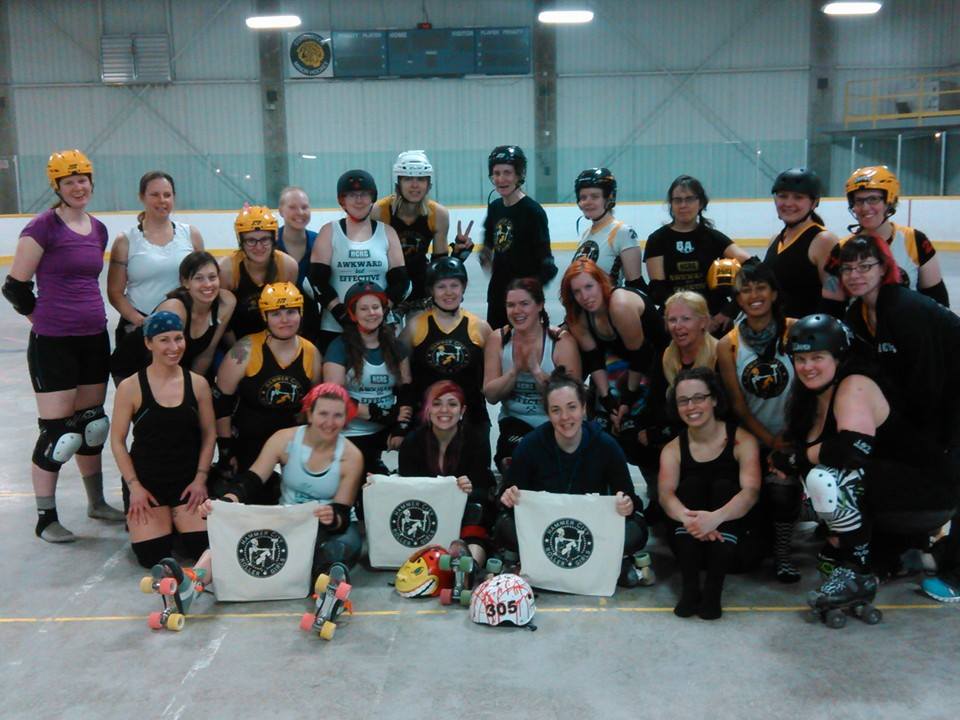
Hammer City brought DNA Coaching up for a two day boot camp! Myself, Antidote, & Shenita Stretcher had a blast, and the teams that participated said they learned a lot – even about the things they thought they already knew
The mental game is a complexity that we must not forget in our journey through training. Even in this blog, I barely touched on how to create new focus in cross training, motivation to complete the tasks you set up for yourself, or how to tackle the depression and disappointment that comes along with injury, naysayers, or plateaus. Continue your journey and continue your personal development. Continue to breathe and continue to challenge yourself to make everything come together in little pieces. Never stop learning. Never stop practicing. Namaste.
Every time I start to get comfortable with the idea of going on a temporary hiatus, I watch roller derby and then convince myself that I can stretch my time for a little longer before my pause. Thank you for making my decision more difficult, Nashville & Madison. This bout at Ashville’s Division 1 playoff has been an awesome way to wake up on Saturday!
Now your next question might be, “Wait, what? Temporary hiatus?”
Life happens, sometimes folks. And so do injuries. I’ve been dealing with knee pain since last October (and to be fair, my doc thinks that the injury I received against Philly is not the same as I incurred when I sprinted into a gopher hole during softball practice). The further I get into physical therapy, and the more we don’t see long term improvement, the less hopeful I am that it can be solved with just nutrition, exercise and patience.
To give you an idea of what I’ve been dealing with – extend your right leg completely. First of all, I have only recently been able to do that. When I do, and when I extend it fully as I walk, there is pain. What kind? Well the spot is just south of my kneecap, on the inside of the leg, and each time I step, it feels like someone is digging a blunt screwdriver into it. When I walk fully (striking on the heel, rounding to the big toe with full leg extension) it feels like a nail and then the blunt screwdriver.
If I stand with all my weight in my heel, it feels like the joint gets “heavy” and everything inside and around my knee cap aches with a dull pain. Every now and again, I’ll be walking and I will experience a pop on the outside of my right knee – I acquaint it to the plucking of a guitar string. This is the flare up some of you have heard me talk about. After a flare up, I cannot straighten or bend my leg for about 5 minutes, and can put zero weight on it.
My flare ups have been improving. The intense pain used to last hours, or days. Now it’s less than a few minutes and I’m fine again. It used to be that I couldn’t straighten my leg for weeks. Now it’s an hour. That being said, there is no rhyme or reason to them. I have had a flare up while demonstrating 180 toe stops, while standing up on my wheels, while bringing myself down off of a bank track, while jogging and kicking the edge of a sidewalk, while sprinting and falling into a gopher hole, while jogging to first base, while walking to the bathroom, while laying down watching a movie.
I have been playing with the idea for a little while now of taking next year off of competitive play to focus on my Derbalife business and to heal up a bit. It’s so hard to make that full commitment to non-competition. If I need to have surgery, than I will be off skates for a while regardless. It is hard to voluntarily say, “I’m taking myself off skates pre-surgery”. I’m really struggling with it.
The plan is to transfer to Charm City. I want to try out for the All Stars (because, c’mon! it’s the Charm City All Stars!! I’ve looked up to that team since I began skating). But for the sake of my body, mind and business I may just aim for B-team and home teams for the majority of 2014. I am hopeful that I can focus on Harm City Homicide for 2014. I am hopeful that I can find the money for an MRI and, past that, surgery.
Harrisburg Area Roller Derby Nuclear Knockouts v Charm City Female Trouble – October 2010.
Even if I hang my skates up, it will not be a permanent retirement. I still haven’t skated at a Divisional playoff. I have a goal of skating at Champs one day as well. It will be realized. It will happen.
Head up. Keep moving. I will do what I can in the meantime and constantly be analyzing and evaluating. There are two more Blitz bouts this season and I just don’t know whether I should push through them. I can’t help but wonder if my team would be better if I just stepped away now so that they can work together without me getting in the way.
I mean – Have I even been an asset this season? Photo by Hispanic Attack from ECDX 2013
How do you make a decision of what to do when you have no idea what is wrong? How do you make a choice when you have no idea when you’ll be able to fix it? Anyone want to start a GoFundMe to help me with my MRI or surgery costs? Anyone want to book me for some boot camps to help me pay for my MRI and surgery costs?
I know in the end I will be stronger. I know a year from now, everything will look different. However, I am so hyper focused on the next two months that it feels impossible to see 12 into the future. I will be pumping some personal development into my skull and continually evaluating my position in life, work and roller derby.
Encouraging words are always appreciated. And thank you for keeping up with my misadventures in recovery. At least my nutrition has kept me peppy through all of it.. #Herbalife #FTW
I fully and readily admit that patience has not always been my strong suit.
I have always been one to rush into decisions. I liked to call myself ‘spontaneous’ when I was younger, but now I see that it was purely rash decision making. Not all of these rash decisions ended up yielding negative results (I certainly wouldn’t be who I am today if it weren’t for rash decisions). Moving in with my brother, going to HACC for theatre, going BACK to HACC for Humanities years later and joining roller derby were all split second decisions. So was auditioning for “There Goes the Bride”. So was starting Herbalife. So was deciding to be a coach. So was both years of Rollercon.
An example of a positive result from a rash decision… Warren and I
That being said, a lot of rash decisions have not yielded such amazing friends and positive results. But “That’s ok,” I’ve always told myself, “They will eventually. I’m on my path to awesomeness.”
So funny thing about that. I’m listening to the audiobook now Start: Punch Fear in the Face, Escape Average and Do Work that Matters by Jon Acuff. (What can I say, the title caught my eye and his writing and narration style is reminiscent of my own so the messages are hitting home really strong)
Seriously. Buy it or download it. Amazing personal development.
In the book he talks about the Path to Awesome. How we’re all on our own Path and how if we don’t look around and take an honest appraisal of where we’re at now and again, then we may not realize that we’re actually on the Path to Average by accident. I have always said that I don’t want to just wait for my turn to die. I continue to hold that belief.
I have recently begun seeking full time employment to compliment my Herbalife business. Let me be clear: I am not putting a halt to my health coaching. I love it, it’s my passion and I feel like my genius lies within the realm of my coaches and clients. That being said, college, relationships and 10 years of minimum wage jobs and botched rash decisions have left me in a hole (ok, a crater really).
I have been bad at being patient.
I did not want to recognize as I graduated that I needed more time to develop my business. I needed more time to become a good coach. I needed more time to understand how to expand my client list simply and locally. I do not regret a single coaching gig. Oh no way! This summer was an amazing ride – full of hills and valleys and corkscrews (actually and figuratively). I have formed strong friendships thanks to my rash decisions of the last few months. Now is the time to change it up, however. I didn’t want to admit that I needed time to become strong at skills and at jobs. I didn’t want to waste time, and in the process I did NOTHING but waste time.
Oh wait, I guess I should mention one more rash decision: I’m moving to Baltimore.
An exact date has not been set, but in order to walk the Path to Awesome I know I need to move. I’ve been saying for the last 2 years that when I graduated I would be moving out of Central PA. I knew that I needed to – I just didn’t know where to go. Well, I know now. I have been applying for full time jobs both in Lititz and in Baltimore. So we’ll see which ones call me first.
Some places I’ve applied to: Baltimore Convention Center, Baltimore Aquarium, Discovery Channel, Honest Tea, Baltimore Sun, Charm City Cakes, Merritt Athletic Clubs, Sheetz, Jimmy John’s and Heavy Seas Alehouse. I’ll be honest, these are just the names that pop into my head. I’ve been sending out 2 to 10 applications a day for at least 5 days. (One of them has to at least interview me, right?)
So here’s the plan for my Path: continue to build an online community and support system for athletes to become HARDERBETTERFASTERSTRONGER. Continue to build up my team of amazing coaches and show them they are awesome and strong and have everything inside them to be successful. Work a full time job for a while to pay down my bills and put some stuff into savings. Move to Baltimore and work with a local club to begin building a local community of clients and coaches. When I hit GET team, I will be able to afford all of my bills, savings, taxes, travel and extras enough to leave whatever job I had been at.
At the Northeast Derby Convention
If it takes one year, awesome. If it takes three years, that’s ok too. This patience thing is where I will learn the skills and learn how to edit and learn how to master all things coaching and health. The patience will hopefully spill over to my personal life, where I have had a habit of expecting things to come along quicker than they should.
And derby. Derby will still happen. I go to see a Physical Therapist tomorrow to get my knee and IT band looked at. If they tell me that I need to take time off, than that is what I will do [though maybe not starting tomorrow]. I am also putting in a bid to help out the Harm City Homicide as a coach. I have found a passion for men’s derby this year, and I want to help my southern boys be strong and fast.
Photo by Hispanic Attack
Here’s really the big key: to the outside world nothing will look different. I will continue my Shred Challenges. I will continue my Instagram and WordPress accounts. I’ll be that person once more that people say, “How do you do it all?”
And my answer will be: “Have you ever heard of Herbalife?”
Derbalife is everywhere.
For more information on getting healthy or becoming a coach, drop me a line at KGreyActiveNutrition@gmail.com
We can all get down. It happens, it’s life, right? But how many times do we succumb to the negativity and just let it consume us? Here are some ways I’ve been employing to just … let it go!
Oh and before all of it there’s something I have to say – you have to WANT to improve. Smile. Right now. Do it. I don’t care if you think it’s silly. Smile. Now laugh. Big belly laugh. That’s ok if the guy at the table next to you thinks you’re weird, do it anyway. Now shimmy a little in your seat… more…. more shimmy! Even a little fist pump if you want! Yea, that’s right!
Awesome. You are awesome. Now grin huge because you are awesome. Ok, you can read on now.
Clean Up Your Space
Our feelings often reflect our environment. If our space is dirty, than we will feel even worse than we already do. So stop whining and do your chores! Not only will your space feel fresher and easier to be in, but you can feel good about all the things you just checked off your To Do list.
If you have a moment to address the smells around you I highly recommend you do so. Living in a tight spot with many animals, I am always looking to improve the scents around me. I have found citrus and mint to be invigorating, lavender and eucalyptus to be calming and sandalwood, rose and saffron to be great for intellectual work.
Candles, incense or even creating perfumes out of essential oils are beautiful for making your space more luxurious. All your senses should be happy. Especially your nose.
heavenandnaturestore.com That’s where I get my favorite scents!
Make the To Do List
Maybe you don’t know what you need to do because you don’t HAVE a To Do list! BAH! Do it! At the start of each day, sit down for 10 minutes. No computer. No TV. Just write down all the things you need to do (today, tomorrow, in five years, whatever comes to your mind – just get it out of your head!)
Then go through and set your priorities: What should you do first, second, third? What can wait til tomorrow? What needs to be done now so that you can complete the other tasks? What is easy enough that it will only take a half hour of your time now?
Now that you have a list, you can start knocking things off of it. BAM. Productivity!
Read, Watch or Listen to Some Personal Development
Some people will poo poo the ‘self help’ industry, but I embrace it. The authors and speakers that put out pieces for me to listen to or read are heroes to me. They get pumped up and excited about life and business and being a better person! How can you be down on that? There seems to be a correlation between my negative moods and the amount of personal development I do. These books always have some AWESOME declarations to add into your repertoire, as an added bonus!
So here’s to picking up a good book or downloading an MP3 or watching some motivation on YouTube. People to look for: Jim Rohn, Mark Hughes, T Harv Eker, David Novak, Spencer Johnson MD and Stephen C Lundin. If you have a favorite author (or know of great women motivational writers) please comment on this blog with them!
“Who Moved My Cheese?” was the first piece of personal development that I ever read and it’s still a favorite of mine
Drink Some Water, Take a Vitamin, Eat some Fresh Veggies/Lean Protein
I’ve said it time and time again: If you feel yucky, look at what your diet is like. I had noticed a lot of processed carbs had crept back into my diet the last 10 days just because of life circumstances. I had not gotten to the store to buy my yogurt so I relied on the “Smart Sense Pretzel Rods” that are gloriously crunchy and salty and in abundance in the house’s kitchen.
Getting back on my Herbalife program with complete vitamins and supplements, 2 shakes a day, recovery programs and my herbal tea and aloe has really helped me to perk up and be ready to go. Plus, my water had slipped a bit. I’m back to my 120 ounces a day, and I feel so much better for it!
It’s all so wonderful
Reconnect with a Hobby
I am busy. Everyone knows that. I am told all the time that people are unsure where I come up with the energy or time to do it all. I had to make time for myself recently though, and finding rock climbing again has really lifted my spirits. I can’t wait to cling onto a rock wall on Thursday night.
Rediscovering a hobby that you’ve been neglecting, or been pushing off because “Oh I just don’t have the _______ for that” (could be time, money, energy, etc) is a great way to get the blood pumping again; even if that hobby isn’t a sport. I’ve known some very passionate knitters in my time. Stop pushing it off – go do it!
Dance. And Sing.
I used to dance all the time. I have gotten away from it because my space is a bit claustrophobic. I am discovering you always have room to dance. And sing. Always sing. Here’s the thing: when we’re sad we have a tendency to pick negative or self-deprecating songs to sing or dance to.
DON’T! Find a song of empowerment. Of strength. Of pure ridiculous happiness. Yes, some of them are silly. Boys… sorry most of my song choices tend to be female oriented, but maybe some of them will strike a chord:
Glee – “Survivor/I Will Survive”, “Rumor Has It/Someone Like You”, “Rio/Hungry Like the Wolf”
Estero – “Wicked Little Girls”
Wicked – “Defying Gravity”
La Roux – “Bulletproof”
OK Go – “This Too Shall Pass”, “Here It Goes Again”
Christina Aguilera (or Glee) – “Fighter”
Lady Gaga – “Edge of Glory”
Florence & the Machine – “Dog Days are Over”
Madonna – “Ray of Light”, “Hung Up”
A Great Big World – “This is the New Year”
Spice Girls – “Spice Up Your Life”, “Wannabe”
No Doubt – “Just a Girl”
Rent – “La Vie Boheme”, “Out Tonight”
Guess what? You also improved your cardio while singing and dancing AND burned some calories as you improved your mood. You’re welcome.
When in Doubt – EXERCISE!
Go for a walk. Go for a run. Do 20 lunges and 10 pushups. Stretch at your desk. Get your blood moving! Feeling sluggish is a huge factor in depression and Sir Isaac Newtown had it right when he said “A body at rest stays at rest”.
It’s awesome to develop a routine so that way you know what you’re doing each day. In an effort to redefine my life, for example, I have decided that each day (regardless of derby practice the night before) I am going to make a workout my first priority in the morning. I have begun the 24Fit DVD set, and have had a hard time fitting it in. I get attached to this laptop and then BOOM. Lethargic.
NO MORE I SAY! I am deciding that I want to be stronger and healthier. I am deciding to make working out a bigger priority in my day to day adventures.
Make a Commitment to Do a Gratitude Journal Every Night
Before bed, write down three things you’re grateful for. Reflect on your day, the people in your life and what is going really well for you. It’s so easy to dwell on the negative. It’s so easy to lack the confidence to see past yourself. Push through and be thankful for the things you have, and more positive things will come to you!
I take the opportunity when I do my gratitude to also write down the five things I need to do the next day, so that way I can clear my head and sleep better. Sleep is just as important as water, protein, working out and dancing.
BAD VIBES OUT. POSITIVE ENERGY IN. I know that there are a ton of other things that I could talk about as far as replacing the negative thoughts, but this is a great start. If you do all of this daily – just think of how much happier you could be.
That’s a great thing to note actually. Stop thinking that you don’t deserve to be happy. You do. We all do; Even if we only have 50 cents to our name. If you think positively and we work hard and don’t give up, the universe will reward our efforts. I believe that, sincerely. I believe in you, even if you don’t believe in yourself and I wish I could write a love letter to each of you for Valentine’s Day to let you know that the darkness passes and reveals the first day of Spring.
Reach out for your own happiness.
Do you have other sadness-busting routines or ideas? Songs that get you ready to kick butt at life? Please leave them as comments!!






 ,
,  ,
, 















 Khaos Theory Derby