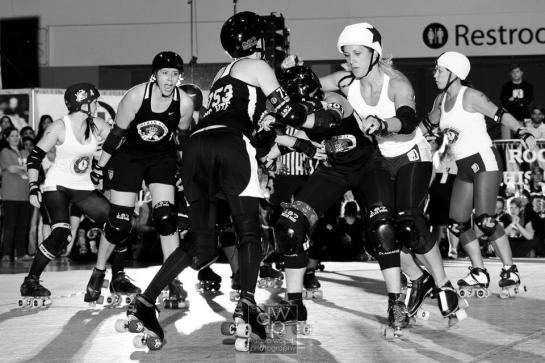
Imagine rushing up to the backs of four very strong, stable skaters at near full speed. Imagine the blur of the yellow tape on the floor, the glare of flashbulbs off of the plexi glass, the noise and the cheers, and the pounding of your heart in your head. And then somehow, you’re backwards and ducking. Suddenly you’re pushing through a hole in the wall you had not seen, but you sensed. With twist and turns and ducks and power you hold your ground and then see daylight. You push. You push like you pushed the prowler, you twist like you did in practice and you move your feet like you have been training for four years.
And then you’re in the air of the arena again, crossing over with fluidity against the draining sap of the sport court that sags when you stop pushing. You’re in the wide open with people looking at you and cheering and unsure who this skater is that they’re just really seeing for the first time. And you think about what just happened, and you don’t view it from a first person perspective, because you don’t feel like you really did it, you just let it happen. Your body did it for you. You let yourself go to the situation and trusted your instincts and let power and intent wash over you and drive you through.
And you were successful. But you don’t quite know how.
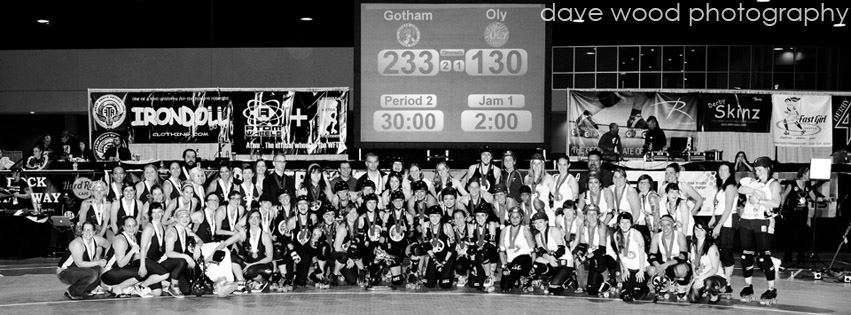
That was most of the Championship bout with the Mobtown Mods for me. I remember doing things, kind of. I couldn’t tell you how. I just let my body go on autopilot. The vets had always said that eventually it would happen. You would find your zen and just start doing things. It started in practice that week and continued into the game.
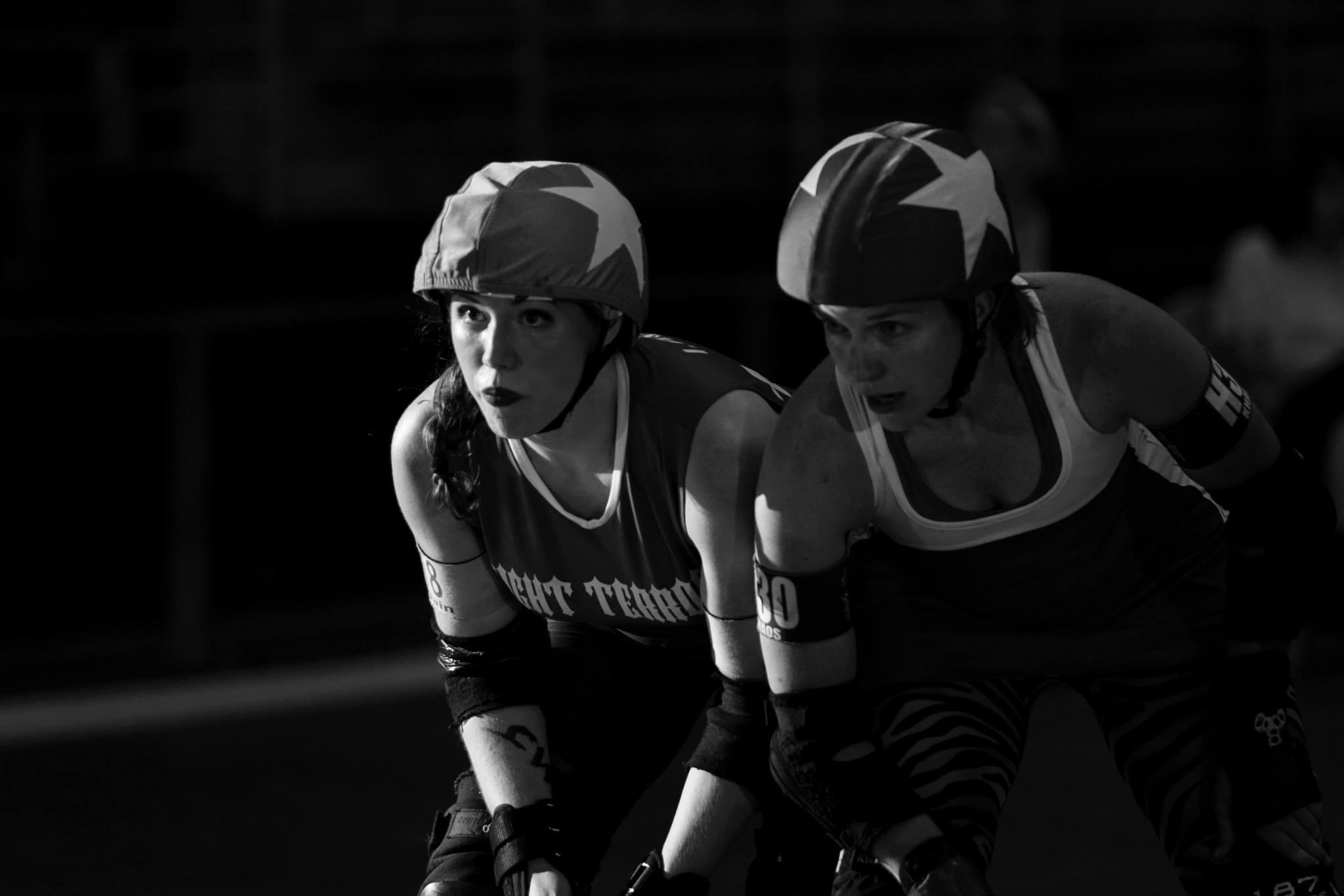
Photo by Down n Out Photography
What is the MENTAL GAME?
In every sport there is the talk of “The Mental Game”, but I feel that the term gets thrown around to mean many different things. Your mental game could be how you handle pressure, how you react to new situations, how you trust your feet, how you read a pack, how you release fear and go on autopilot, how you steel yourself after a team mate has gone down with injury. I am going to talk about a few things you can do to increase your mental stability during game play and practice time and what I have done to help better myself internally for roller derby.
Make Practice Time Harder Than Game Time
You play like you practice. We have all heard it, and hopefully digested it and spewed at someone else. If you play like you practice, and you allow yourself to get away with drills at 50% than you are going to play at 50%. If every sprint you are pushing your hardest, and every step of footwork is done with hard, clean precision than you will slowly prepare yourself for the intensity a game demands.
If you find yourself able to go through the motions of the drills easily, you are not pushing yourself. Gotham is not a three-peat champion because every practice they do fancy new drills that you haven’t heard of. They are champions because they do the same drills over and over and over. Not until they are perfect, but until they can’t get it wrong.
The moment that you are bored in a pace line, that you catch yourself thinking “This again?” that is the moment the mental game kicks in. You need to build the mental strength to do that drill, and do it with focused strength and intention. Bring yourself internally in that moment and think about doing the drill in a way you never have: look behind you more often, take note of the wheels the people around you are wearing, learn to sense the people around you and how close or far they are, learn the width of the track while you are bursting harder and stopping faster.
Every moment you can sharpen your mind while in drills will translate to better gameplay at game time.

Set goals
How will your mind know where it’s going, if you don’t decide where you’re going?
Goal setting should not be arbitrary or hastily done. Take 30 minutes of quiet time. No TV or internet, and turn off Spotify; just you, a notebook, and a pen sitting together. Center yourself and think about what you want to accomplish in a year. Write it down. If it’s one over-arching goal or many goals, write them down. Now look at them and see if you can turn them into SMART goals (Specific, Measurable, Attainable, Relative, Time-Specific).
Statement: Be on travel team.
SMART Goal: By June 30, 2015, I will be a starting player on the All Stars.
Once you have your year goal, you can work backwards. Your relative goals don’t have to be a replication of the long term goal. If your goal is to be an all star, what smaller goals can you set for yourself that will make you all star material?
Possible Goals:
Between now and December 31, I will attend 1 boot camp per month.
Between now and December 31, I will decrease my 30 lap time by 15 seconds.
Between now and December 31, I will increase my squat PR by 75 pounds.
These goals are not “I will be looked at by the all stars”. You cannot control when the all stars will actually begin considering you, however if you make self-improvement goals that make you a desirable skater for the all stars, you’ll be working towards your goal of being one. Let’s break it down further. So you have mid-range goals, so let’s make some shorter term goals.
Possible short term:
In 6 weeks, I will decrease my body fat by 3%
In 6 weeks, I will be able to do a 120 pound front squat.
In 6 weeks, I will be able to hockey stop.
Boom. Just keep making your goals smaller and more precise, and keep working backwards. If you find that you are creating goals that do not relate to the longer term goals, ask yourself why you want to achieve those things. If I just randomly say I want to be able to do 5 pull ups, ask yourself why? How does it relate? Maybe add in another long term goal so that you can see the long term advantage of being able to do those pull ups.
When your training is hard, when you are feeling discouraged, come back to these goals. Read them daily. Put them in a spot where you can be reminded of them. Use post-it notes. Get dry erase markers and write on your mirrors. Remind yourself and you will be motivated forward. Your brain is easily set astray – keep it on track.
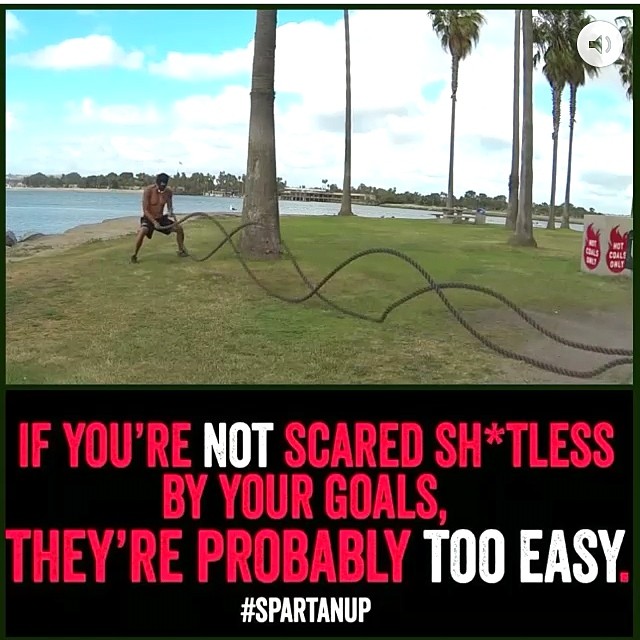
Make declarations, set intentions, listen to motivation
I am a firm believer that the energy we put out is the energy we put in. Motivation and mental clarity takes work and maintenance, just like our fitness and nutrition. Our mental game does not only come when we put on our sneakers or skates, our mental game is present in every facet in our life. We believe what we tell ourselves. If you spend your ‘real life’ enveloping yourself in negativity, no amount of positive reinforcement during training will help you overcome a difficult drill or a plateau.
When you wake up, listen to an audiobook of personal development, or go onto YouTube and find a motivational video to watch and listen to. (Ted Talks has a lot of good stuff too.) Listen to it, without distraction. Absorb it. Take those first minutes of the day for yourself and for your mind.
Then, write your intention and declaration for the day. Make them strong and clear so that you and the Universe know what it is you are going to achieve that day.
Examples of intentions:
I intend to meet 1 person today who I can help.
I intend to complete my full training circuit without taking extra water breaks.
I intend to run for 45 minutes.
Examples of declarations:
I am worth a healthy life.
My past does not define me.
I am greater than my bank account
Words of negativity are not my truth. I do not have to bend to meet them.
I deserve happiness and strength.
Audiobooks full of Personal Development and Declarations:
Secrets of the Millionaire Mind by T Harv Eker
The Big Leap by Gay Hendricks
Energy Bus by Jon Gordon
Tribal Leadership by Dave Logan
Start. Punch Fear in the Face, Escape Average, Do Work that Matters by Jon Acuff
Fish! The Book by Stephen Lundin

“Fear is excitement, without the breath.”
Breathe!
We hear it all the time, but why do we hear it? There is the obviously the direct physical advantage to having more oxygen in our body as we’re trying to complete a task. There are multiple mental aspects as well that are often not thought about.
For example, did you know that your brain uses about 20% of your oxygen intake when you are at rest?[1] So if that much is used while you’re sitting doing nothing, can you imagine how important it is to keep your brain running while it’s sending out electrical signals to every muscle and nerve in your body while keeping your mind sharp for physical reaction and strategic thinking? If you are not breathing, you are depriving your muscles of strength AND you are depriving your muscles of strong neurological signals that they need to work powerfully.
Let’s also think about heart rate and breathing and the brain. “Fear is excitement, without the breath” (Robert Heller); when we are scared, we try and starve the fear by holding our breath. Think about when a hit was coming for you, and you weren’t confident enough to dodge it. Think about your first time wearing the jammer panty. Think about if you have ever been in a car accident or ridden a roller coaster.
When we hold our breath all we do is increase the fear. When we are afraid, part of our brain shuts down and stores memories independently[2] – which might be fine if you’re in a car accident, but if you’re in the middle of a jam, you need to be in control. When we breathe, and stop starving our brain of oxygen, the fear turns to excitement. It is a complex chemical process within the brain where we understand that we are not in danger, despite a feeling that we should be. I can’t say it nearly as eloquently as Shirah Vollmer.
Breathing also has a direct effect on our heart rate. (An increased heart rate, which can be effected by the lack of breath, can also cause fear within the body, ps) When we breathe steady, our heart rate comes down. Our heart can keep up with the athletic needs of our body and we can perform more optimally. Breathing has been a source of centering and focus for thousands of years, so why turn our back on the practice now? When it gets hard, when you get tired, breathe.
When I jam, for example, I will count my strides after I break from the pack. I will also have made conscious efforts in every training session to breathe in and out distinctly (whether I’m skating, running, or pushing a sled). It helps me to focus on the task at hand while my body is getting the oxygen it needs.
Moral of all this: KEEP BREATHING!!

Photo by Tyler Shaw – Prints Charming Derby Photography
Practice and scrimmage and practice and scrimmage
We play a sport that is unlike anything in this world. We must play offense and defense at the same time. We take away the stability of our feet and play on wheels instead. Everything about all of the techniques we use are unnatural to our body and must be trained.
Which means that you cannot ever stop practicing.
The mental clarity that you see in the top athletes does not come from luck or talent, but repetition of the game. Earlier I mentioned that drills will get boring. They should get to a point where you can do them without getting them wrong. When you get to that point, make them faster, stronger, harder, sharper.
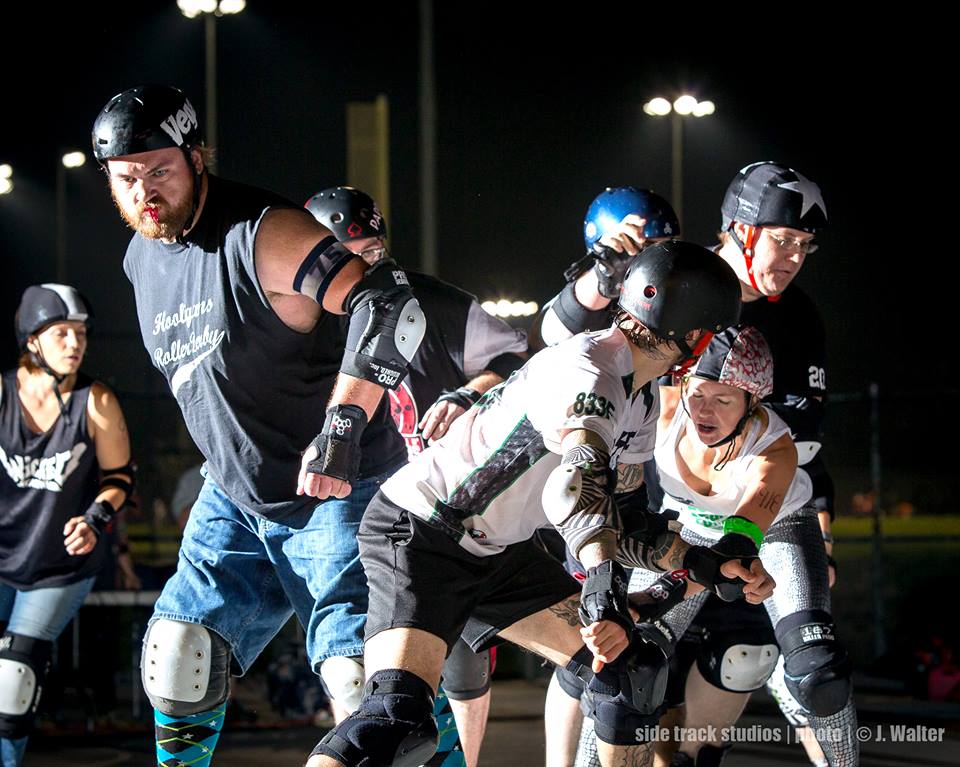
Push your limits at scrimmage. Play different positions and with different packs whenever possible. I also believe that getting out of your comfort zone in scrimmage can strengthen your mental game. I have spent many years playing in mash up games and in challenge bouts. When I was a lower level, it made me more aware of my surroundings and listen better to the leaders on the floor so I could complete the strategies. I had to think on my feet. My mental awareness and reaction improved because I did not know where these people were going to skate to or do next. I may have been able to hop into a scrimmage with Madhouse Mexi and know where she was going to block, but in a pack with Battery Operated, I had no idea.
So you learn. Now that I’m at a higher level, the mix up scrimmages help me make quicker decisions and communicate more effectively. I am able to play with higher level skaters in a way I never have before, because I understand what they are going to do, despite never having played with them before. At Northeast Derby Con, I had a wonderful jam with Richard Gaudet of Mass Maelstrom. I knew his style of skating because I’ve seen him, but we were able to communicate non-verbally in order to hold the jammer behind me while he guided me from the front. Using my legs and small steps to maintain position, and Gaudet’s guidance and stability, we were able to effectively hold the opposition while we communicated to our other two to play offense for our jammer. (PS when she finally did get around us, we were able to recycle to the front and come back together almost instantly. It was pretty awesome.)
Without having been in scrimmage after scrimmage over the years, I would not have been able to react in such a clean, direct way. The mentioning of Gaudet brings up a good point. Move out of your comfort zone! If you’ve never played co-ed before, why haven’t you? What tools could you learn from playing with different body types? Have you ever played on a bank track? MADE or USARS rule set? Go do something new.
By taking yourself out of your comfort zone in scrimmage, you are putting pressure on yourself that you don’t feel with your home league. Repetition of pressure in a scrimmage situation will help your brain function under conditions of increased endorphin levels and less oxygen (which will be very helpful training if you ever find yourself with the star in the last jam of the game with only 20 points separating you and the opposing team in the Championship bout).
Just saying.
Watch footage, talk shop
To be the best at the game you must understand the game on a deep, psychological level. To understand the game, you must watch the game and discuss the game. Not just what motions skaters use, but you must talk out the strategies and the theory of roller derby. Watching footage is not just useful to understand and train for your opponents, but it gives your mind a visual solution to problems when they come up on the track.
Roller derby is a series of “ah ha” moments, no one can argue that. I have overcome many “What the hell?” moments by simply accessing memory banks of game footage I had watched previously. I knew the solution that Rose City had used, so I was able to attempt the same maneuver, or predict the next motion of the jammer because I had already seen someone else do it.
Watching the bouts and then taking the time to digest and visualize yourself completing the motions successfully and definitively will give your brain a baseline of what to do and when to do it. We do the things we tell our brains we can do or have done. If you take the time to do visualization exercises of making the apex jump, completing a Pegassist, stopping on a dime; your brain will believe that you have already done them, and when the situation comes up in game play, the fear will disappear. Your brain will access the file that says that you have done this before, and will present that option to your muscles.
Creating those ‘card files’ in your brain of different solutions for strategic problems is critical in the development of your mental game. Instead of panicking because you don’t know what to do in the situation, your brain will calmly instruct you on your options. It is easy to see what skaters have not watched game footage when their jammer is knocked out of bounds and drawn backwards. Skater who have seen this done before will move forwards, in the hope to suck in the jammers coming backwards, to put them on a negative pass. Jammers will pace themselves and watch the hips of the person who knocked them out of bounds, so that they can enter legally, but as far away from the approaching wolves as possible.
Skaters who have not watched footage will either come right back onto the track, to promptly get a cut track penalty, or they will stare at their bench with that “What now?” look on their face.
Don’t lie. We’ve all seen that pack of blockers that has no idea what to do in this situation because they’ve never seen it done before. Well. You’ve seen it if you watch footage or go to live derby.
Don’t have time for a full bout? Chew on tidbits provided by RD Junkies!

Go to all the camps, book all the coaches
We all fall into patterns, including our coaches. Our brain needs a little bit of variety to stay sharp. When we are in a familiar situation for learning over and over again, our neurons have a tendency to get a bit burnt out, so to keep it fresh[3] – never turn down the opportunity to learn from someone new. Coaching variety not only offers new drills, but also new explanations of old skills. A new explanation could finally help make something ‘click’ internally so that you can complete a physical skill. When teaching plow stops, specifically, I always tell new skaters who are having trouble with the skill to ask EVERYONE how to do it. You never know who you are going to learn from.
If your league is (sadly) not open to the idea of various coaches, or having a guest coach come in now and again, you must seek out new learning opportunities on your own. Boot camps are becoming very popular across the globe. They are a great chance to get a lot of information from a new source, and have access to new insights and teaching styles. The newness of it will keep your brain focused on the drill, even if you’ve done the drill before or you are advanced at the skill it is teaching.
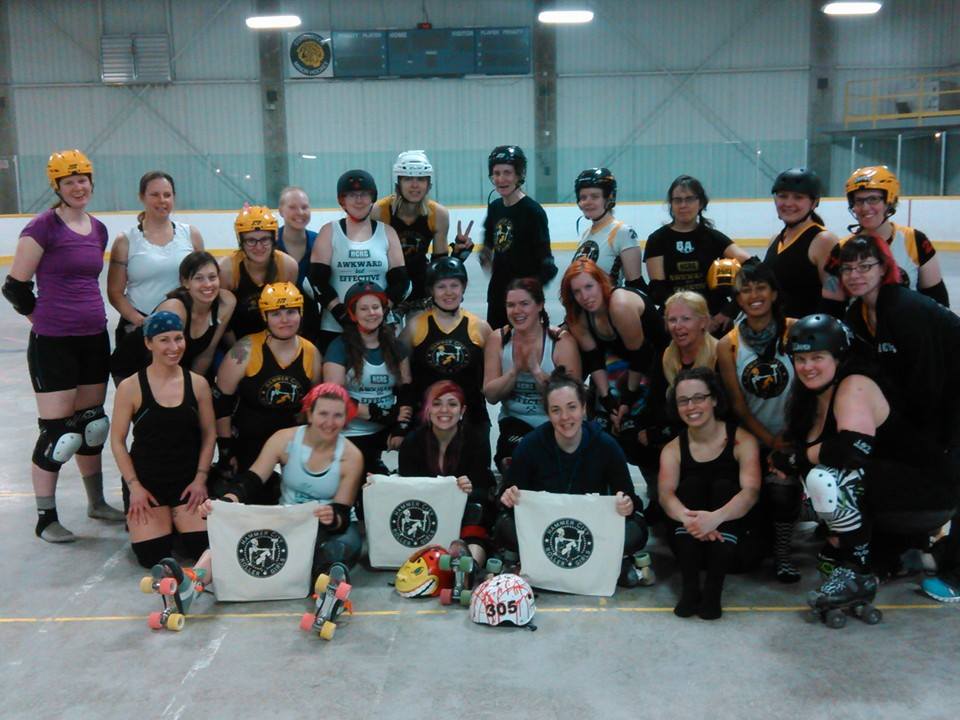
Going to training events like Northeast Derby Con, RollerCon, and Beat Me Halfway are great opportunities to learn from a smattering of coaches in a short amount of time. It is a great way to learn, and for many they serve as a reboot. They refresh the brain with new and interesting techniques to apply to the drills and skills and coaching that is going on at their league that they may previously have been mentally fatigued by.
Also, it again trains the body and mind to function and perform together in new and difficult circumstances. You’re being watched by those who you may admire. You’re on a floor you are not used to. You are working with people you are unfamiliar with. The situation demands a mental focus and clarity that will benefit you in the comforts of your home rink.
The mental game is a complexity that we must not forget in our journey through training. Even in this blog, I barely touched on how to create new focus in cross training, motivation to complete the tasks you set up for yourself, or how to tackle the depression and disappointment that comes along with injury, naysayers, or plateaus. Continue your journey and continue your personal development. Continue to breathe and continue to challenge yourself to make everything come together in little pieces. Never stop learning. Never stop practicing. Namaste.
[1] http://www.unm.edu/~lkravitz/Article%20folder/brainandex.html
[2] http://discovermagazine.com/2003/mar/cover
[3] http://teacher.scholastic.com/professional/bruceperry/brainlearns.htm






 Khaos Theory Derby